





Starfield Composer Says Bethesda’s Space RPG Will One Day Become “Legendary”
Inon Zur, the composer behind the music of Starfield and several major Bethesda titles, believes the space RPG will eventually gain recognition as a landmark game despite mixed reactions at launch.
Speaking in an interview with RPG Site, Zur argued that the game’s direction reflects the long-term vision of Bethesda director Todd Howard and may take years for audiences to fully appreciate.
Zur has worked in game music for nearly three decades and has composed scores for more than a hundred titles. His collaborations with Bethesda include Fallout 3, Fallout 4, Fallout: New Vegas, and Starfield. In the interview, he described Howard as one of the most creative figures in the industry and credited his leadership with shaping the studio’s projects.
"Todd is one, if not the most creative and invigorating human beings in the industry. He just doesn't stop. He always has new ideas. He always knows what he wants. He is very persuasive and has a very strong character. He will also find ways to describe what he wants without really calling it a name. He knows how to allow freedom of creativity on one hand, but also how to steer it to his own vision. He is a visionary. He sees things that people will start to find out years later."
— Inon Zur
Zur linked that leadership directly to Starfield’s design and reception. The game launched in 2023 after years of development as Bethesda’s first new universe in decades. It was marketed as a large-scale role-playing game set across a vast network of explorable planets. While the release attracted significant attention, the reaction from players and critics proved mixed.
"When Starfield released, I believe people were just not ready for it. It's a different way of looking at it, but Todd is really strong, and he said very, very lightly, 'Look, if you don't like it, then you don't like it, but this is the new thing that we're doing, and we're sticking to it.' He believes in his way, and it just has proven time and time again that eventually people will understand his vision. It just takes time and this is a common thing for all the big visionaries. Sometimes people really don't understand them correctly, but they were strong enough to stay on course, and Todd will stay on course on Starfield. Starfield will eventually become something that will be legendary. I have no doubt. It's just a matter of time."
— Inon Zur
At launch, Starfield received a range of responses from critics and players. Professional reviews generally described it as a solid role-playing game, though not necessarily a defining one. On PC platforms such as Steam, tens of thousands of user reviews eventually settled into a “mixed” overall rating. The game also did not immediately develop the same modding community momentum that had defined earlier Bethesda titles such as The Elder Scrolls V: Skyrim.
Zur’s comments suggest he sees that reception as part of a longer cycle common in the history of large creative projects. According to him, visionary developers often introduce ideas that audiences initially struggle to interpret. Over time, those ideas can find wider acceptance as players revisit the work or as the industry evolves around it.
His perspective also reflects a close working relationship with Bethesda. Zur described a collaborative process in which the studio provides direction while still trusting his judgment. The composer said that even after years of cooperation, every project still involves multiple iterations and adjustments before the final music is approved.
Before entering the video game industry, Zur worked extensively in television during the 1990s. He composed music for children’s and action-oriented programming such as Power Rangers and Beetleborgs. His first video game score came in 1997 with Star Trek: Klingon Academy. Since then, he has remained active across major franchises and publishers.
In the interview, Zur explained that his approach to composing for games begins with three guiding questions about the project’s setting and story. He described them as the “three W’s”: where the story takes place, when it occurs in time, and why the events happen. Those questions help determine the emotional tone of the music.
The composer said that games require a different approach than films or television because player behavior is unpredictable. Instead of matching music directly to specific scenes, game composers must create emotional frameworks that can support many possible outcomes during gameplay.
Starfield presented a distinct challenge because it takes place in a large-scale space environment that mixes emptiness with constant movement. Zur said his earliest idea for the soundtrack came from imagining the contrast between a vast silent void and rapid motion within it.
He structured the orchestral score to reflect that tension. In his arrangement, woodwinds perform fast, repeating patterns that represent motion through space. Brass and strings, by contrast, often hold slower tones to suggest the stillness and scale of the surrounding environment.
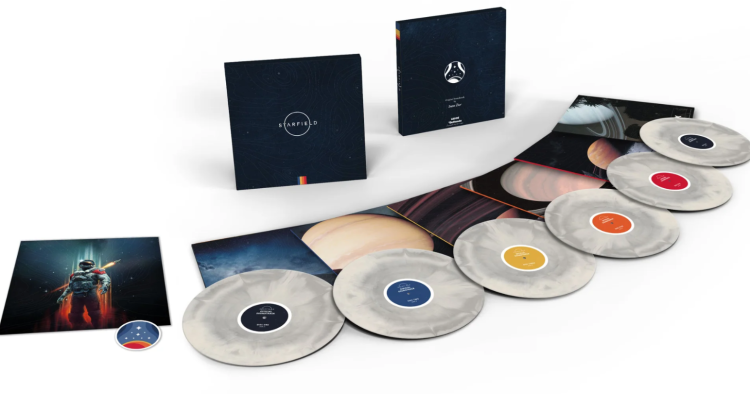
Zur also described a second element that shaped the score: the presence of an individual human perspective within that enormous setting. The music attempts to express the contrast between a single person and the vastness of space, while still emphasizing the importance of that individual point of view.
That idea guided many of the compositional decisions for the soundtrack. Zur aimed to create a musical language that felt connected to classic science fiction traditions while still presenting a distinct identity for Bethesda’s new universe.
He said the process involved balancing influences from well-known film composers with the need to build something unique for the game. Instead of directly imitating established space music styles, he tried to capture the emotional core of the experience players would have while exploring Starfield’s world.
The composer also acknowledged that large projects like Starfield require close coordination with developers. Even experienced collaborators must sometimes produce multiple versions of a piece before reaching the final form that fits the game.
Beyond Starfield, Zur remains active in other projects. His recent work includes the score for Rise of the Ronin from Team Ninja, as well as music connected to the Fallout series. Over the years, he has helped define the musical identity of several major RPG franchises.
The Fallout franchise in particular has become closely associated with his work. Zur composed the main themes for Fallout 3 and Fallout 4, developing a distinctive sound that mixes orchestral elements with atmospheric textures. He described the Fallout musical style as a toolbox that can be adapted for different stories within the same universe.
I see Zur’s confidence in Starfield as an extension of that long collaboration with Bethesda and a belief that creative ideas sometimes outlive their first reception. I think players are still waiting for Starfield on PlayStation 5, and perhaps when Skyrim finally feels truly outdated, the next generation may grow attached to Starfield as something closer to a classic RPG in its own right.


 Successfully copied... Thank you for sharing our content!:



5% deposit bonus up to 100 gems

a free Gift Case





EGAMERSW - get 11% Deposit Bonus + Bonus Wheel free spin


EXTRA 10% DEPOSIT BONUS + free 2 spins

3 Free Cases + 100% up to 100 Coins on First Deposit


5 Free Cases, Daily FREE & Welcome Bonuses up to 35%

3 free cases and a 5% bonus added to all cash deposits.

+5% to deposit




Comments