




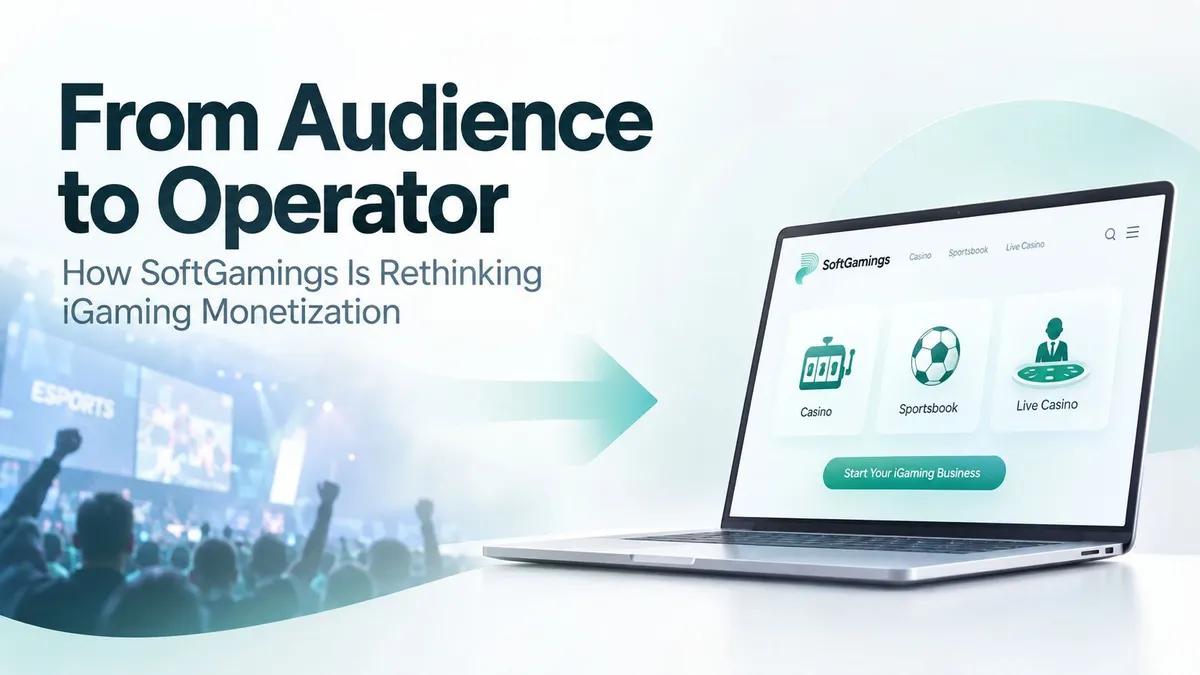
From Audience to Operator: How SoftGamings Is Rethinking iGaming Monetization
From Audience to Operator: How SoftGamings Is Rethinking iGaming Monetization
For gaming and esports businesses, audiences are assets. Media outlets, communities, affiliates, and brands can turn attention into sponsorship or affiliate revenue, while most product economics remain with a third-party operator.
As gaming, esports, and betting continue to overlap, another route is becoming more relevant: moving from monetizing someone else’s product to owning the product itself. Instead of only directing users to a casino or sportsbook, a business can become the operator behind the iGaming experience.
That is where SoftGamings fits in. As an iGaming platform software provider, the company brings together online casino technology, sportsbook, game content, payments, engagement tools, and operational infrastructure. The entire environment rests on an iGaming platform designed to help operators shorten time-to-ROI.
This does not guarantee profitability, which still depends on market conditions, acquisition costs, retention, regulation, quality, and execution. Technology can, however, shorten the path from opportunity to a monetizable product.
The Difference Between Monetizing Traffic and Owning the Product
For a business with a large gaming audience, the traditional model is simple: send users to a partner and earn commission from registration, deposits, or revenue share. This avoids managing infrastructure and operations, but limits control over the customer journey.
An owned iGaming model changes the equation. The brand controls the product, casino catalog, betting markets, promotions, retention, and roadmap. For companies with an established audience, the question shifts from finding traffic to how much of the value created by that traffic they can retain.

Why Sportsbook Changes the Equation for Gaming and Esports Audiences
For an esports audience, sports betting can be a natural entry point into iGaming. Users already understand teams, players, tournaments, maps, statistics, and performance, so betting can become another product layer around content they already follow.
For a business, a sportsbook does not have to be a separate project disconnected from the existing brand. SoftGamings’ sportsbook platform supports betting functionality, odds and trading management, and engagement mechanics, creating a path from media or community monetization toward an owned wagering product.
The sportsbook is only one vertical. The operator can later add slots, live casino, and other game types, creating multiple revenue verticals around the same audience.
Casino and Sportsbook Do Not Have to Be Separate Businesses
Casino and sportsbook are often treated separately, but operators can manage them in the same customer ecosystem. A user arriving for esports betting may later explore slots or live casino, and vice versa.
SoftGamings combines casino platform solutions and sportsbook with other iGaming infrastructure, allowing an operator to start with the most logical vertical and expand later. Fewer technical barriers between products can make it easier to test and scale new revenue channels.
Three Ways to Become an Operator
Not every company needs the same level of control over its infrastructure. One of the main decisions in launching an owned iGaming project is therefore which operating model fits the business.
White Label: A Streamlined Launch Route
White Label casino software provides a faster route to market. A media business, affiliate project, or other traffic owner can start from a ready-made foundation and focus on branding, audience development, marketing, and acquisition instead of building the full infrastructure internally.
Turnkey: More Ownership and Control
Turnkey casino software is built for businesses that treat casino as a long-term operating vertical and want more control over branding, product configuration, payments, content, and operations. It can fit companies with an established digital audience that want to turn proven demand into an independent iGaming business.
Self-Service: For Teams with Their Own Technical Capability
Self-Service casino software is aimed at companies with their own development teams, letting them use the underlying technology engine while keeping more control over development and the front-end experience.
The launch therefore does not require one fixed route. The operator can select a suitable option based on budget, timeline, and overall business strategy.
From Platform to Product Ecosystem
Launching the platform is only the beginning. To develop an iGaming project over time, an operator needs to keep working on content, payment infrastructure, engagement, and retention.
SoftGamings’ product portfolio therefore extends well beyond the core casino platform.
A casino games aggregator working through an API integration addresses the content layer by giving operators a more centralized way to expand their catalog instead of maintaining a separate technical relationship with every provider. The company also offers content bundles for specific needs, including slots, live casino, crash, and quick games.
Sports betting is covered by a sportsbook platform, allowing an operator to add a second vertical to an established business or build a casino project around an existing betting audience.
The loyalty management platform provides a comprehensive environment for player engagement and retention, using behavioral data to coordinate bonus mechanics, gamification, and CRM. Beyond its product portfolio, SoftGamings also provides services that cover incorporation and the wider operational preparation: payment infrastructure setup, bank account assistance, entity setup, and licensing support.
This broader ecosystem allows operators to source more of the required components within a connected environment, reducing the need to assemble a stack from unrelated integrations.
For an audience-led business, that modularity can also reduce the risk of overbuilding at launch. The company can begin with the products that match its existing traffic, then add content, engagement tools, payment options, or betting functionality as the commercial model develops. That makes the platform relevant not only to launch, but to the stages that follow it.
How Starting Position Shapes the Route to Commercial Operation
An experienced operator already has players, processes, and a technology stack. Its challenge may be launching another brand, entering a new market, or migrating to infrastructure that can support further growth.
A first-time operator starts from the opposite position: it may understand the market but still lack much of the technology and operational infrastructure. A ready platform can free resources for market entry and acquisition instead of requiring an upfront build of platform architecture, integrations, payments, and player management.
The starting points differ, but the objective is the same: moving faster from opportunity to an operating commercial product.
Platform Infrastructure that Supports Faster Time-to-ROI
Time-to-market and time-to-ROI are not the same thing. A casino can be technically live without having enough users. A sportsbook can launch and still require product tuning. An established gaming brand can have millions of views without proving that its audience will convert into iGaming customers.
Technology cannot eliminate those commercial risks. What it can do is reduce the time a business spends on work that is not its unique advantage: building base platform infrastructure, creating numerous individual integrations, and connecting systems that were not designed to work together.
For an experienced operator, the SoftGamings platform built for faster time-to-ROI becomes an advantage when launching new brands, entering new markets, or migrating to support further growth. For a first-time operator, it is a shorter path to an independently operated casino business. For an audience owner, the sooner the platform helps the project reach ROI, the sooner the business can move beyond recovering its initial investment and realize operator-side returns from traffic it already owns.
From Audience Economics to Operator Economics
For esports and gaming companies, the question of moving beyond the familiar economics of audience monetization is becoming more relevant as the boundaries between content, betting, communities, and digital entertainment continue to overlap.
Not every media company or creator business needs to become a gambling operator. Doing so requires a separate strategy, licensing, responsible gambling standards, and a clear understanding of the regulatory environment.
But for companies already building a significant business around a gaming audience, an owned casino or sportsbook can become another possible step in monetization. As Vigants Lesausks, the CSO of SoftGamings, puts it: “An established audience can dramatically change the starting point of an iGaming business. By reducing the technology and operational work between that audience and an owned casino or sportsbook, we aim to shorten the path to revenue and ultimately to ROI.
From this perspective, SoftGamings is not simply selling casino software or sportsbook technology. It is offering multiple routes into an operator model: White Label for a faster launch, Turnkey for greater ownership, Self-Service for technically mature teams, and separate products and services for content, payments, engagement, and betting.
That changes the question a large gaming audience owner can ask: not only how much more affiliate revenue existing traffic can generate, but whether that traffic can become the foundation of an iGaming business the company owns.


 Successfully copied... Thank you for sharing our content!:



5% deposit bonus up to 100 gems

a free Gift Case





EGAMERSW - get 11% Deposit Bonus + Bonus Wheel free spin


EXTRA 10% DEPOSIT BONUS + free 2 spins

3 Free Cases + 100% up to 100 Coins on First Deposit


5 Free Cases, Daily FREE & Welcome Bonuses up to 35%

3 free cases and a 5% bonus added to all cash deposits.
+5% to deposit




Comments