




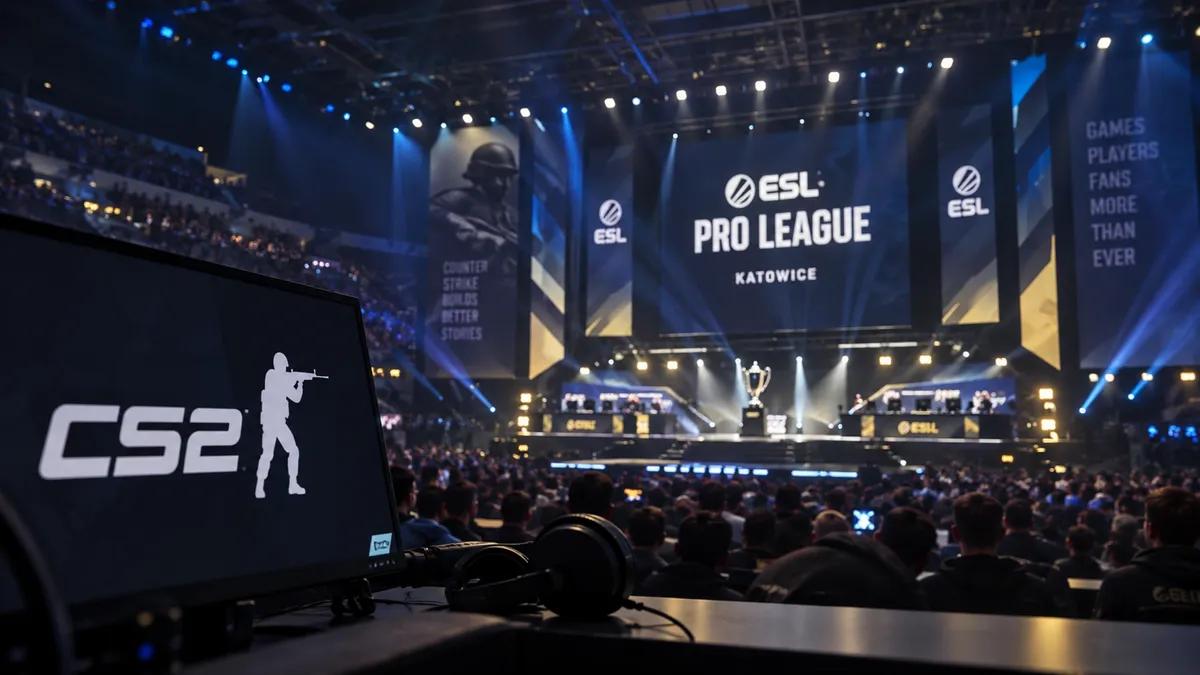
ESL Pro League Season 24 brings a full LAN format to Katowice
 ESL
ESL ESL Pro League
ESL Pro League Season 24 will bring 16 Counter-Strike 2 teams to Katowice, Poland, for nine days of competition between 3 and 11 October 2026. Every match will be played on a local area network, with the final weekend taking place inside the Spodek Arena.
This marks a change for ESL Pro League. Season 23 used online competition before moving its playoffs to LAN, while Season 24 places the entire tournament in one physical location. The reduced field and shorter schedule are intended to keep the event compact without removing the Swiss stage that gives teams several chances to progress.
For someone accustomed to shorter digital sessions such as online slots, a professional Counter-Strike series demands a different kind of attention. A best-of-three match can change through economy management, tactical pauses and map selection long before the deciding round begins.
When is ESL Pro League Season 24?
The tournament is divided into two sections:
- Swiss stage between 3 and 7 October
- Playoffs between 9 and 11 October
The day separating those stages gives the qualified teams time to prepare for their quarterfinal opponents. It is also used for playoff media work and arena preparations.
Players and staff are expected to arrive on 1 October, followed by a media day on 2 October. Teams reaching the playoffs remain in Katowice until the final weekend, while those eliminated during the Swiss stage can depart on 8 October.
Holding every stage on LAN removes many of the technical differences associated with online play. All teams compete through the event network, using tournament-approved equipment and playing under direct administrative supervision.
Which teams will compete in Katowice?
The Season 24 field contains several of the biggest organisations in Counter-Strike:
- Team Spirit
- MOUZ
- Team Falcons
- Team Vitality
- Legacy
- FURIA
- G2 Esports
- 9z Team
- Natus Vincere
- Aurora
- BetBoom Team
- PARIVISION
- TYLOO
- 1win
- M80
- ShindeN
Twelve invitations were allocated through Valve Regional Standings. The remaining four places went to teams connected with ESL Challenger League competition in Europe, North America, South America and Asia.
That distribution gives the event regional variety without expanding it to the 24 or 32 teams seen at some international tournaments. European organisations still occupy much of the field, but teams representing the Americas and Asia have direct routes into the competition.
TYLOO carry much of the Asian interest, while M80 provide another opportunity for a North American roster to test itself against leading European opposition. FURIA, Legacy, 9z and ShindeN add a substantial South American presence.
How does the Swiss stage work?
All 16 teams begin in one Swiss stage. Teams are paired according to their records, so a roster with two victories should meet another side in a similar position rather than an opponent that has already lost twice.
Every match is a best-of-three series. This reduces the possibility of one unusual map deciding a team’s entire tournament, although an early defeat still creates a more difficult route through the stage.
A team must collect the required number of series wins to qualify for the playoffs. Eight teams advance, while the other eight are eliminated.
The system gives coaches time to respond after a loss. A weak performance on one day does not necessarily end the campaign, but recurring problems with map selection or defensive setups become harder to hide across several series.
Swiss formats also create pressure around seeding. Strong teams want to qualify as quickly as possible because additional matches reveal more tactical information and require more mental energy. A clean route can provide extra preparation time before the playoffs.
Why does the map veto matter?
Counter-Strike teams do not play every competitive map at the same level. Some build their identity around strong defensive rotations on one map, while others prefer open layouts that reward individual aim.
Before a series, both teams remove maps and make selections through a veto process. The resulting order can determine the type of contest that follows.
A team with a deep map pool has more flexibility. It can remove an opponent’s best option without exposing a severe weakness elsewhere. A roster relying on two or three preferred maps becomes easier to prepare for because opponents know which choices are likely to remain.
Best-of-three matches give each team one preferred selection before a deciding map is required. The grand final uses a best-of-five format, so the finalists need enough depth to compete across most of the active pool.
Coaches will examine recent matches, starting-side preferences and pistol-round patterns before completing a veto. They must also judge how much tactical material to reveal during the Swiss stage. Using a new strategy may secure qualification, but future opponents can study it before the playoff bracket begins.
What changes once the playoffs begin?
The eight qualifying teams enter a single-elimination bracket. One series defeat ends the tournament.
Quarterfinals, semifinals and the third-place match are played as best-of-three series. The final expands to best-of-five, asking the last two teams to prepare for a much broader tactical contest.
Single elimination changes how coaches use timeouts and substitutions. Saving a tactical idea for a later opponent has little value if the team is close to losing its current match.
Arena conditions add another challenge. Players communicate while hearing the crowd react to successful plays, missed shots and developing situations. Noise-cancelling headsets reduce outside sound, but the physical response of an audience can still affect the pace and emotion of a series.
Experienced rosters often manage these moments better because their players have already competed on major stages. Less experienced teams may play too cautiously or take unnecessary risks after winning an important round.
Why is the Spodek Arena important to Counter-Strike?
Katowice has a long association with elite Counter-Strike, and the Spodek Arena has hosted some of the game’s most memorable international tournaments.
The circular venue creates a recognisable setting, with the audience surrounding the main stage rather than sitting at a distant end of a conventional exhibition hall. Polish crowds also have a reputation for responding strongly to both international stars and local players.
ESL Pro League has often used studio environments that prioritise frequent matches over large spectator attendance. Bringing the playoffs into the Spodek moves Season 24 closer to the atmosphere associated with Intel Extreme Masters events.
That setting raises expectations for the final weekend. Teams are competing for prize money and ranking value, but a deep run in Katowice also gives players experience that can matter at Majors and other arena tournaments.
How is the $1 million distributed?
Season 24 carries $1 million in total winnings, divided between direct prize money and club rewards.
The champion receives $125,000 in prize money, while its organisation receives a $170,000 club reward. The combined first-place return is therefore $295,000.
The runner-up receives $50,000, accompanied by a $125,000 club reward. Third place earns $30,000 plus $90,000 for the organisation, while fourth receives $20,000 and a $65,000 club payment.
Teams finishing between fifth and eighth each receive $10,000 in prize money and a $40,000 club reward. Payments continue through the lower positions, so every participating roster earns a share of the direct prize fund.
The event also contributes to the ESL Grand Slam race. That separate competition offers a $1 million reward to an organisation that wins the required combination of qualifying ESL tournaments within the specified window.
Which teams enter with the greatest expectations?
Spirit, MOUZ, Falcons and Vitality occupy prominent positions within the international field. Each organisation has the individual talent and structural depth required for a long tournament run.
Natus Vincere and G2 also carry considerable expectations because of their history and international support. FURIA will be closely watched by Brazilian fans, while Legacy and 9z have opportunities to strengthen South America’s results against European opposition.
The format leaves room for a less favoured team to break into the final weekend. Three strong Swiss performances are enough to reach the knockout stage, where one well-prepared series can remove a leading contender.
Season 24 should provide a useful test of ESL Pro League’s more compact structure. Sixteen teams, an all-LAN schedule and an arena playoff reduce the event’s length while keeping enough matches to reward consistent play. By the time the best-of-five final begins on 11 October, the champion will have survived both repeated Swiss-stage pressure and a knockout bracket with no second chance.


 Successfully copied... Thank you for sharing our content!:

Comments