




The Occultist Review
 PlayStation
 Steam
Steam Xbox
Xbox Review
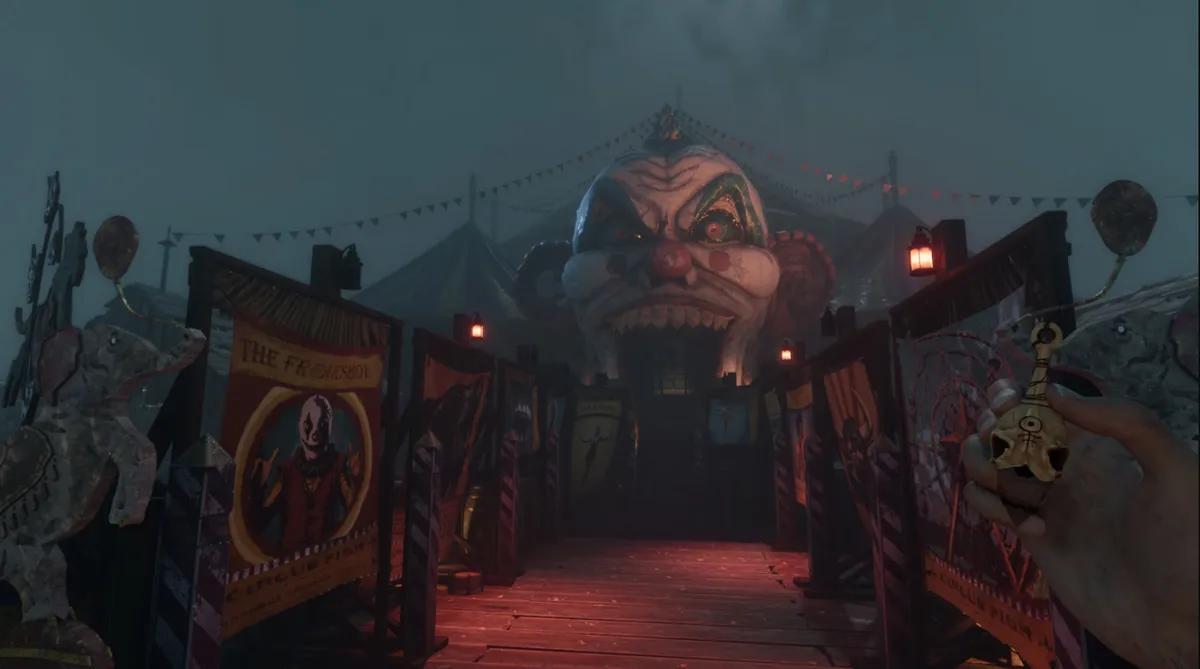
DALOAR's debut game drops players on Godstone Island as paranormal investigator Alan Rebels, searching for his missing father among the remnants of a 1950s cult. The Occultist was released on April 8, 2025, for PlayStation 5, Xbox Series S/X, and PC, published by Daedalic Entertainment. Built in Unreal Engine, it mixes psychological horror with puzzle-based exploration across locations including a hospital, an orphanage, a carnival, and a cemetery. Doug Cockle, known worldwide for voicing Geralt of Rivia in The Witcher series, leads the voice cast as Alan.
Godstone Island and Its Dead

Alan arrives on Godstone Island to find it abandoned. The island was home to a community until 1950, when the wealthiest resident performed a ritual that killed every inhabitant. The bodies remain, appearing decades old despite the passage of time. Alan's father vanished after traveling to the island where he grew up, and the game opens with Alan stepping onto its shores with little more than a pendulum and questions. No one has come to investigate Godstone in all those years, a gap the story never adequately explains.

Godstone is divided into self contained levels. Each location is its own enclosed puzzle space: a dilapidated hospital, an abandoned orphanage, a haunted circus, a cemetery, and a well lit mansion near the end. The game funnels exploration through these spaces in sequence, and navigation stays readable throughout without requiring an explicit map. Signposting works, though a few deliberate maze sections test patience. Compared to many horror games where finding your way around becomes an obstacle in itself, Godstone's layout is a relief.
The narrative builds around the cult's history and the fallout of its ritual. Notes, newspaper clippings, and documents fill in background details across every level. Ghosts tied to the main story appear to deliver exposition and nudge Alan toward his next objective. They contribute to the worldbuilding but vanish once their segment concludes, never to reappear, which weakens their impact as characters.
Puzzles and Progression

Puzzle design ranges from straightforward item hunts to multi step chains that demand lateral thinking. Cutting a chain with bolt cutters sits at one end. At the other, a sequence requires finding a valve to activate an oven's gas supply, then reversing time on the oven to recover a burned piece of paper containing a password. One puzzle uses an x-ray sheet as a door key. Solutions draw on observation rather than mechanical complexity, and none demand dexterity or reflexes.

Alan records clues in a notebook split into two halves. The first section stores story details, illustrated with sketched depictions of locations Alan has visited. The second half logs puzzle relevant information: padlock codes, names, and rules for specific challenges. Crows scattered across the island also dispense hints for anyone stuck, which gives the game a third assistance layer on top of the notebook and the pendulum. A player can check all three before ever consulting an external guide.
Drawing minigames appear at several points, where the player must complete symbols, forge signatures, or paint specific images. Most work fine. A few demand near pixel perfect accuracy, and the game can stall for extended stretches when it refuses to register a slightly imprecise input. One segment involving painting a corpse proved particularly frustrating, with upwards of twenty minutes lost to repeated failed attempts at what should have been a minor task.
The Pendulum and Its Powers

Alan's primary tool is an occult pendulum inherited from his father. From the start, holding it up reveals hidden messages, blood trails, and objects invisible to the naked eye. The pendulum's glass is a lens into a reality layer just below the visible one, and checking each new room through it becomes standard practice. Hidden trails guide navigation when the path forward is unclear, and concealed messages unlock puzzle solutions that would otherwise stay hidden.
Additional abilities unlock as the game progresses. Time reversal repairs broken objects, restoring them to a previous state; the oven puzzle is a prime example. An ethereal raven can be summoned and directed to retrieve items from unreachable spots. The final power borrows directly from Asobo Studio's A Plague Tale, granting control over swarms of rats to clear paths or solve environmental puzzles. Puzzles increasingly require switching between these abilities, and the time reversal and raven powers see consistent use throughout the second half.
The rat control, by contrast, appears only a handful of times. It arrives late and exits without leaving much of a mark. The ability could have added real mechanical variety to the final stretch, but DALOAR barely deploys it.
Ghosts, Stalkers, and Stealth

The Occultist contains no standard combat. Enemy encounters rely entirely on stealth and evasion. Ghosts patrol specific areas, and Alan must sneak past or hide to survive. Getting spotted does not trigger instant death. The AI is forgiving, and Alan can outrun pursuers or duck into an adjacent room to break line of sight. This leniency avoids the frustration of trial and death loops common in the genre, though it keeps the tension lower than it could be.
The enemy roster includes a wheelchair bound old woman and a possessed doll rigged with explosives. The doll pauses before detonating, giving roughly three seconds to move clear. These designs lean cartoonish rather than threatening, and their presence disrupts puzzle solving more than it generates dread. Stalkers can sometimes be walked behind without detection, and their patrol patterns rarely demand careful observation. As an occultist who communes with the dead and controls rats, Alan's inability to defend himself against these enemies in any form feels like an odd limitation.
Health is tracked visually through Alan's hand. Necrotic discoloration signals proximity to death. A dedicated button lets Alan glance behind him while running, a small mechanical touch that reinforces the chase dynamic even when the actual threat stays low. Occasional collision issues with scenery can trap the player in the path of approaching ghosts, and those deaths feel unearned.
Atmosphere, Visuals, and Sound

The game's first half delivers its strongest horror. Tight corridors in the hospital and orphanage create confined sightlines where objects shift when unobserved, doors close without explanation, and dolls reposition between glances. Jump scares land hardest when they arrive without musical telegraphing: a blood faced spectre materializes a meter ahead in an otherwise quiet hallway, a sharp audio spike fires, and the figure vanishes before the player can react. A ball falls from a shelf. A body drags itself out of sight. These moments accumulate rather than announce themselves.
I think the atmosphere carries the horror more effectively than any single mechanic, and those early indoor levels prove DALOAR knows how to build dread through spatial design. The circus keeps some of that tension, but the shift to open environments in the cemetery and the brightly lit mansion drains the scare factor. Wide spaces and good lighting strip away the cornerstone of what made the earlier sections work. A cemetery less frightening than a hospital is hard to overlook.
Visually, the game uses Unreal Engine well. Environments range from detailed forest paths to ornate architecture, and performance holds steady on mid range hardware like an RTX 4060. Character models and textures sit below current triple A standards but land well for a first release from a new indie studio. A known bug causes documents and items to display with black redaction lines obscuring their content, though the developer indicated a fix was planned for launch. Composer Pepe Herrero's soundtrack sustains a foreboding tone across most of the game and fits the exploration without drowning it out.
Doug Cockle's voice performance holds the game together. Alan talks constantly, covering monologues, puzzle musings, and conversations with the few remaining inhabitants, and Cockle keeps all of it from becoming grating. His delivery splits opinion: some hear the familiar gravel of Geralt repurposed effectively, others detect a flatness in the reading. All conversations in the game are fully voiced, and the supporting cast delivers competent work aside from a few inconsistent accents.
Boss Fights, Runtime, and Pacing

Two boss encounters interrupt the otherwise exploration focused pacing. The first requires kiting an enemy into pillars to inflict self damage, with no puzzle element or pendulum use involved. It plays like a segment borrowed from a different game. The final boss does incorporate pendulum abilities but generates little tension and ends without much mechanical challenge. Neither fight fits the game's core design, and both feel grafted onto a structure that works better without them. Scattered quick time events produce similar friction.

Runtime varies by playstyle. A focused run clears the game in under six hours, enough to trigger a speed run achievement automatically. A thorough approach that seeks out collectibles, reads all documents, and explores every corner extends playtime to eight or twelve hours. The game does not pad its length, and each location introduces enough new elements to justify its place in the sequence. For a story about one man searching a dead island for his father, the runtime fits the scope.
Pacing holds together through the hospital and orphanage, where horror and puzzle density stay balanced. The carnival is a transitional point, keeping some scare value while expanding the environment. After the carnival, the game shifts toward pure puzzle solving in larger, better lit spaces. The horror elements recede, and what remains is a competent adventure game exploring an interesting setting without the tension that defined its opening hours.
Verdict

DALOAR's debut builds strong atmospheric horror in its first half and pairs it with readable, layered puzzle design, but the back half loses the tension that made the opening sections work.The Occultist is a 7/10 PlayStation game.
Pros:
- Doug Cockle's voice performance keeps constant narration engaging across the full runtime.
- Pendulum abilities create layered puzzle design that rewards switching between powers.
- The hospital and orphanage levels deliver genuine scares through spatial confinement and unpredictable timing.
Cons:
- Boss fights lack puzzle integration and clash with the game's exploration-focused structure.
- Horror effectiveness drops sharply once environments shift from tight corridors to open, well lit spaces.
I find DALOAR's first release a strong starting point that shows a clear understanding of environmental horror and puzzle construction. The studio's handling of Godstone's early levels pulls off sustained dread that few indie debuts manage. What comes next from this Spanish developer will say whether The Occultist was the start of something or a one-off that peaked in its first half.


 Successfully copied... Thank you for sharing our content!:



5% deposit bonus up to 100 gems

a free Gift Case





EGAMERSW - get 11% Deposit Bonus + Bonus Wheel free spin


EXTRA 10% DEPOSIT BONUS + free 2 spins

3 Free Cases + 100% up to 100 Coins on First Deposit


5 Free Cases, Daily FREE & Welcome Bonuses up to 35%

3 free cases and a 5% bonus added to all cash deposits.

+5% to deposit




Comments