




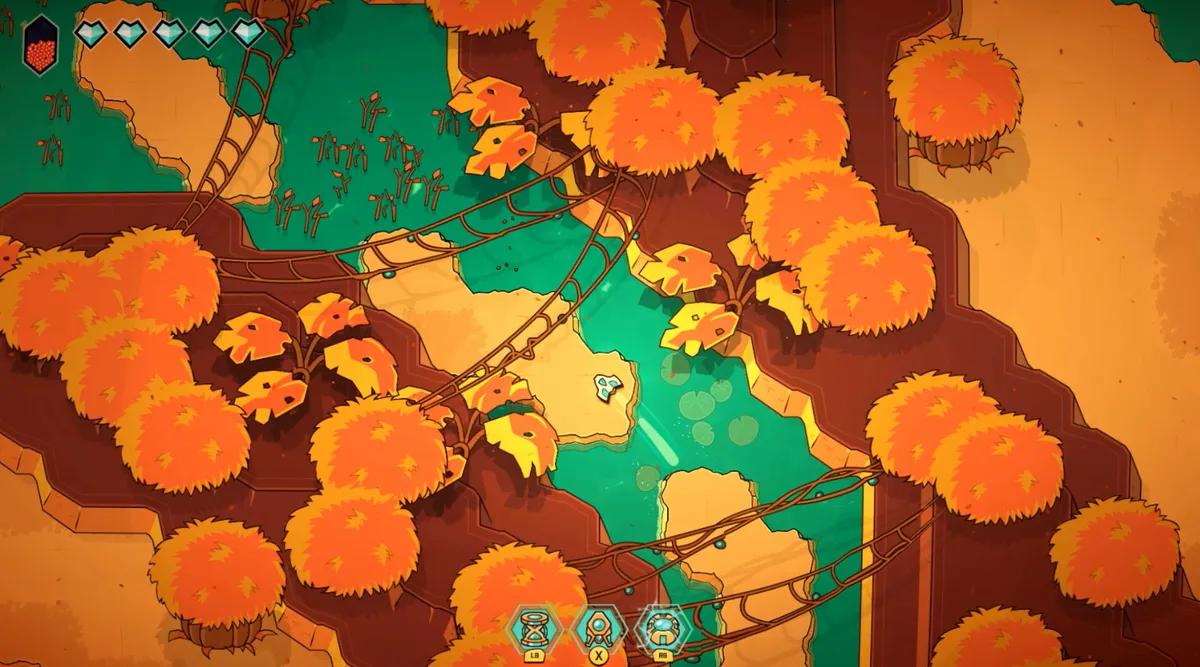
Minishoot' Adventures Is the Zelda-Inspired Twin-Stick Shooter That Actually Works
Minishoot' Adventures first released on PC in April 2024 from developer SoulGame Studio, published alongside IndieArk, and has since been ported to Nintendo Switch 2, PlayStation 5, Xbox Series X/S, and the original Nintendo Switch. The premise answers a design question that almost no one was asking: what happens when classic top-down Zelda structure absorbs twin-stick bullet-hell combat as its primary fighting language? The answer, across roughly ten hours, is that the combination holds together more tightly than the premise suggests it should.
A Familiar World, A Different Weapon
The game puts the player inside a small beige ship called Minishoot' — the apostrophe abbreviating "Minimalist Shooter Adventure" — navigating a corrupted top-down world to rescue fellow sentient ships called Shiplings, each encased in crystals by an invading force. The story occupies under a minute of screen time across the entire runtime and makes no further claims on the player's attention. The world is built from Zelda's structural vocabulary without attempting to disguise it. Hearts display health in the upper corner of the screen; heart pieces appear hidden across the map; locked areas open as new abilities are acquired; one screen below the starting base sits a direct replication of The Legend of Zelda's NES opening screen. SoulGame Studio presents these references not as shortcuts but as a declared foundation, using the familiar layout to introduce a combat system the source material never carried.
Controls, Movement, and the Upgrade System
Movement uses the left stick; firing uses the right, directing bullets in any direction independent of where the ship is pointing. The two inputs operate simultaneously without conflict, and the base feel of moving across the map is smooth enough that it becomes a source of satisfaction on its own before any upgrades enter the picture. Surf and boost abilities unlock over the course of the game — surf allows traversal over water, boost sends the ship over pit-crossing ramps — and both extend the map in ways that reward returning to previously visited areas.
Progression runs through an 11-slot upgrade system covering fire rate, damage, bullet speed, range, and related attributes. Defeating enemies and destroying gem deposits scattered across the world generate experience, and leveling up awards a skill point. Each of the 11 enhancements can be upgraded multiple times, but the increments per individual upgrade are small enough that single investments rarely produce a perceptible change in the ship's output. The upgrade cost scales with enhancement level, so a second damage upgrade costs three accumulated levels rather than one. The rate of progression never stalls entirely — new movement abilities arrive frequently enough that forward momentum stays consistent — but the gradual accumulation of individual upgrades takes long enough to feel like slow grinding before the system pays off.
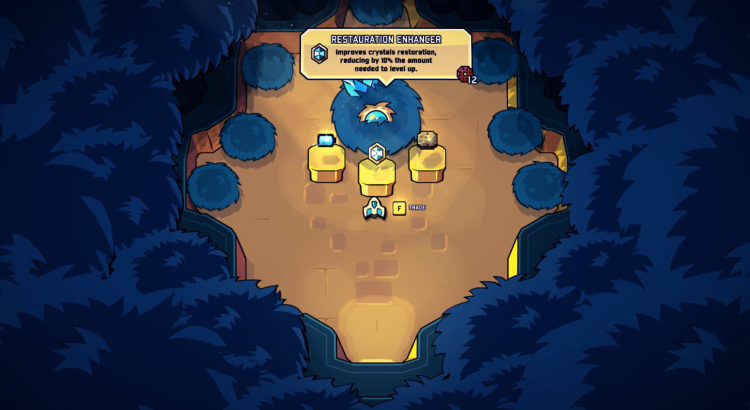
The more impactful upgrades arrive through modules and rescued Shiplings rather than the leveling track. Modules found in the overworld or purchased at hidden shops do things like reduce the experience cost of leveling, flag map locations that still contain secrets, and provide a chance to absorb incoming hits without taking damage. Rescued Shiplings restore health, improve weapons, and unlock blocked map sections. These discoveries land with more weight than any single skill point allocation, and they arrive through exploration rather than attrition.
Enemy Design and Combat Arenas
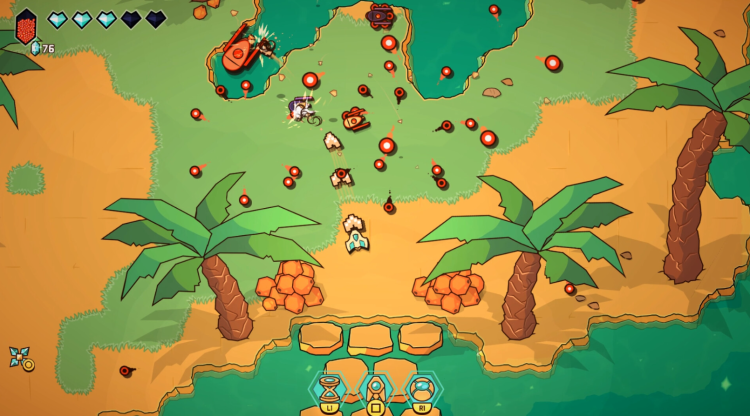
The enemies are mechanically varied and visually generic. Every opponent is a geometric mechanical construct — circles, triangles, different configurations of ship — sharing the same beige-and-metal palette as the protagonist. They do not carry the design identity of the creatures in the games Minishoot' Adventures draws from, and reviewers consistently identified this as the most visible shortcoming in an otherwise carefully constructed game.
What the enemies lack in appearance, they compensate for through behavior. Stationary turrets fire from fixed positions while swarms of smaller ships close the distance simultaneously, requiring split-second prioritization between clearing the cluster and evading ranged fire. Armored dive-bombing enemies trail projectiles across the screen with each pass. Different biomes carry distinct enemy populations, and the arenas combine them in configurations that produce different tactical problems from area to area. Rooms seal shut and spawn escalating waves until all opponents are eliminated. Races appear as optional challenges, using starting blocks and finish lines to reframe the movement mechanics as a separate test.
I think the visual monotony of the enemy roster is the game's only genuinely persistent weakness — not a problem that fades as the design compensates, but one that stays present across the entire runtime because the art style never deviates from it.
Boss Fights and Difficulty Balance
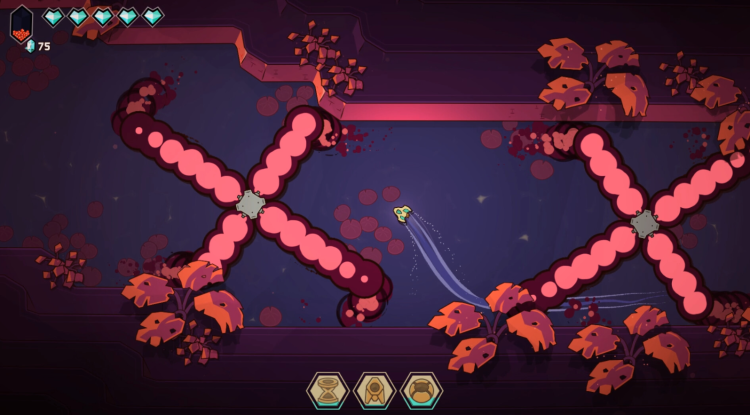
Bosses appear at dungeon conclusions and at points throughout the overworld. They divide into phases, with each phase introducing new projectile patterns that require threading through at speed while directing fire toward the target. The fights push into bullet-hell density — patterns multiplying, coverage expanding across the screen — in ways that the standard combat encounters do not. Both reviewers died frequently in these encounters, and neither framed that frequency as a design failure.
Dungeon layouts route short paths back to boss rooms from respawn points, removing the friction that makes repeated attempts in similar games feel punishing. A rare camera issue pulls the view far enough out during certain encounters that precision becomes harder to maintain — bullet patterns that are legible at normal zoom grow harder to thread at maximum distance. This does not affect most fights, but it surfaces on specific encounters and was noted across both reviews.
Fairness is consistent throughout. Difficulty escalates as new areas open, and nothing in the damage economy or enemy behavior felt arbitrary to either reviewer. When attempts failed, the cause traced back to a readable pattern that the player had not yet learned to navigate rather than a system operating outside what the game had prepared them for. I found the dungeon structure specifically well considered — short respawn routes and the absence of health-punishing return trips communicate that the game expects multiple attempts and builds the environment to support them.
World Design, Secrets, and Sound
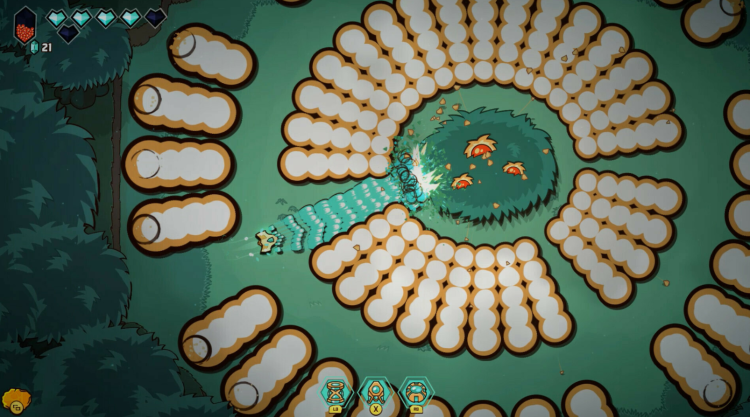
The overworld is handcrafted rather than generated, and its construction reflects consistent attention to how information reaches the player. Hidden paths announce themselves through faint indentations in walls. Enemies shift visibly toward red as damage accumulates, removing the need to track numerical health values during fast-moving combat. Map chunks appear as collectibles, rewarding exploration with cartographic progress. Symbols appear in unexplored regions as progression continues, directing attention toward areas of interest without providing coordinates.
Secret areas tucked behind trees and walls use visual cues legible enough that missing one traces to the player's own path rather than to obscured design. Neither reviewer needed external guidance to navigate the world or resolve a puzzle during their respective playthroughs. The electronic soundtrack maintains a consistent presence without demanding attention, and the sound design leans into tactile feedback — the small audio hits from enemy contacts and environment interactions sustain a cozy sensory register even during the densest bullet patterns.
Minishoot' Adventures completes in approximately ten hours and covers its mechanical ground fully within that window. The twin-stick combat integrates into the Zelda structure without friction, the upgrade system eventually accumulates into a genuinely powerful weapon loadout by the final boss, and the world design rewards returning to explored areas with new routes rather than retreading familiar ground for its own sake. The forgettable enemy visuals and the slow early progression curve are real costs. At nine out of ten, neither one outweighs what the game delivers across those ten hours.
Minishoot' Adventures is available now on Nintendo Switch 2, PC (Steam), PlayStation 5, Xbox Series X/S, and the original Nintendo Switch, developed and published by SoulGame Studio alongside IndieArk.


 Successfully copied... Thank you for sharing our content!:



5% deposit bonus up to 100 gems

a free Gift Case





EGAMERSW - get 11% Deposit Bonus + Bonus Wheel free spin


EXTRA 10% DEPOSIT BONUS + free 2 spins

3 Free Cases + 100% up to 100 Coins on First Deposit


5 Free Cases, Daily FREE & Welcome Bonuses up to 35%

3 free cases and a 5% bonus added to all cash deposits.

+5% to deposit




Comments