




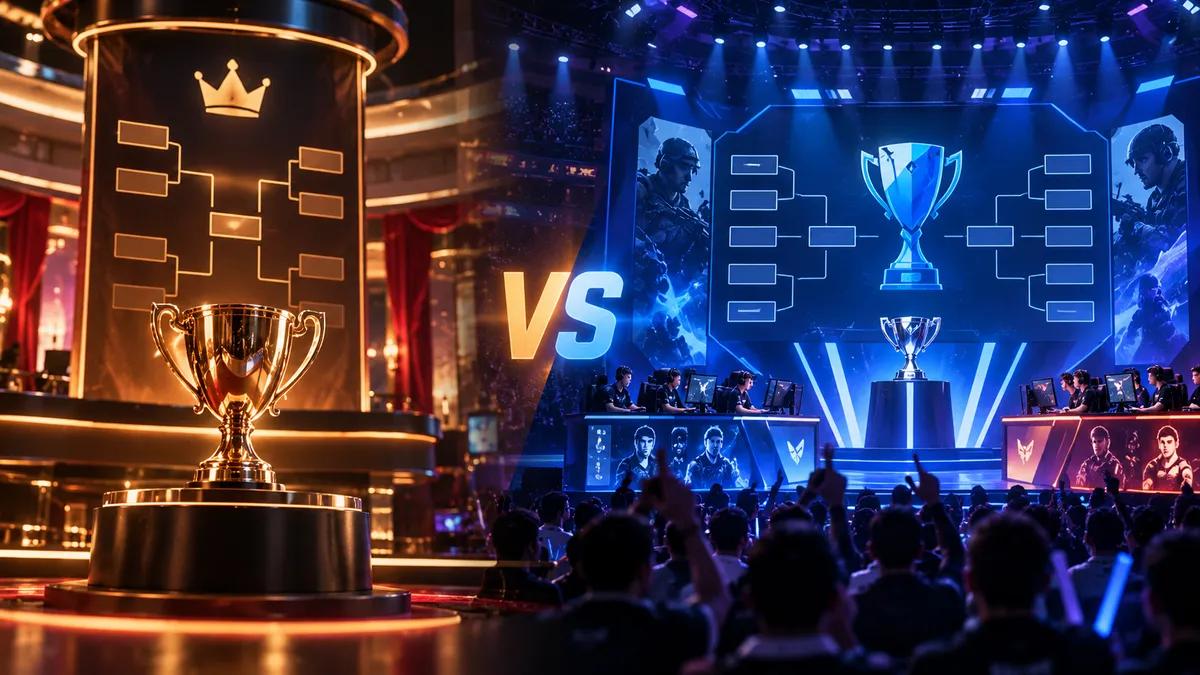
How Casino Tournament Formats Compare to Esports Tournament Structures
 Others
The structural overlap between competitive esports formats and casino tournament formats runs deeper than most observers notice. Both verticals have independently evolved tournament conventions around brackets, leaderboards, timed events, prize pool distribution, and qualifier pathways, and the parallel evolution has produced formats that share a surprising amount of structural DNA. Looking at the two side by side reveals how much of the current format architecture was invented in esports and then adapted elsewhere, and how much of it emerged independently in both spaces.
The comparison matters because the format architecture shapes what players actually experience in each category. An esports bracket feels different from a casino leaderboard, but the underlying design patterns around competition, scoring, and reward distribution share recognizable roots. This piece looks at tournament format conventions in both verticals, where the structural patterns align, and what the architecture looks like when it comes to casino tournaments as they currently run at UK operators, with Fruity King's slot tournament schedule reflecting the format in its mature state.
Tournament formats in competitive gaming were not invented all at once. They emerged through decades of trial and error as organizers worked out which structures produced the best competition, the clearest narrative arcs, and the most sustainable spectator engagement. What follows is a structured comparison of how the two verticals have landed in similar places through different design pressures.
Esports Tournament Format Conventions
Esports tournaments have standardized around a handful of recurring format patterns. Single-elimination brackets handle fast decisive stages where losers exit immediately, while double-elimination brackets provide a loser's bracket for teams that drop a match early, tempering the variance of a single bad series. Swiss-system group stages, borrowed from chess, pair teams by current record and run multiple rounds without full elimination, which is how most CS2 and recent Dota 2 majors handle their group phases.
Prize pool structures vary by game and organizer. Esports Charts tournament data tracks the full landscape of event prize pools and viewership, from flagship events with multi-million-dollar prize pools down to smaller regional qualifiers running on a few thousand dollars. The top-end tournaments concentrate most of the attention, with The International, the League of Legends World Championship, and the CS2 Majors anchoring their respective calendars, but the long tail of smaller tournaments is where most players actually compete.
Qualifier pathways run alongside the main events, with open qualifiers letting any team enter and work their way up and closed qualifiers restricting entry to teams with prior competitive ranking. Regional leagues feed into international events, with the top finishers earning direct seeds and the rest competing through qualifier runs. The pathway structure is designed to produce a competitive narrative where the eventual winner has demonstrably beaten the strongest field available.
Casino Tournament Format Conventions
Casino tournaments have developed their own format conventions, with slot tournaments and poker tournaments serving as the two main structural families. Slot tournaments typically run on leaderboard mechanics, where players compete over a set window on nominated titles with their accumulated scores or multipliers determining their rank. Poker tournaments use bracket-adjacent structures with elimination stages, blinds that increase over time, and a final table that mirrors esports grand-final staging.
Entry mechanisms in the casino space split into free-entry formats open to any account holder with operator-funded prize pools, buy-in formats that resemble poker tournament structures where entry fees combine to form a prize pool, and automatic-entry formats tied to normal wagering activity. The automatic-entry structure pulls players into leaderboard competition based on their regular play, which rewards engagement without requiring a separate registration step, and the buy-in structure sometimes includes a guaranteed operator overlay to attract participation.
Durations also vary across casino tournament formats, with short-session formats compressing competition into a single hour or evening with a leaderboard reset at the end and weekly tournaments giving players a longer window to accumulate scores. Multi-week series tournaments build sustained engagement with cumulative scoring across multiple events, and operators often layer these onto broader loyalty program structures.
Where the Two Formats Converge and Diverge
Looking at the format dimensions side by side makes the structural parallels clearer. Both verticals use leaderboards, both use bracket structures in certain contexts, both run qualifier pathways of some kind, and both distribute prize pools using tiered structures that reward top finishers disproportionately. The structural differences come down to who funds the prize pool, how spectators engage with the event, and how qualification pathways route players into the main competition.
Format comparison across the two verticals
Primary structure
Esports: Single or double elimination brackets, round-robin groups, Swiss-system stages
Casino: Leaderboards accumulated over a set window, often alongside bracket-style finals
Entry mechanism
Esports: Qualifier series, invitations, open qualifiers, regional pathways
Casino: Opt-in registration, buy-in entries, or automatic entry via a qualifying wager
Prize pool funding
Esports: Publisher-funded, sponsor-funded, or crowd-funded through in-game cosmetics
Casino: Operator-funded, with occasional buy-in top-ups adding to the base prize pool
Event duration
Esports: Multi-day live events, often spanning a weekend or week-long group-stage format
Casino: Short-form windows ranging from a few hours to several weeks on leaderboard formats
Qualification pathway
Esports: Competitive ranking from prior events, regional league results, open qualifiers
Casino: Registration-based, often with no prior qualification required beyond account standing
Spectator engagement
Esports: Live broadcasts with commentary, dedicated streaming production, in-venue audiences
Casino: Live leaderboard feeds, in-session position updates, occasional operator stream coverage
The convergence between the two format families suggests that competitive gaming has developed a shared vocabulary of tournament design, even where the games themselves have nothing in common. Players moving between esports and casino tournaments encounter familiar structural patterns in both spaces, which lowers the cognitive barrier to engagement across formats. For operators and organizers in both verticals, the shared design vocabulary means that format innovations in one space often get picked up and adapted in the other, and the overall tournament design landscape continues to evolve as a result.


 Successfully copied... Thank you for sharing our content!:



5% deposit bonus up to 100 gems

a free Gift Case





EGAMERSW - get 11% Deposit Bonus + Bonus Wheel free spin


EXTRA 10% DEPOSIT BONUS + free 2 spins

3 Free Cases + 100% up to 100 Coins on First Deposit


5 Free Cases, Daily FREE & Welcome Bonuses up to 35%

3 free cases and a 5% bonus added to all cash deposits.

+5% to deposit




Comments