




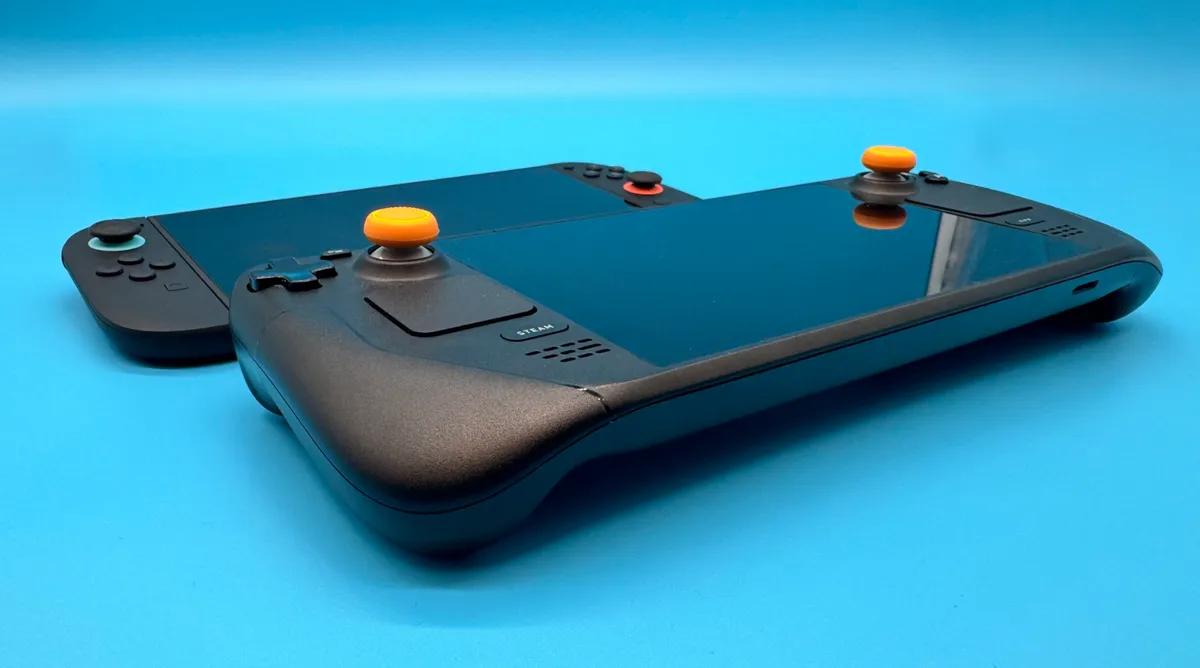
Steam Deck More Expensive Than Nintendo Switch 2 Now
 Steam
Steam Nintendo
Valve has raised the Steam Deck OLED to $789 for the 512GB model and $949 for the 1TB, an increase of up to nearly 50%, and blamed the global memory and storage shortage driven by AI demand. The restocked handhelds sold out across North America within a day at the new prices, and the discontinued 256GB LCD model is gone from the store. The hike now puts the Deck well above a Nintendo Switch 2 and casts fresh doubt over what Valve will charge for the upcoming Steam Machine.
SteamDeck New Price vs. Old Price
Valve confirmed the new pricing on its Steam Deck store page on Wednesday. The 512GB OLED model rose from $549 to $789, and the 1TB OLED jumped from $649 to $949, increases of $240 and $300. On the 1TB unit, that is close to a 50% bump in a single move. The 256GB LCD model, which had been out of stock for months because of RAM shortages and once sold for around $400, is no longer listed for sale at all.
| Steam Deck model | Previous price | New price |
| 512GB OLED | $549 | $789 |
| 1TB OLED | $649 | $949 |
| 256GB LCD | ~$400 | No longer sold |
Both remaining models carry an estimated three-to-five business-day shipping window. Valve also sells certified refurbished Steam Decks priced between $279 and $759, which now sit well below the new retail figures. Outside the US the jump is steeper still: in Canada the 1TB model runs $1,349 before tax, which clears $1,500 once provincial sales tax is added in some regions.
Valve tied the increase to the cost of parts rather than any change to the hardware itself.
Steam Deck itself hasn't changed; these new prices reflect the current state of component costs.
— Valve
Memory, SSDs and GPUs have all climbed sharply, largely because of demand tied to AI, and the company also pointed to broader logistical problems across the industry. Reporting on the hike traced those logistics in part to the war the US launched against Iran and the closure of the Strait of Hormuz, which has disrupted supply with little sign of near-term relief. The handheld and its OLED revision are several years old at this point, so the higher prices buy the same machine that shipped before, only at a moment when its components cost far more.
SteamDeck Is More Expensive Than Nintendo Switch 2 Now

The hike pushes the Steam Deck clear of Nintendo's console on price. The Switch 2 launched in June 2025 at $449.99 in the US, and Nintendo confirmed in May 2026 that the figure will rise to $499.99 on September 1, citing the same memory and chip costs that have hit the rest of the sector. Even measured against that higher number, the cheapest current Steam Deck OLED costs about $290 more, and the 1TB model runs roughly $450 more than the Switch 2's launch price. Nintendo also raised the Switch 2 in Canada to $679.99 and in Europe to 499.99 euros, with RAM costs nearly doubling over the year as AI data centers outbid hardware makers for the same supply that Valve is now paying more for.
Valve is not alone in lifting hardware costs. Sony increased PlayStation 5 prices by up to $150 in March 2026, and Nintendo, Sony and Microsoft have all pushed console prices up over the past couple of years. Some have tried to soften the blow elsewhere: Nintendo prices its digital first-party games below physical copies, Microsoft cut the cost of its top Game Pass tier, and Sony has tested dynamic discounting on its store. What separates the Deck is that it is not a closed console locked to one shop. It is a portable PC and, as Polygon framed it, an ancillary device for a platform, Steam, that buyers already use elsewhere.
That platform takes some of the edge off the sticker. PC games tend to cost less than console releases, Steam runs frequent seasonal sales, Valve does not charge for online multiplayer, and there is no subscription required to play. Its value also rests on software, and SteamDeck launches many solid games that run cleanly on the handheld, from Baldur's Gate 3 and Elden Ring to Hollow Knight: Silksong. Valve has also shown, through the rapid sell-out of its Steam Controller, that it can move hardware at premium prices when the quality holds up.
Will It Return To The Old Price?

Valve framed the hike as a response to current costs, which raises the obvious question of whether the prices drop back once those costs ease. Two things work against it. The restocked Decks sold out across North America in under a day, with the store page warning that stock will be intermittent because of memory and storage shortages, so demand is holding at the new figures. And the shortage itself is forecast to deepen. The Team Group CEO has warned that DRAM and SSD prices will keep climbing, and the analyst firm Omdia estimates enterprise SSDs will cost almost 13 times as much as hard drives per gigabyte through 2026, more than double the ratio in 2023. Several NAND makers have said their entire 2026 capacity is already reserved, with no plans to expand production.
I think the price is unlikely to fall back to where it was, because Valve is selling every unit it can ship and the component crunch behind the increase is projected to worsen rather than ease. There is little commercial reason to cut a price the market is absorbing without complaint, and Ars Technica has noted the squeeze could run for a long stretch.
Stock is thin rather than absent in other regions. The Deck Scan tracker shows limited availability in the US, UK, Europe and Australia, with units flickering in and out of stock minute to minute. As of the price change, Australia still had the older LCD model on sale at its original price, which Valve had not touched.
Steam Machine Price After Steam Deck New Price

The Deck increase reads as a warning for the Steam Machine, the SteamOS-powered PC Valve announced in November 2025 alongside the Steam Frame headset and a new Steam Controller. The Machine uses DDR5 memory and SSDs, the exact parts the AI boom has made expensive, which is why Valve has repeatedly tied both its schedule and its pricing to the shortage.
Key points on the Steam Machine:
- SteamOS-powered mini PC announced in November 2025, bundled at launch with the new Steam Controller
- AMD Zen 4 CPU with 6 cores and 12 threads up to 4.8GHz, paired with an RDNA 3 GPU and 8GB of VRAM, close to an AMD RX 7600
- 16GB of DDR5 memory and a choice of 512GB or 2TB NVMe storage, with microSD expansion
- Digital Foundry placed its performance between the Xbox Series S and the PlayStation 5
- No official price; analysts once floated $400 to $500, while insider Brad Lynch now points to above $1,000
- First targeted for Q1 2026, then pushed to the first half of the year, with a slip into 2027 still possible
On price, Valve has stayed guarded. Hardware engineer Yazan Aldehayyat said the Machine competes with similarly powered PCs, and on the Friends Per Second podcast, programmer Pierre-Loup Griffais framed the target as matching a self-built PC of equal performance rather than a subsidized console.
That's the general price window we aim to be at. — Pierre-Loup Griffais
Part of Valve's argument for buying a Steam Machine instead PC self-builds is the set of living-room features a home tower struggles to match, such as HDMI-CEC control to switch a TV on and off and a single button to wake the device. The Machine runs SteamOS like the Deck, with the option to drop into a desktop Linux mode and install other storefronts such as the Epic Games Store and GOG. Its 8GB of VRAM has drawn concern, since many modern games strain on 8GB or less while the Xbox Series X and PS5 reserve closer to 10GB for graphics, which limits how much texture data the Machine can hold at 4K. Valve says most Steam titles run well at 4K 60 with FSR upscaling, while noting some are better played at a 1080p internal resolution with variable refresh, and the RDNA 3 GPU is held to FSR 3 rather than AMD's newer FSR 4. A subsidy looks unlikely. Where Microsoft and Sony sold the Xbox Series X and PS5 at a loss to build an audience, Valve's earlier guidance points away from that model, and analysts believe it pays more for components than its rivals do. Brad Lynch, the source of many Valve leaks, was given a price estimate roughly two months ago and says at least one configuration could land well above $1,000, with predictions now stretching toward $1,200. I see a price above $1,000 for at least one model as the realistic outcome now, given that a 1TB Deck already costs $949 and the Machine carries a dedicated GPU, more memory and more storage. Analyst Rhyss Elliott of Alinea Analytics has argued that anything over $500 risks pushing it into compact-PC territory rather than the living room, while $400 with a controller would anchor it as an accessible option. When Valve unveiled the three products in November, it expected to set pricing and dates by now, but said the rapid rise in memory and storage prices forced it to revisit its shipping schedule and pricing, especially for the Steam Machine and Steam Frame. Former Xbox executive Larry Hryb has urged calm over the early platform sparring around the device, noting such cycles rarely merit the heat they draw.
Valve's Hardware Recap

Valve's hardware push runs wider than the Deck. It shipped the new Steam Controller on May 4 for $99, releasing it ahead of the Machine and Frame after splitting the three products apart in response to the RAM shortage, and the pad sold out quickly. The controller uses TMR magnetic thumbsticks, two haptic trackpads and a gyro sensor, and mechanical engineer Steve Cardinali said the team held the $99 line by being strict about which parts made the cut, against comparable high-end pads that run $150 to $200. Valve has cast it as a building block for the Machine, including the out-of-box setup, while aiming it mainly at desktop users who never plug in a Machine at all. The Steam Frame and the Machine both remain undated, and Valve has acknowledged the Deck has gone out of stock in many regions, blaming shipping difficulties alongside the memory shortage.
Underneath all of it sits SteamOS, Valve's Arch-based system with a KDE Plasma desktop. That same Linux Desktop has drawn outside money: Germany's Sovereign Tech Fund handed the KDE project 1.3 million euros to harden the desktop that ships on the Steam Deck. The wider Linux shift is turning up on Steam itself, where Linux passed 5% of users on the March 2026 hardware survey, up from 2.13% the month before, helped along by SteamOS being built on Arch.
Valve has also confirmed it is working on a Steam Deck 2, with Griffais drawing a straight line from the original Steam Controller and Steam Machines through the current Deck to the next handheld. The company's longest-running question mark remains Half-Life 3; former Valve writer Chet Faliszek, who worked on the series, recently called any sequel a "disaster nightmare" to work on Half-Life 3, even as insider rumors point to an advanced build and a possible Summer Game Fest tease.
Holding the lineup together through the shortage is a supply approach Valve built in at the design stage. Griffais described avoiding single-sourced parts and working with both large and small manufacturers so one supplier's trouble cannot stall a whole product, the same flexibility he said carried Valve through the COVID-era chip crunch, though he conceded the memory situation is global enough that flexibility only goes so far.


 Successfully copied... Thank you for sharing our content!:



5% deposit bonus up to 100 gems

a free Gift Case





EGAMERSW - get 11% Deposit Bonus + Bonus Wheel free spin


EXTRA 10% DEPOSIT BONUS + free 2 spins

3 Free Cases + 100% up to 100 Coins on First Deposit


5 Free Cases, Daily FREE & Welcome Bonuses up to 35%

3 free cases and a 5% bonus added to all cash deposits.

+5% to deposit




Comments