


Esports Awards CEO Mike Ashford: “Eyeballs Create Traction, Which Creates Sponsors”
 Others
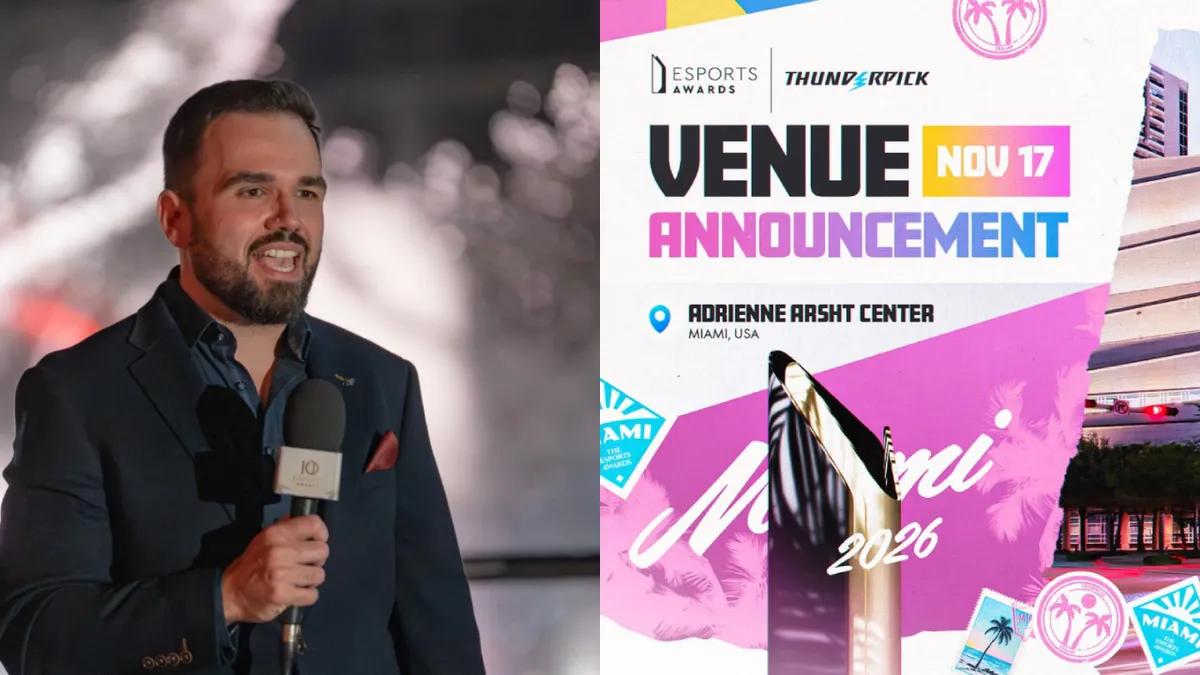
The Esports Awards hold their 11th ceremony in Miami on November 17, three days after the League of Legends World Championship final. This year’s finalists range from IShowSpeed to Faker, a sign of how far the awards now stretch across streaming and competitive play.
We spoke with Esports Awards CEO Michael Ashford about turning casual viewers into esports fans, what happens when a Worlds result lands days before the show, and how a largely English-language event tries to recognise scenes around the world. The ceremony is supported by title partner Thunderpick.
This chunk of the interview was exclusively shared with EGW.News.
How can the industry turn creator audiences into esports fans?
This year’s finalists range from IShowSpeed to Faker. What can the industry do better to turn people who watch creators and casual gaming content into fans of competitive esports?
The Esports Awards are now in their second decade. We started back in 2016, and this year we celebrate our 11th ceremony in Miami on November 17, with our title partner Thunderpick supporting and enabling it.
Over the years we have had to adapt and overcome the same challenges as everyone else as new interests have come in. One thing I think we still need to see is pro players returning to content creation.
Esports really resonated with the audience when there were behind-the-scenes episodic series and the players’ personalities could shine. That has maybe faded as results have become more important. I’m talking about things like TSM Legends and making-of documentaries, which gave pro players the same kind of influence that a lot of creators enjoy today. Returning to those roots would be super healthy, because we know eyeballs create traction, which creates sponsors.
We also need to keep collaborating, and we’ve seen some really cool stuff recently. At the League of Legends World Championship, one of the AEW pro wrestlers, who is also a massive League of Legends fan, came in. You get these catalysts for culture, and that’s what we need to see more of.
Can the Worlds final change the results?
The Worlds final takes place on November 14, just three days before the ceremony. How do you handle major results that land right before the show? Could the final shape a category like Esports Personality of the Year?
It can, and it has. There is a precedent. As we’ve built a longer legacy in the industry, we’ve learned how dates shift and affect results, and we always want to give the fairest representation of the esports calendar. About five years ago we introduced wildcards, which account for anomalies that might change a category entirely.
The Esports Awards work on panel and fan voting. We have a panel of around 150 judges, and above them sits a panel council of around six people with more responsibility and longevity. Then we have the fans alongside them.
There are always touch points later in the year, such as the League of Legends World Championship. This year’s final is very stacked, with two deserving teams that have shown strong results both internationally and domestically. If a team isn’t represented in a category but now should be because of the result, the panel council can wildcard them in. Then the judges get the chance to recast their votes in key categories such as PC Player of the Year, Team of the Year and Organization of the Year, which can have a knock-on effect on the outcome.
A good example is 2024, when T1 won Worlds. T1 are always expected to perform at Worlds, but that year people felt they weren’t having their strongest results and they weren’t favourites. Then they dominated and won the tournament, we had to reopen the process, and that eventually led to T1 being crowned Team of the Year.
How do non-English-speaking scenes get fair recognition?
The Esports Awards are mostly advertised and conducted in English. How do you make sure players and scenes from other regions still get fair recognition?
It is a massive challenge, and it’s certainly not something we get perfect every year, especially because esports has its own trends.
There are times when Chinese esports is more competitive than Korean, and times when it’s the other way round. There’s almost a lag between that shift happening and the information being relayed. You need a seismic event, like MSI, the League of Legends World Championship or a Valorant tournament, to get there. Take Valorant Champions and LOUD winning again this year. At the time, people probably felt the Chinese teams were going to win again and were starting to get a foothold, and it takes a while to recalibrate. LOUD are very successful at Champions; it’s their second title.
So we have worked hard to make sure the panel is globally represented, with people in regions like Latin America and APAC who act as ambassadors and make sure those regions get a voice. Our internal panel committee also handles a lot of the data. If there’s going to be representation for StarCraft II, for example, we go out and find the best players across the planet, not just in a single region. The same goes for Dota and the other titles.
It is a challenge, and some people will still be missed, because esports is so broad and being a global awards show comes with compromise. But I like to think we’re getting better every year.


 Successfully copied... Thank you for sharing our content!:


Comments