



How to Understand Pattern Indexes on CS2 Skins
 Skins
SkinsWhen players evaluate the worth of a skin, they most frequently consider its rarity, level of wear, and market demand. However, some skins have another feature that can also affect the price: the pattern index. Even skins that look identical can have different placement of color or pattern. Some skins have little difference, while others make an item desirable and wanted by collectors. Knowing what a pattern index is and when it really matters is enough to understand why one skin can look different and cost more than its counterpart.
What Is a Pattern Index?
A pattern index is a number assigned to a skin when it is created. Typically, this number is between 0 and 999. The value does not impact the weapon's performance or durability. It simply determines which pattern is applied to a particular skin. That means two knives can have the same float value but different placement of colors, transitions, or metallic areas. Visually, they look different, but technically, they are the same skin.
Why Isn't the Pattern Index Important for All CS2 Skins?
For many skins, the pattern index has little or no visible effect. If you take a standard AK-47 or M4A4 skin with a fixed design, the pattern index usually has little or no visible effect. Finishes that use a large random texture work quite differently. This is where different patterns can completely change the appearance of an item. For example, the Case Hardened firearm skin does this.
Therefore, collectors always pay attention not only to the float but also to the pattern number. Sometimes it is this number that determines whether a particular skin is considered common or rare.
Fade Skins
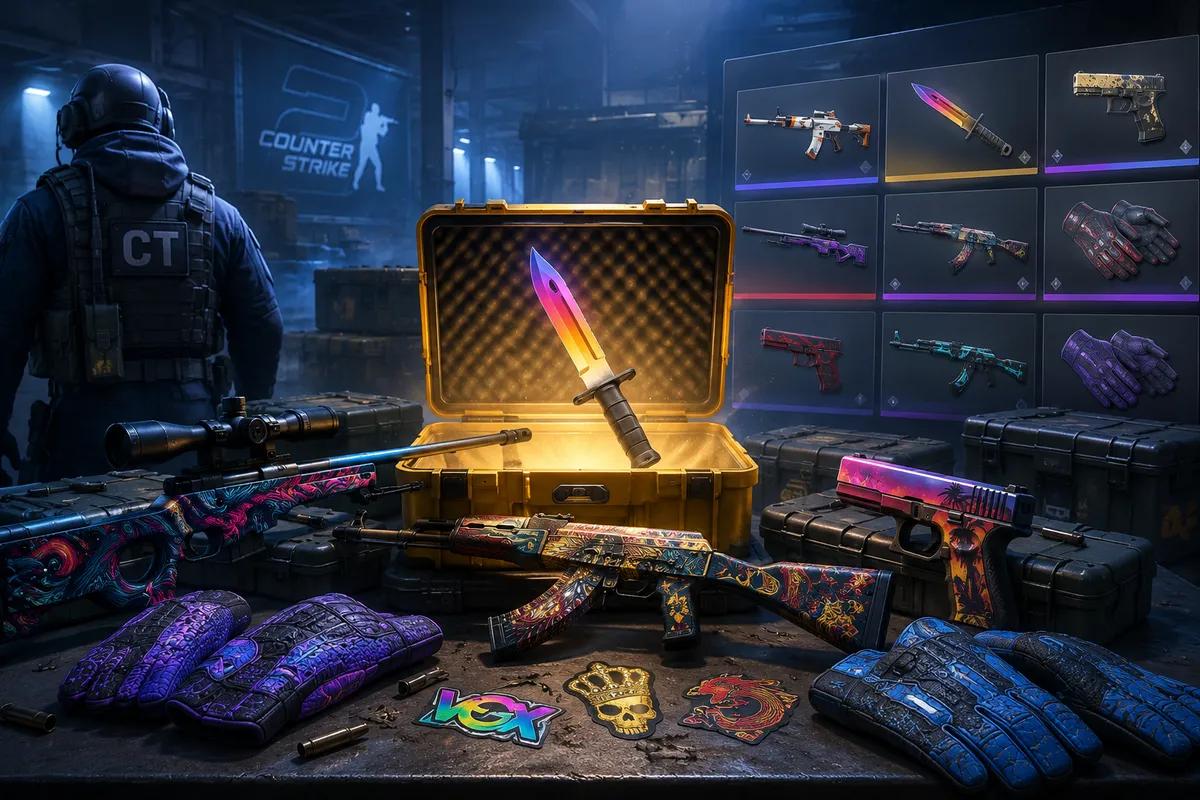
Fade is considered one of the most famous examples of a finish where the pattern index truly matters. The gradient itself remains consistent across knives: yellow, pink, and purple shades are used. However, their placement on the blade varies depending on the pattern. Because of this, one knife may have more yellow, while another will contain significantly more purple and pink.
Over time, the community has developed a more convenient system for evaluating such knives. Instead of manually comparing hundreds of pattern indexes, players use the Fade calculator for CS2 skins, which displays the exact distribution of colors on a knife for a given pattern, as well as the Fade percentage. This makes it much easier to evaluate the visual characteristics and value of the pattern. When purchasing an expensive knife, most experienced traders focus on this percentage, not just the pattern number itself.
Case Hardened Skins
While the differences in Fade are relatively subtle, in Case Hardened they can be dramatic. This finish uses a random distribution of blue, gold, and purple metallic patches. One pattern might contain just a hint of blue, while another might cover almost one side of the weapon with it. This is where the famous Blue Gems come from. These are the names given to Case Hardened skins whose pattern index creates a particularly well-placed arrangement of large blue areas. Since such combinations are very rare, the price of some Blue Gems can be many times higher than that of a standard Case Hardened.
That's why it's always important to check the specific pattern index before purchasing such items, rather than relying solely on the skin name.
Doppler Skins
At first glance, Doppler seems to differ only in color, but it also uses a pattern system. Different patterns determine the placement of dark and light areas, as well as the ratio of primary colors. This is how the well-known Doppler phases emerged. For example, Phase 1, Phase 2, Phase 3, and Phase 4 differ in the distribution of shades, although they formally belong to the same finish. Ruby, Sapphire, and Black Pearl stand apart, considered the rarest varieties.
How to check a CS2 skin's pattern before purchasing
Almost every current marketplace and inventory checker allows you to see a skin’s pattern index before you complete a transaction. This information is generally shown along with the float value and other item characteristics. But the number itself isn't enough. Databases for popular finishes have long existed, allowing you to see how each pattern appears on a specific CS2 weapon or knife. Calculators can show even more, including the percentage distribution of colors in different patterns.
Conclusion
The pattern index isn't a characteristic that applies to every skin. For most skins, it's irrelevant. But for Fade, Case Hardened, Doppler, and a number of other popular finishes, this parameter can change the item's appearance drastically, and thus, its market value. Therefore, experienced buyers almost never evaluate an expensive skin solely by its float value or wear level. They also check the pattern index to understand the quality of a particular piece.


 Successfully copied... Thank you for sharing our content!:

Comments