




WWE 2K26 Builds on a Strong Foundation While Monetization Tightens Its Hold on the Series
WWE 2K26 launched on March 13, 2026 for PlayStation 5, Xbox Series X/S, Nintendo Switch 2, and PC, developed by Visual Concepts and published by 2K Games under a Teen rating. The game carries the series' largest roster to date — over 400 performers past and present — four new match stipulations, a restructured MyRise story mode, and the debut of the Ringside Pass, a battle pass system replacing the post-launch DLC model that carried the series through 2K25. WWE World Heavyweight Champion CM Punk anchors the cover, and his career provides the framework for this year's Showcase mode. Whether the additions represent genuine progress depends on which parts of WWE 2K the player values most, and across three separate reviews, that question produced sharply different answers.
A Solid Annual Entry With Growing Structural Problems
From our previous WWE 2K25 coverage — noting it as really the best wrestling game since WWE 2K24, with fantastic presentation, intergender matches, and welcome updates to both MyRise and Showcase — the series had been on its most impressive run to date. Since that assessment, WWE 2K26 arrived officially with CM Punk on the cover, a roster exceeding 400 performers, and upgraded game modes across the board, releasing on PC, PlayStation 5, Xbox Series X/S, and Nintendo Switch 2 on March 13. The question the new entry raises is whether that momentum continues or whether the accumulating additions are beginning to weigh against the series' core strengths.
In-Ring Adjustments: Stamina, Physics, and the New Match Types
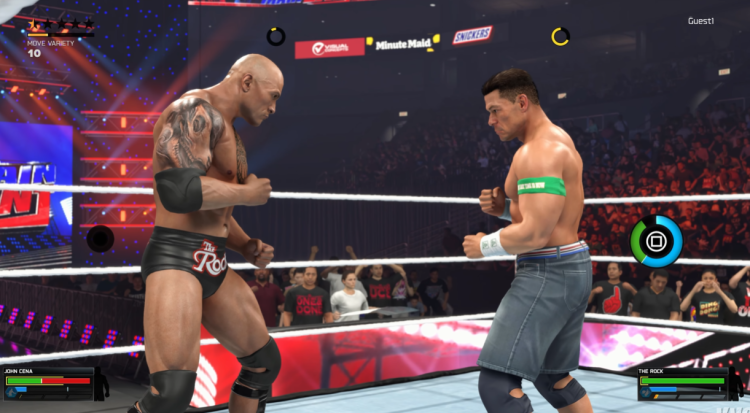
The core in-ring action has not been overhauled. Visual Concepts made one significant change to the stamina system by introducing a condition called "winded." When a superstar fully depletes their stamina bar, the wheel turns from yellow to purple, and they cannot run or use reversals until it drains back to normal. The adjustment raises the cost of stamina-heavy play — reversals, offensive combinations, and sprinting — by penalizing the bar hitting zero rather than simply running low.
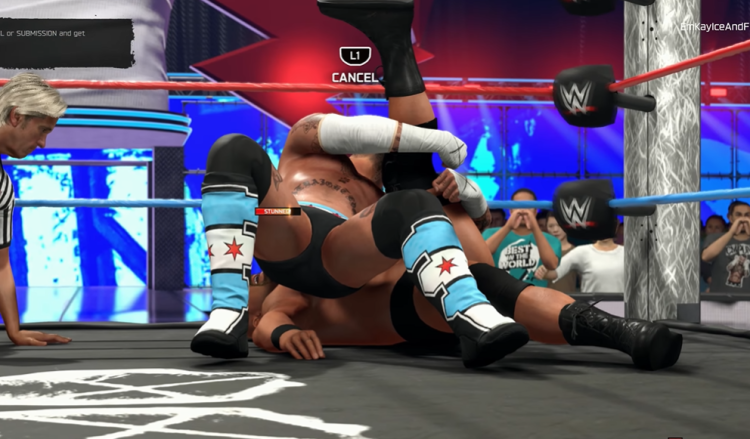
The reversal system has accumulated criticism for two separate problems: it rewards players who internalize its timing with near-invincibility, and it remains difficult to learn because the prompts appear at inconsistent points across move animations. The winded condition addresses the first problem by making overuse a liability. It does not address the second. New players still face the same steep learning curve before reversals become reliably executable, and the consequence for becoming proficient is now a stamina penalty that didn't exist before. One approach some reviewers identified for managing the winded window is attempting pins or submissions during it rather than pushing aggressively, which produces pacing that mimics real television wrestling but runs against the energy that motivates playing a wrestling game in the first place.
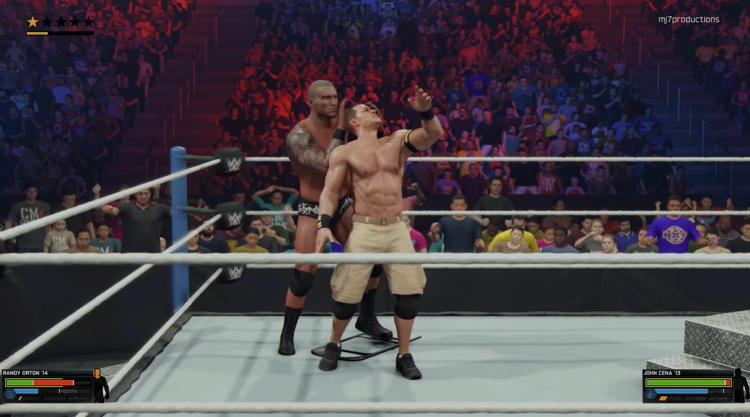
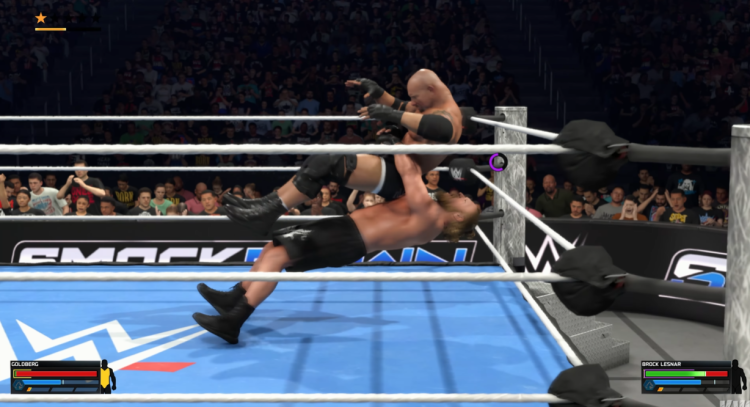
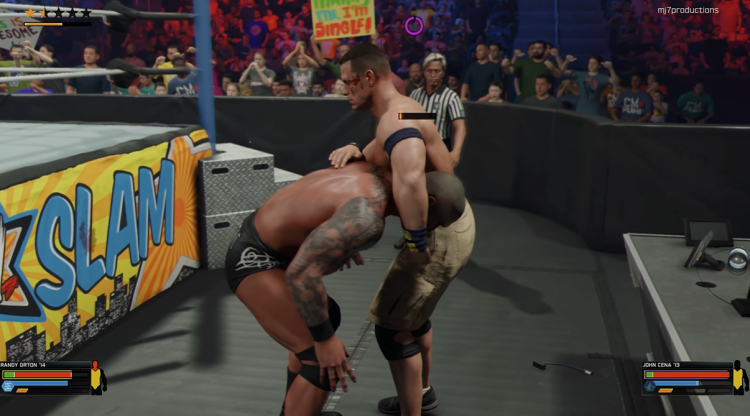
Collision physics received a separate adjustment. Throws and bumps now interact with ring elements rather than triggering canned animations that clip through them. A suplex into the ropes registers contact and produces a reactive bounce. An opponent thrown onto the ring steps crunches around the metal block. The changes carry no measurable mechanical advantage — damage output does not increase based on the surface an opponent contacts — but the visual results extend the slapstick quality already present in most matches to more extreme levels, which reviewers found entertaining without finding meaningful.
Four new match stipulations join the existing roster. The Dumpster match functions identically to the Casket and Ambulance formats, where weakening opponents enough to shove them into an enclosed space determines the winner. Input latency during that placement interaction was flagged across multiple reviews, requiring a second button press to register when attempting to put opponents inside the dumpster. The Inferno match returns from the Smackdown vs. Raw era: offensive moves raise a temperature gauge, and the match ends when a fully heated opponent is exposed to the ring's flames. The novelty is brief. Three Stages of Hell runs three player-selected stipulations as a two-out-of-three falls gauntlet, adding format variety without adding mechanical depth.
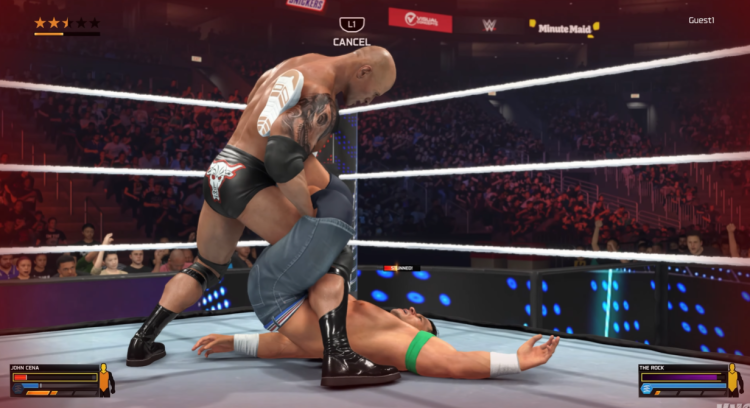
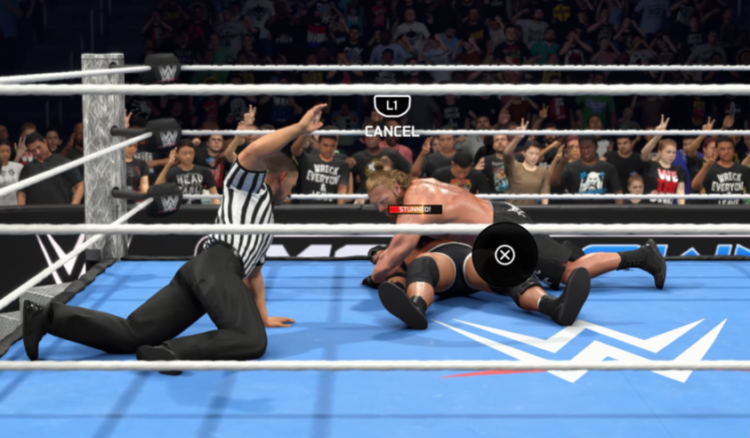
I Quit is the most successful new addition. Instead of the standard submission mashing minigame, the defending player faces a series of timed gauge checks — hitting specific zones enough times to stay in the match. Those zones shrink as damage accumulates, and the attacking player can earn blockers through the same mechanism used to earn finishers, placing obstacles across the gauge to complicate each check. The interaction is complex enough to require attention without becoming unmanageable, and it layers tactical decisions into submission offense that the standard system lacks entirely.
Roster Size, Presentation, and Commentary
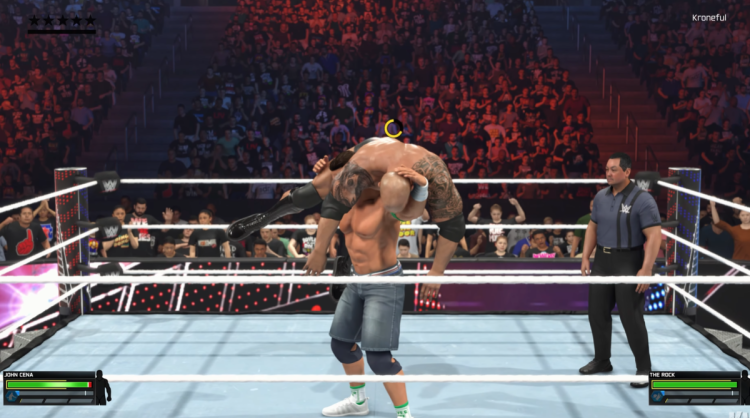
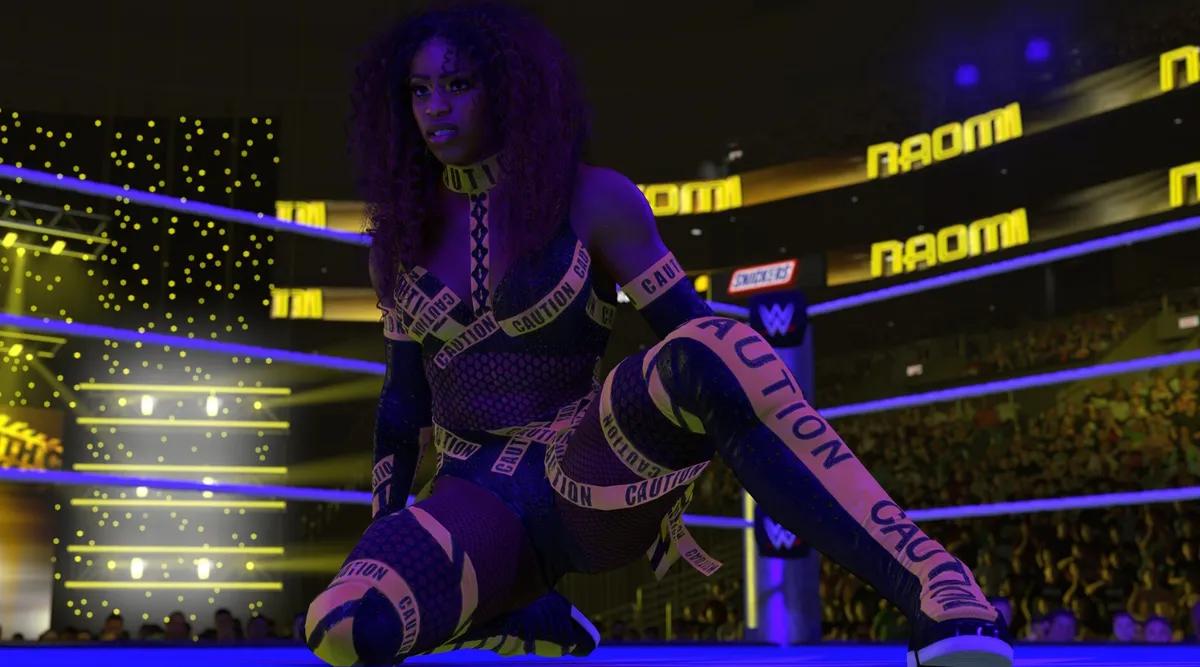
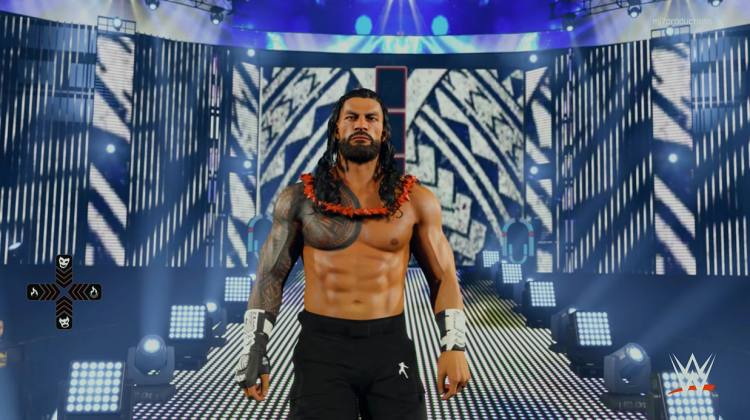
The 400-plus roster is the widest the series has fielded. Models for current performers range from very good to exceptional. Legends carry the most inconsistency — some scan well, others show low resolution that becomes most noticeable during match setup screens and close-range in-game cutscenes, reading as though the face is constructed from low-poly geometry that did not survive the scaling process. Dropping last-generation hardware entirely allows the current-gen presentation to run at a consistent baseline, unavailable when versions needed to exist across multiple platforms simultaneously.
Commentary received specific praise for adding Wade Barrett and Booker T to the announce team. Both brought a refreshing presence that reviewers described as the strongest the booth has sounded in years. Character model animation during dialogue — particularly in MyRise cutscenes — is a separate issue. Jaw movement frequently appears disconnected from speech, and lighting in certain scenes produces an uncanny rendering effect on custom characters that several reviewers found distracting. These issues concentrate in story mode sequences and diminish during standard match presentation.
Showcase Mode: CM Punk's Career, Selectively Told
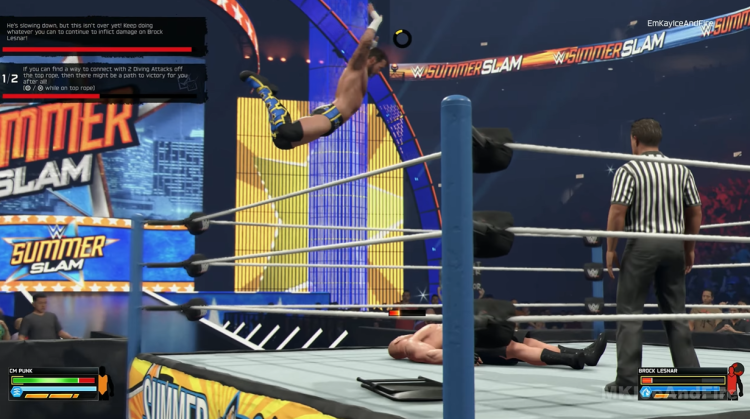
This year's Showcase traces CM Punk's WWE career through two separate runs, blending playable matches with real broadcast footage using the series' Slingshot Technology. The mode divides roughly in half between historical recreations and fantasy bouts against opponents Punk never actually faced.
The historical side has a structural problem that no design choice within the mode addresses. Coverage concentrates on the final year of Punk's first WWE tenure — 2013 to 2014 — and his current run, with a decade-long gap between them that the mode does not examine. Several opponents from Punk's earlier career cannot appear because they currently work for competing promotions. Jeff Hardy and Chris Jericho are absent for that reason. No ECW content appears. The Straight Edge Society period goes unrepresented. Money in the Bank 2011 — one of the most widely discussed matches in Punk's career — does not appear in the mode, reportedly tied to Vince McMahon's involvement in that event. The Pipe Bomb, an off-script promo Punk delivered in 2011 that remains one of the most discussed unscripted moments in recent WWE history, receives no acknowledgment. The mode makes no attempt to address the circumstances of Punk's decade-long departure, which multiple reviewers identified as an obvious and deliberate omission that the fantasy match section was constructed to fill rather than a choice made for creative reasons.
I see the Showcase's refusal to engage with that chapter as its most significant failure — not because commercial or legal factors could have been easily navigated, but because the mode builds a career narrative around a person whose most discussed career event is structurally excluded, producing a portrait shaped entirely by what the corporation was willing to sanction.
The fantasy match half uses a time machine narrative — Punk engaging with the Slingshot Technology between matches — to generate matchups and counterfactuals. Punk embodies Bret Hart to prevent the Montreal Screwjob; hypothetical bouts against opponents from different eras fill the slot that unavailable history cannot. Reviewers were split on whether these feel like genuine creative choices or like filler constructed around what could not be included. A Gauntlet format runs all 20 Showcase opponents consecutively and unlocks every mode reward simultaneously upon completion, giving players who want the unlockables without the historical framing a direct path to them. Showcase matches carry fewer completion objectives than in prior years, reducing checklist pressure for players pursuing full completion. Punk's in-match commentary provides context for matches that do appear, and for those specific bouts, it works.
MyRise Struggles, Universe Improves, The Island Persists
MyRise follows a character called The Archetype, a former top performer returning from an extended absence, across six chapters. The structure is more streamlined than previous entries, with fewer total story events but heavier consequences attached to alignment decisions at each major beat. Choosing a heroic or villainous path changes what happens in subsequent chapters, and the back-and-forth between those trajectories — betrayals, impossible odds, recovered momentum — follows the standard arc of any WWE television main-event story. Writing quality received consistent criticism across reviews for ranging from bland to awkward, with dialogue scenes compounding those problems through animation that does not support the performances.
The pacing problem sits at the mode's center. Advancing between story chapters requires earning 12 performance stars across as many matches as it takes to accumulate them, with each match awarding up to five. Those matches draw from a small pool, producing repeat opponents in sequence before the story resumes. One reviewer connected this structure directly to the Ringside Pass, noting that winning matches generates pass XP and the mandatory grinding sequences keep players inside that XP loop. Whether or not that connection drove the design decision, the practical effect is identical: story momentum stops repeatedly for matches that exist only to meet a numerical requirement and contribute nothing to the narrative. The Archetype's central premise — a return from a year-long absence, with the choice of how and why that absence happened — had enough setup to sustain interest, but several reviewers found that the grinding extinguished it before the first chapter was completed.
Universe mode receives two additions that reviewers described as substantive. The WWE Draft allows roster shuffling against a computer-controlled GM at any point during a save, giving long-running universes a tool to disrupt staleness without starting over. Money in the Bank cash-ins no longer require designating a target championship in advance — briefcase holders can cash in on any eligible title on a given show, which reviewers who use the mode found made MITB feel like an active narrative mechanism rather than a management obligation to resolve. Each show supports eight championship titles across men's and women's divisions. The Universe Wizard automates significant portions of show setup during configuration, reducing the manual adjustments previously required to get a show running.
MyGM expands to 50-week seasons with additional premium live events filling the extended calendar. Intergender matches and feuds are now bookable, and wrestlers can appear in both a match and a promo slot on the same card — a combination that reviewers noted opens booking combinations that were unavailable before and meaningfully increases the strategic options available week to week. The Creation Suite doubles its superstar limit to 200 slots and adds two-tone color blending for custom character design. Reviewers who use the creation tools described the expansion as a real improvement; one noted they spent more time building custom arenas as a primary use of the suite.
The Island returns as the online hub with voice acting, a new map layout, and three faction storylines led by CM Punk, Rhea Ripley, and Cody Rhodes. The voice acting is a genuine improvement over the prior version's absence of it. The structure has not changed. VC cosmetic stores are distributed throughout the environment, and custom superstar stat progression requires grinding 4-way matches at the new Scrapyard area or completing roguelike gauntlet runs for each faction. An early handicap match in Rhea Ripley's Order of Shadows path places the player's underpowered custom superstar against two opponents simultaneously, a difficulty wall that multiple reviewers interpreted as a prompt to spend VC on stat upgrades rather than a challenge intended to be cleared through preparation or skill. Reviewers who tried The Island without spending real money found competitive leaderboard performance difficult to achieve without investing more grind hours than the mode's content quality justified.
The Ringside Pass: More Content, Higher Cost, More Friction
The Ringside Pass is WWE 2K26's first battle pass and the addition that generated the most consistent critical attention. It operates across 40 tiers split between a free track and a premium track, with XP generated by any in-game activity advancing tier progress. Rewards include wrestlers, championships, cosmetic items, MyFaction cards, timed XP boosts, and Virtual Currency. The pass does not expire: rewards on both tracks remain accessible indefinitely, and there is no time gate forcing completion within a season window.
Season 1's free tiers unlock more wrestlers than WWE 2K25's full post-launch DLC cycle delivered in total, which constitutes a measurable improvement in accessible content for players who spend only the base game price. The premium track adds further wrestlers alongside MyFaction-specific items. Purchasing all 40-tier skips simultaneously costs more than the combined total of 2K25's post-launch packs.
Tier advancement pace was contested. One reviewer spent roughly 25 hours across exhibition matches, Showcase, a complete MyRise playthrough, and several hours on The Island, reaching tier 14 of 40 — well short of late-track rewards, including a costume and a move set they had identified as specific targets. A second reviewer found the advancement pace reasonable and reached double-digit tiers without feeling pressured. The discrepancy likely reflects which activities each reviewer used to generate XP. A third reviewer had not yet engaged with The Island but expressed appreciation for the permanent ownership structure, calling it how battle pass reward retention should function across the industry.
The replacement model is the sharpest point of criticism. The Ringside Pass substitutes directly for wrestler DLC packs that players could purchase as discrete items in prior years. Content that would have been an immediate, fixed-price transaction — a specific wrestler, an arena, a championship design — now sits at a tier requiring either XP accumulation or a skip purchase. Some of that content would have been available at launch in earlier entries, or purchasable immediately with in-game free currency. The migration of that content into a progression wall means players who want specific items must play toward them over time or pay to skip the distance. Combined with The Island's VC stat walls, the two monetization systems create sustained incentive to spend in a game that already sells multiple premium editions at launch.
Verdict
WWE 2K26 is a functional and often entertaining wrestling game built on a foundation that Visual Concepts has been refining since 2K22. The roster is the series' largest, Universe and MyGM receive real additions, I Quit introduces the best new mechanical idea the game offers, and the Creation Suite expansion is substantive. Commentary is stronger than it has been in years. The Ringside Pass's permanent reward structure avoids the time-pressure tactics that make many battle passes punishing for players with limited schedules.
Against that, the reversal system remains difficult to learn and inconsistently timed, with the winded condition adding a penalty on top of a problem it does not resolve. Showcase builds a career retrospective around a performer while avoiding the event that defined the period covered by half its runtime. MyRise breaks story momentum with mandatory grinding sequences that appear designed to generate battle pass XP as a secondary function. The Island added voice acting and a new map while keeping the VC pressure and stat walls intact. The Ringside Pass replaces DLC with a tier system that costs more to skip completely than prior DLC seasons combined, and moves previously accessible content behind a progression gate.
Pros:
- Largest roster in series history at 400-plus performers, with strong current-superstar model quality
- Ringside Pass rewards never expire; content remains accessible after the season ends
- I Quit match introduces a genuinely tactical submission system that adds depth to that stipulation
- Universe mode gains the WWE Draft and revised MITB cash-ins, both substantive improvements
- Creation Suite doubles superstar slots to 200 and adds two-tone color blending
- Commentary improved by additions of Wade Barrett and Booker T
Cons:
- Reversal system remains inconsistently timed and hard to learn; winded condition penalizes players who mastered it
- Showcase ignores Punk's decade-long absence, skips Money in the Bank 2011, the Pipe Bomb promo, and the Straight Edge Society entirely
- MyRise pads story chapters with repetitive grinding matches that serve pass XP generation over narrative pacing
- The Island retains VC stat walls and grind pressure; the Order of Shadows handicap match reads as a spend prompt
- Full Ringside Pass tier-skip purchase costs more than all of 2K25's post-launch DLC combined
- Input latency affects Dumpster and Ambulance matches during opponent placement interactions
WWE 2K26 is available now on PlayStation 5, Xbox Series X/S, Nintendo Switch 2, and PC. Developed by Visual Concepts, published by 2K Games, rated Teen, released March 13, 2026.


 Successfully copied... Thank you for sharing our content!:



5% deposit bonus up to 100 gems

a free Gift Case





EGAMERSW - get 11% Deposit Bonus + Bonus Wheel free spin


EXTRA 10% DEPOSIT BONUS + free 2 spins

3 Free Cases + 100% up to 100 Coins on First Deposit


5 Free Cases, Daily FREE & Welcome Bonuses up to 35%

3 free cases and a 5% bonus added to all cash deposits.

+5% to deposit




Comments