




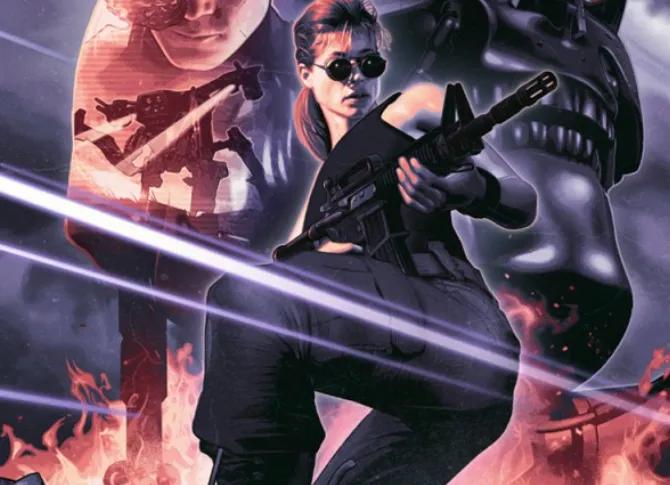
Terminator 2D: No Fate Review: A Careful Return To Judgment Day In Two Dimensions
 Games
Games Review
 Steam
SteamTerminator 2D: No Fate arrives as a deliberate throwback, built to recall a period when licensed games chased immediacy rather than longevity. Developed by Bitmap Bureau, the side-scrolling action title adapts Terminator 2: Judgment Day into a compact arcade structure that favors repetition, difficulty, and visual fidelity over modern service-driven expectations. Its design resists current trends, opting instead for short sessions, limited resources, and a narrow mechanical scope that mirrors 16-bit console releases of the early 1990s. The result is a game that treats constraint as a feature rather than a compromise.
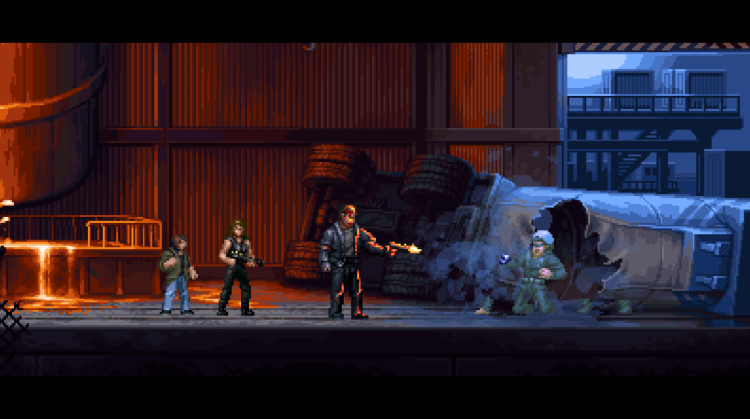
Our Terminator 2D pre-release coverage positioned the project as a direct response to nostalgia without irony. Terminator 2D: No Fate is set to launch on September 5 across PS5, PS4, Xbox Series X/S, Xbox One, Nintendo Switch, and PC, reworking James Cameron’s film into a pixel-art arcade format. Bitmap Bureau frames the game as a reinterpretation rather than a retelling, combining side-scrolling combat with multiple playable characters and film-accurate set pieces. Its presentation leans on hand-animated sprites, sharp silhouettes, and recognizable scenes designed for fast, repeatable play.
The critical context around the release is shaped in part by Luke Reilly’s review on IGN, which frames the game as a conscious rejection of contemporary design norms. Reilly positions Terminator 2D as an answer to decades of mechanical inflation, noting how its structure echoes an era when replay value came from mastery rather than content volume. His assessment emphasizes the game’s brevity and rigidity as intentional design decisions rather than limitations, grounding the review in historical comparison rather than modern expectation.
“Make no mistake, the team at Terminator 2D: No Fate developer Bitmap Bureau has seen this future, and they clearly don’t like it.”— Luke Reilly
The main story mode tracks the events of Terminator 2 with minor deviations, completing in roughly an hour for players who manage a clean run. Failure resets progress in a way that mirrors arcade cabinets and early console cartridges, where memorization and pattern recognition were central to advancement. Continues are capped at nine, and excess pickups convert into points rather than safety nets. The system enforces discipline, making each mistake costly and each successful run feel earned.
“This philosophy feels pretty heavily baked into Terminator 2D and, even though I no longer have the time, the patience, or the sugar-enhanced reflexes of a 12-year-old with no job, I do respect the format.”— Luke Reilly
Gameplay shifts regularly despite the short runtime. Levels alternate between run-and-gun combat inspired by Contra, close-quarters brawls, and slower sequences that rely on positioning and avoidance rather than firepower. One notable section set in Pescadero State Hospital replaces aggression with stealth, requiring players to evade the T-1000 while navigating scripted patrols. The tension in these segments relies less on mechanics and more on timing, audio cues, and music placement.
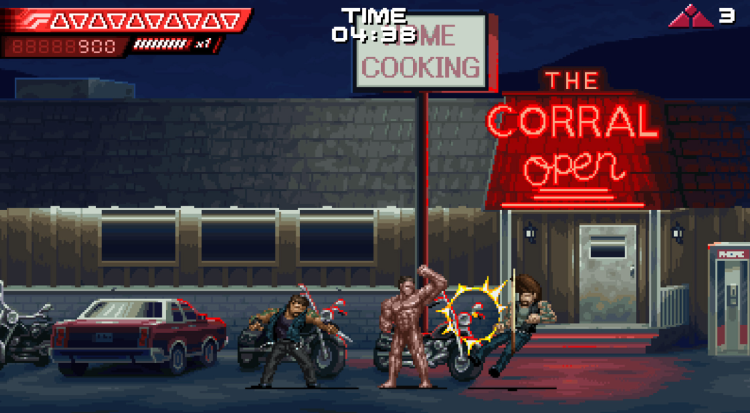
Audio design plays a central role throughout. Without voice acting, the game depends on its soundtrack to carry mood and pacing. Terminator 2’s original themes are rearranged into heavier, faster compositions that reinforce the arcade tempo. Specific moments, such as the biker bar sequence, integrate licensed music in ways that underline player actions rather than simply filling background space. The soundtrack operates as a structural element rather than a decorative one.
“Terminator 2D is as fabulous to look at as it is to listen to.”— Luke Reilly
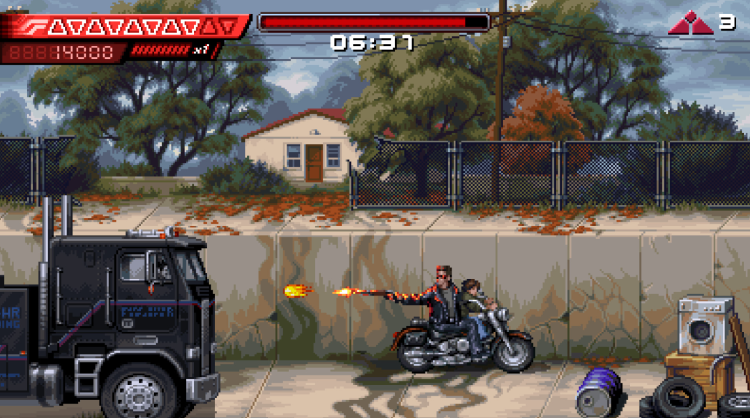
Visually, the game prioritizes animation clarity over sheer detail. Character sprites are expressive and fluid, emphasizing motion and impact. The T-800’s weight is communicated through slower movement and heavy hit reactions, while Sarah Connor’s animations focus on speed and evasive motion. Environmental details are economical but precise, using color and contrast to guide player attention without cluttering the screen.
Playable characters include the T-800, Sarah Connor, and a future-war version of John Connor, each built around distinct mechanics. The T-800 absorbs damage and delivers forceful melee attacks but moves slowly. Sarah trades durability for agility, relying on sliding attacks and a laser sight ability that increases damage at the cost of mobility. John Connor operates at mid to long range, using a plasma rifle and explosives to control space rather than rush forward. The differences encourage replay without altering the underlying structure.
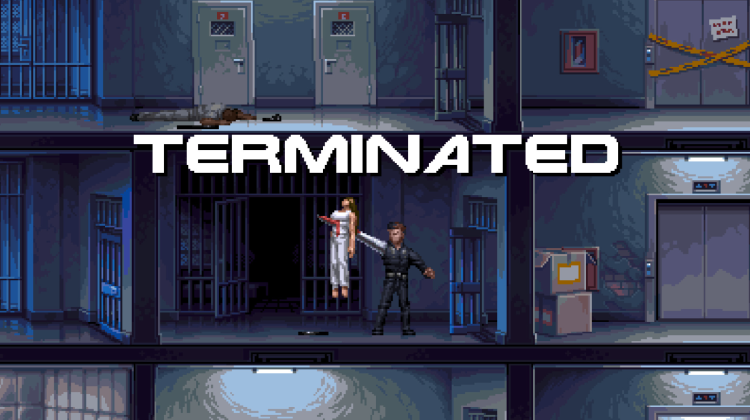
The T-1000 serves as the primary antagonist, appearing in both combat encounters and scripted sequences. Its liquid metal transformations are rendered through rapid sprite changes that convey instability and threat. In early playthroughs, these encounters create uncertainty, as the enemy’s behavior breaks from standard patterns. On repeat runs, their scripted nature becomes apparent, but the initial impact remains strong.
One of the game’s more debated choices is the limited time spent controlling the T-800. Outside of the biker bar and canal chase, the character is often sidelined in favor of Sarah or John. Iconic moments from the film, such as confrontations at Cyberdyne Systems or the steel foundry, are either abbreviated or observed rather than played. The absence of Arnold Schwarzenegger’s likeness may partially explain this restraint, though the game does not address it directly.
“I’m not sure whether or not the slight sidelining of the T-800 is related to the fact Arnold Schwarzenegger's likeness is not actually featured.”— Luke Reilly
After completing the main story, players unlock branching paths that lead to alternate endings. These routes introduce small variations to existing levels and grant access to bonus modes such as Boss Rush and a Sarah-focused scenario titled Mother of the Future. An Arcade Mode removes continues entirely, reinforcing the game’s commitment to difficulty. These additions extend playtime modestly but do not fundamentally change the experience.
Bitmap Bureau’s approach favors cohesion over expansion. The game does not attempt to modernize Terminator 2 through open systems or persistent progression. Instead, it treats the source material as a fixed framework, adapting it into a format that values precision and repetition. The design assumes players will fail, restart, and gradually improve rather than consume content once and move on.
Terminator 2D: No Fate stands as a focused adaptation that understands its limits. Its short length, rigid systems, and selective use of fan service reflect a studio intent on honoring a specific period in game design. While it leaves certain cinematic moments underexplored, it succeeds in translating the tone and rhythm of its source into an interactive form that feels consistent and deliberate. The game functions less as a comprehensive retelling and more as a playable artifact, built for players willing to meet it on its own terms.
Terminator 2D: NO FATE is available to play on PC through Steam.


 Successfully copied... Thank you for sharing our content!:

Comments