




Skate Story Review: A Descent Shaped By Momentum And Myth
 Review
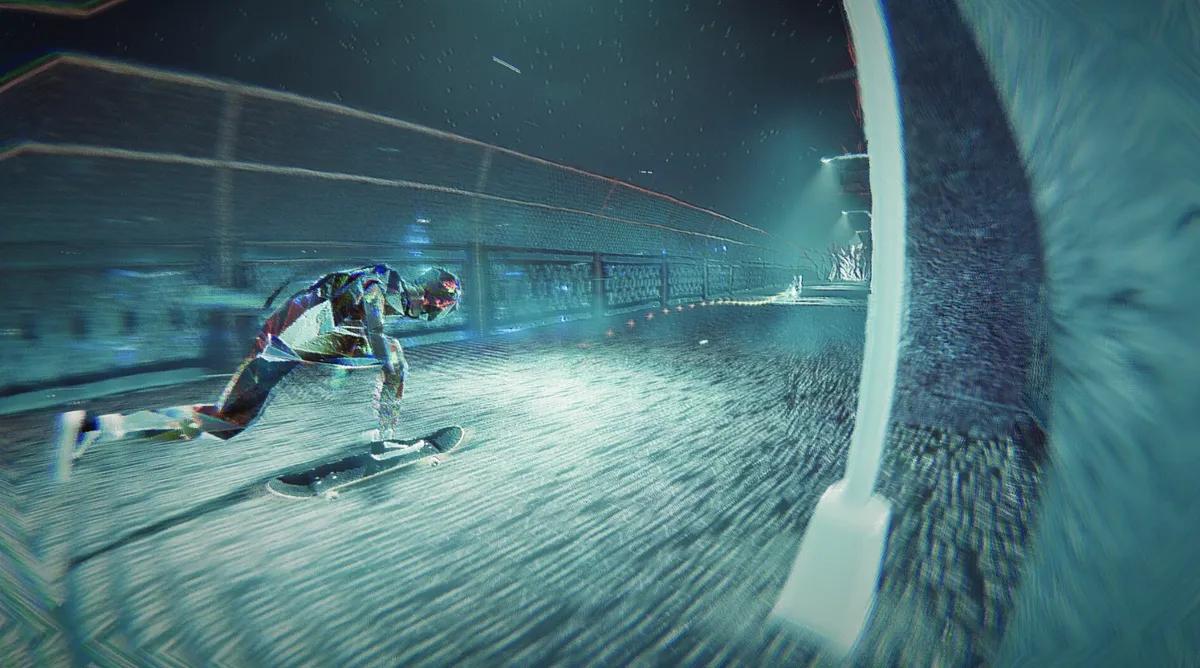
Here’s Skate Story review. The game is built on momentum, resistance, and the physicality of motion inside a world designed to fracture anyone passing through it. The descent through nine layers of Hell plays out as a sequence of controlled impacts and measured acceleration rather than a conventional action campaign. Its clarity comes from the friction between movement and environment, where every push of the board pulls another detail out of the underworld’s shifting surfaces.
This post draws on Lincoln Carpenter's review on PC Gamer, which examined the game’s structure and tone with close attention to its mechanical and visual decisions.
Skate Story opens with an image of fragility. The protagonist is a glass-bodied skater assembled from sharp angles and translucent surfaces. Their contract with the Devil, framed as a pact to eat the moon in exchange for their soul, shapes the entire route. The premise sets an immediate limit: everything depends on speed, timing, and the ability to avoid shattering under pressure. The game holds to that rule with no narrative diversion. The board becomes the only tool for progress, resistance, and expression, and the design channels every idea through it.
The skating model defines the experience more than the setting does. Tricks rely on primed inputs executed before leaving the ground, which shifts the rhythm away from frantic button execution and toward deliberate pacing. The system creates lines that feel tangible. Momentum has weight, turns demand commitment, and air time forces decisions rather than improvisation. The result is a mechanical loop that encourages focus instead of excess. Under constant threat of breaking the brittle skater, each jump or grind lands with a crunch of simulated force, amplified by the game’s camera shake and precise audio layer.
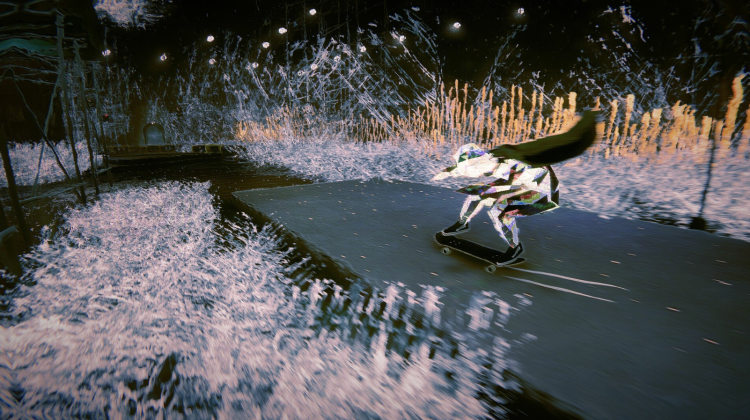
The visual design reinforces the tension. The underworld resembles a warped version of New York, with concrete blocks dissolving into iridescent textures and buildings rendered as melting photographs. The imagery leans into distortion without collapsing into abstraction. Familiar spaces—bodegas, laundromats, office lobbies—sit beside structures labeled with blunt concepts such as REGRETS or MEANINGS. The effect is geographical dissonance: a city assembled from memories, pressure, and emotional residue. It constructs a recognizable place where nothing adheres to the usual rules.
The narrative maintains the same unstable cadence. Its voice is poetic, arch, and occasionally incoherent. Lines shift between literal description and metaphor without signaling any transition, allowing words to behave like objects inside what the game calls “the Devil’s Geometry.” The writing often abandons grammar to capture a movement or impression rather than a formal idea. It fits the world’s tone, where meaning and absurdity share the same surface, even when certain passages strain the game’s balance between clarity and mood.
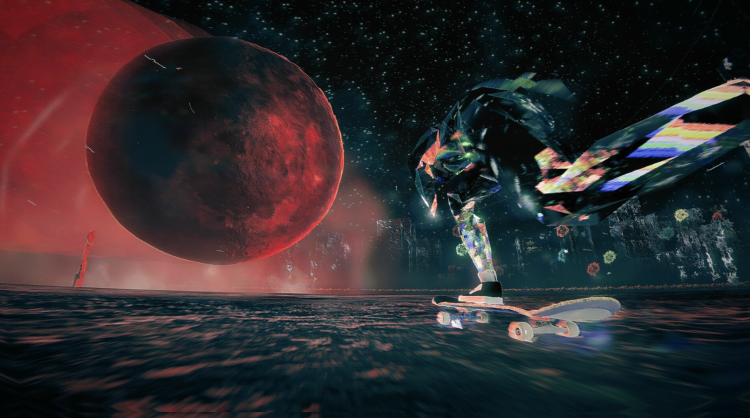
Combat exists as an extension of movement rather than a separate system. Enemies draw their damage from the player’s trick chains, which convert accumulated score into an attack. Boss encounters use this mechanic to stage elaborate sequences where lighting, effects, and music converge into bursts of color and motion. Time slows as tricks land, debris erupts from the ground, and the boardslide or heelflip becomes the central force that reshapes the arena. Battles unfold like kinetic performances. They run longer than necessary because the spectacle encourages players to stay in the moment rather than rush toward victory.
Score management strengthens or undermines that component depending on how quickly the system clicks for the player. Combos decay instead of resetting instantly, giving enough room to reposition or prepare another trick without losing the entire chain. Once that timing becomes intuitive, the game flows differently. Movements slow, lines straighten, and the player stops reacting out of panic. Momentum transforms into a controlled tool rather than an obstacle.
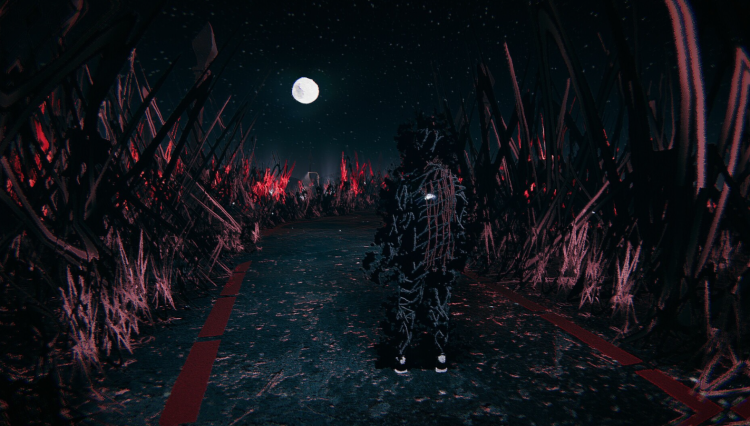
Sound defines the atmosphere as strongly as the visuals. Blood Cultures’ soundtrack injects harsh synthetic noise, subdued melodic stretches, and sudden crescendos that frame the underworld as a place pulsing with pressure. Lighting and particle effects synchronize with the score, producing synchronized flickers and flares as the music peaks. During boss fights, the coordination feels deliberate, as if the world moves according to the band’s tempo.
The setting blends menace with mundane detail. Hell’s torments follow recognizable patterns: hunger, exhaustion, bureaucratic obstruction, and the daily grind of work. The underworld positions these pains as endless rather than violent. A skater unable to find a place to sleep becomes an illustration of punishment through inconvenience. Structures such as the CAGE OF SORROW appear without drama, labeled with plain typography that underscores their institutional tone. The world seems engineered by an authority that sees torment as routine paperwork.
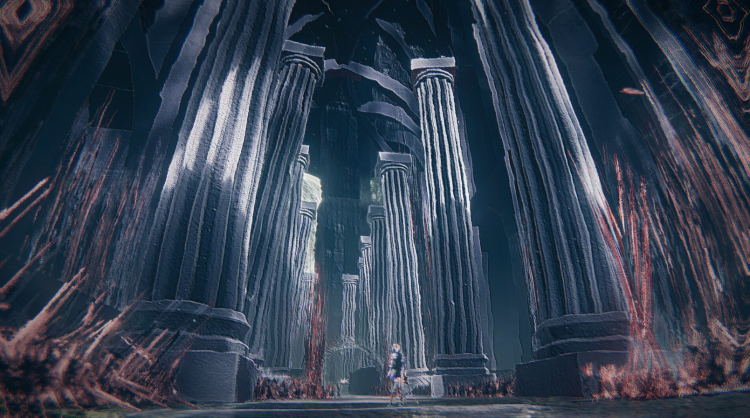
The contrast produces stretches of unexpected calm. Narrow streets, suspended roads, and fog-covered blocks serve as small contemplative zones where skating becomes a meditative loop. The game rewards experimentation by letting each area offer potential routes, lines, and improvisational runs. Its one major limitation is the inability to revisit earlier spaces without restarting, a structural choice that keeps the progression strict but limits exploration for players who want to return to favorite paths.
The design’s relationship to New York is central but unspoken. The imagery suggests a city reinterpreted through dread, nostalgia, and distortion. Names such as Godhook and Hellsea echo real places without matching them, hinting at a familiarity degraded through time or emotion. The environment’s hollowed blocks and oil-slick textures resemble moments observed through rain-streaked windows or remembered through fatigue. The game derives much of its mood from this sense of place filtered into myth.
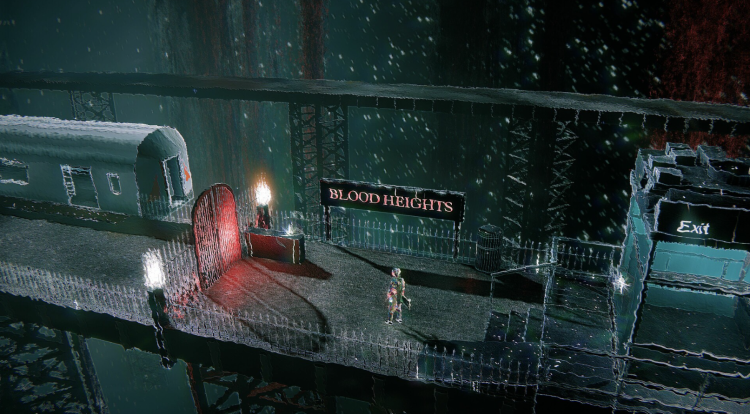
Enemy and boss designs use a similar logic. Demons appear as manifestations of emotional turbulence rather than mythic figures. Objects such as obelisks labeled with personal burdens stand beside amorphous enemies that erupt into clouds of color when struck by a high-scoring trick. The tone is more surreal than symbolic; encounters operate on sensation instead of lore.
Later chapters push the audiovisual direction further. Skating sequences accelerate to speeds that strain the game’s ability to communicate obstacles, which leads to occasional wipeouts at critical moments. These interruptions break the flow but do not undermine the larger structure. The closing sequence takes an abrupt leap in scale, heightening the spectacle until the game’s earlier environments feel miniature in comparison. The board becomes a force that bends the world around it, and the narrative closes on a thematic note rather than a plot revelation.
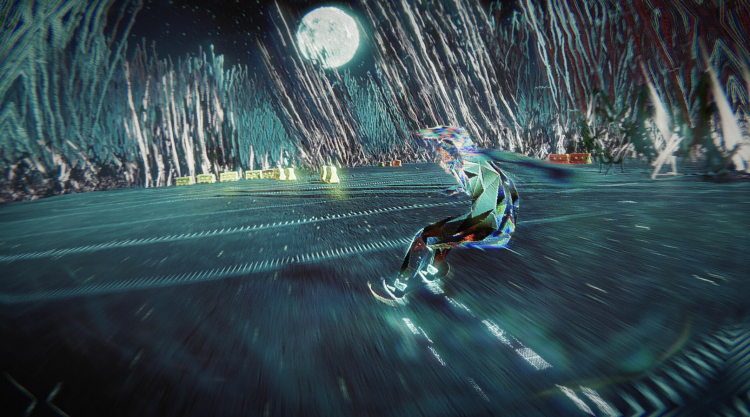
The message is conveyed through action rather than dialogue. The skater presses forward because movement offers the only form of resistance. The underworld’s rules insist on collapse, yet the game frames each successful landing as proof that progression remains possible. The motif repeats in mechanical and visual layers: break, reform, push again. It avoids sentimentality by relying on the physicality of the skating itself, which becomes the clearest expression of defiance.
Skate Story stands out for its cohesion. Every system funnels into the same point: the sensation of moving through a hostile place by treating motion as craft, discipline, and refusal. The world is hostile but comprehensible. The tricks are unforgiving but predictable. The narrative drifts between clarity and abstraction but never contradicts the underlying premise. The entire structure holds together through friction, weight, and the forward pull of the board.
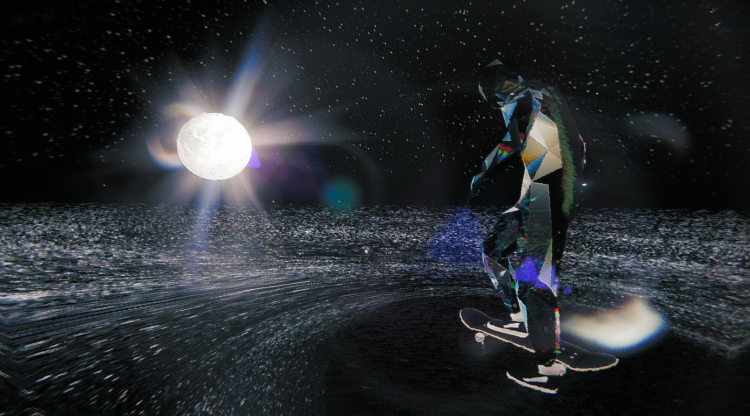
Its imperfections come from ambition. Tight corridors and sudden turns can feel mismatched with the game’s required speed. The world’s symbolic language occasionally overwhelms its practical design. Some stretches of narration slip into density for the sake of tone. Yet these issues register as brief collisions rather than structural failures. The larger experience remains intact.
Skate Story maintains a persistent tension between difficulty and serenity. Its tone rarely settles, shifting between menace, humor, and bleak calm without marking the edges. A frog appears in the closing acts with no narrative explanation, and it fits the world as naturally as any demon. Moments like this reflect the game’s internal logic: strangeness is constant but never random.
The final impression is determined by the balance between motion and the world resisting it. Skate Story constructs a hell that punishes through pressure, repetition, and decay, yet gives the player the means to carve temporary freedom through movement. The underworld acknowledges the defiance but continues to press in. The result is a game that treats skating as a kind of survival instinct.


 Successfully copied... Thank you for sharing our content!:

Comments