





Unbeatable Review Highlights A Game Caught Between Style And Structure
 Review
Unbeatable Review opens on a strong visual hook: a punk-styled rhythm adventure built around rebellion in a city where music has been outlawed. The premise promises a union of vivid art direction and musical action, but the final game falls short of that pitch. It pairs a narrow rhythm system with a narrative that struggles to link scenes in a coherent line, leaving its most confident elements tucked inside an optional arcade mode. The gap between the idea and its execution defines most of the experience.
This post draws on Gabriel Moss’ review on IGN, which identifies the tension between the concept of Unbeatable and the version that shipped.
Unbeatable frames its dystopia through a band led by Beat, whose voice and determination are meant to revive a sound the world has forgotten. Music is banned, remembered only as something dangerous enough to justify a dedicated police force armed to enforce silence. A narrative built around this setup could lean toward urgency, but Unbeatable rarely reaches that tone. It presents a long stretch of exploration punctuated by pockets of rhythm gameplay, though those pockets are so infrequent in the story mode that they barely shape the experience. The bulk of the playtime unfolds in quiet corridors, sparse outdoor zones, and static rooms where conversations drift without momentum.
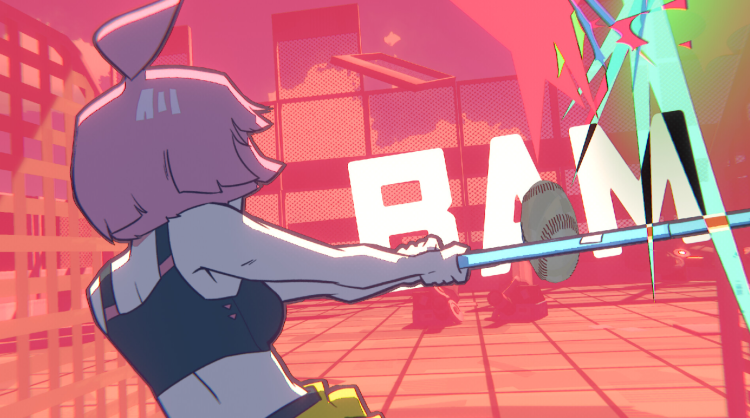
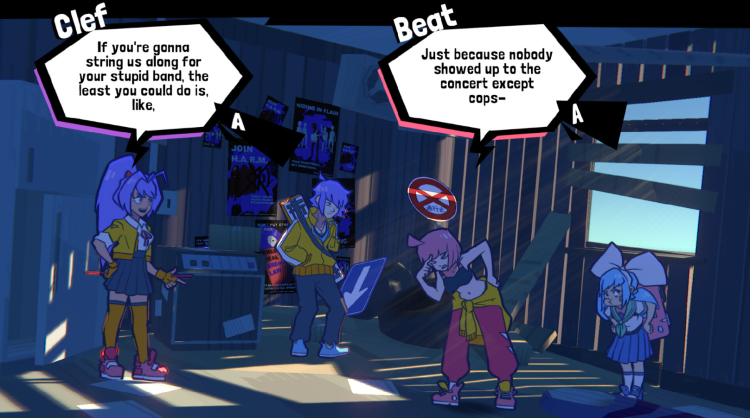
The story includes a wide cast of bandmates and opponents, but the dialogue they trade often undercuts the stakes. It moves between earnest monologues about art and rapid-fire, internet-style jokes. The shifts repeat across the campaign and create a sense of fragmentation. Characters toss out quips, argue about familiar band problems, or debate the logic of rebellion without pushing the story forward. Scenes arrive in abrupt cuts, skipping transitions that would show how moments connect. Players jump from a prison cell to a cafeteria, then to forced labor, then to an escape scene where headphones become makeshift skates. Each location introduces a visual idea, but the game does not demonstrate why events progress in that order or how the characters move between them.
The source cited several repeated cutscenes in the story mode, with entire conversations resurfacing unchanged. These glitches weaken the rhythm of the narrative and make the world feel assembled from mismatched scraps rather than intentional pieces. The flow never stabilizes long enough for the campaign to build tension. The late-game emotional payoff lands only after the credits, when its impact has few surrounding scenes to reinforce it.
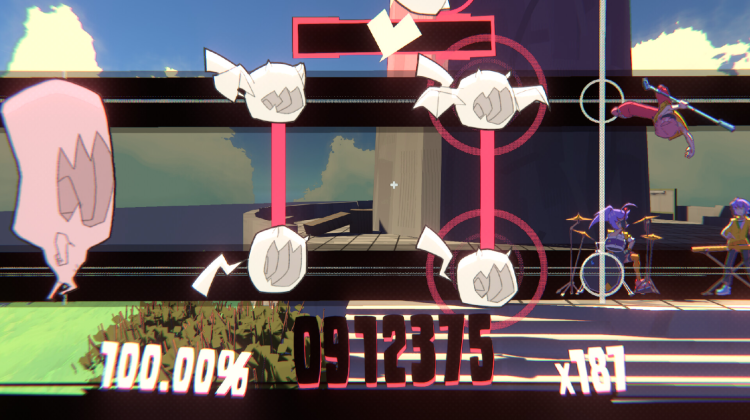
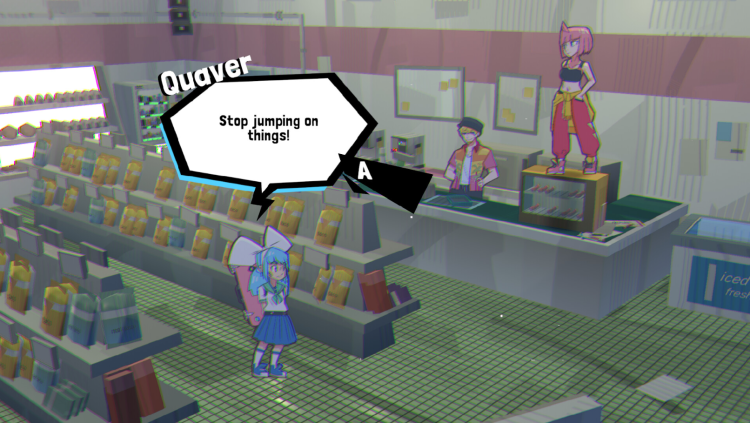
A recurring observation throughout the review is the limited presence of rhythm gameplay during the campaign. Players enter long stretches of minigames unrelated to the central mechanic. One sequence asks them to mix drinks in a bar to overly loud jazz cues. Another introduces a batting cage with little narrative relevance. Sewer work leads to a valve-closing task that resets each time the player’s bandmates undo their progress. These digressions stretch the runtime but do not expand the core design. Even when story-linked rhythm sections appear, they sometimes begin without context and end as abruptly as they started.
Unbeatable describes rebellion through saturated imagery and dense references to music, but the script does not clarify what resistance demands from its cast. Beat’s opposition, the police force called HARM, appears as a nominal threat without defined motives. The city’s laws forbidding music receive little explanation beyond their role as a setup for conflict. That loose framing allows the art direction to shape the world, but not the narrative. Locations resemble sketches in a notebook rather than parts of a connected place.
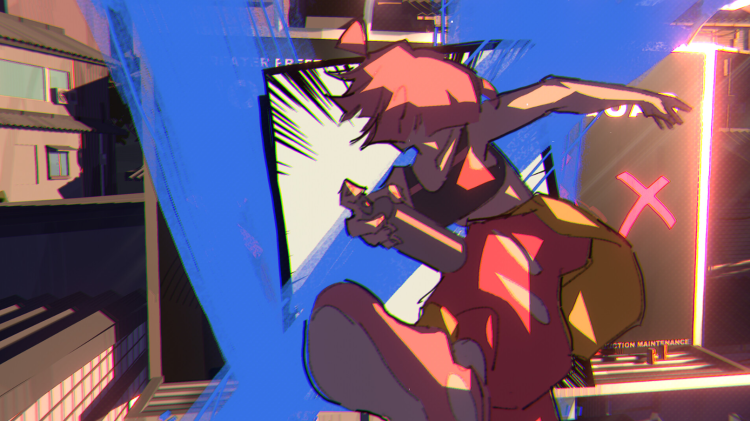
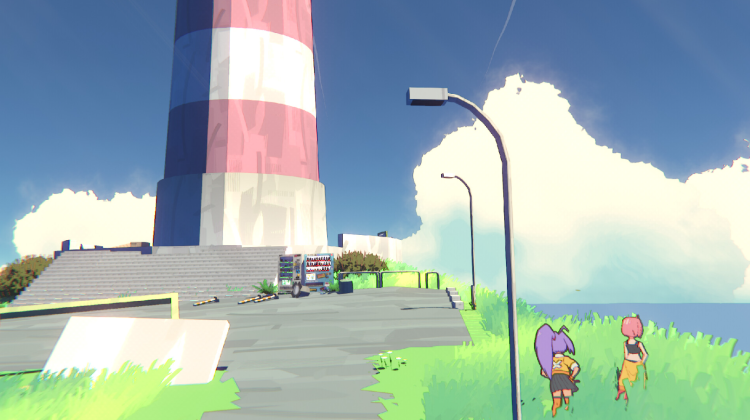
The visual identity, however, often lands. Layered 2D character art over stylized 3D environments gives the world a hybrid anime-punk look. Scenes bathed in warm afternoon light along a beach or a town street show how polished the aesthetic can be. The pause menu extends this style with scratchy vinyl textures and a record-scratch effect. These touches give the game a consistent look even when the story wanders. They also highlight the contrast between the team’s ambition and the uneven structure supporting it.
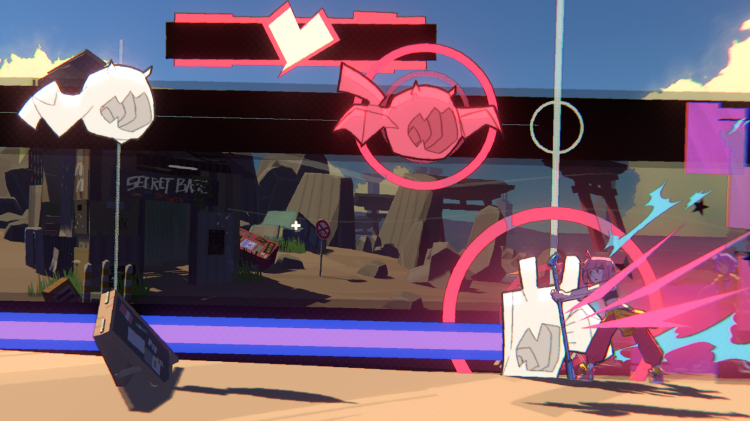
The rhythm mechanics rely on two inputs: one for ground targets, the other for aerial ones. Under that simple setup, players rebound between notes arranged to match each track. Timing works reliably, and the synchronization with high-refresh monitors performed well during testing, as noted in the review. The challenge curve changes only when the game increases speed and note density. Normal difficulty offers little resistance. Hard and Expert introduce heavy note floods combined with camera shakes and zooms. The difficulty leans on visual intensity rather than layered mechanics, which can turn dense sequences into noise instead of precise tests.
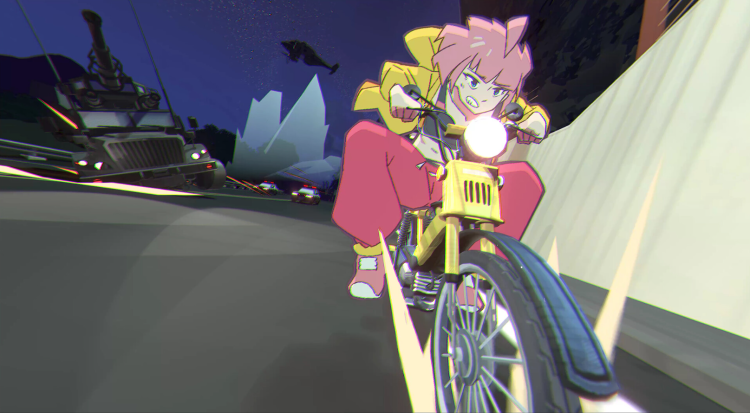
Camera movement complicates the story mode as well. Exploration is frequently disrupted by angles that obscure paths or hide doorways. The player may need to walk toward the edges of the screen that the camera has not yet adjusted to, which makes simple navigation a guessing game. Environments often feel unfinished, filled with wide spaces that offer little interaction.
The UX shifts between two extremes. Menus appear clean, with interface boxes that echo comic-book designs. Rhythm indicators in the main battle sequences read clearly. Yet some minigames replace those cues with unclear signals, as in the bomb-inspection task during the prison arc. Dialogue windows also misbehave, stacking or drifting off-screen as characters move. These issues mirror the story’s inconsistency: sharp ideas visible through structural flaws.
Despite these weaknesses, several sequences show the potential of the underlying concept. A late train fight stands out, placing Beat and her band on a moving car as they play through a track and fend off enemies. The rhythm aligns with motion and scene construction in a way the rest of the story seldom attempts. A few other highlights surface but disappear quickly, replaced by slower fetch quests or repeated scenes.
The review positions the arcade mode as the strongest part of Unbeatable. Removed from the story’s pacing, this mode collects tracks across several difficulty tiers and arranges them into a challenge board with unlockables and leaderboards. It focuses on rhythm play without interruption. Songs from artists such as Alex Moukala and Peak Divide add variety and drive. The arcade structure supports repeated attempts, making it a better fit for a rhythm game’s loop. A portion of the soundtrack is held behind day-one DLC, though the review notes that many strong tracks are available without extra purchase.
The contrast between the two modes reveals the game’s identity conflict. The story wants to foreground characters and rebellion across a stylized city, but the plain level layouts and inconsistent writing undercut those goals. The rhythm game at the center can be enjoyable, but the campaign keeps it at a distance. The arcade mode, by isolating the mechanics, demonstrates how much stronger the experience becomes when it drops the adventure framework.
One notable line from the review captures the friction between ambition and execution:
“The message it's trying to communicate takes itself too seriously to lean into its absurdity effectively.” — Gabriel Moss
This tension plays out across the entire project. Unbeatable leans hard on its punk aesthetic, but avoids committing to either satire or sincerity. It signals themes of expression, suppression, and camaraderie, but frequently shifts to exchanges that read more like late-night chat jokes than reflections on art under pressure. The world’s systems exist because the story needs them, not because they support its ideas.
The technical presentation reflects a similar gap. The PC test noted in the review reported accurate beat alignment at 1440p with a 180Hz G-Sync display, confirming that the underlying timing remains stable. The game includes a toggle to disable the VHS filter and to reduce camera motion, both of which help ease visual strain. These options signal an awareness of accessibility, though other elements—such as heavy camera motion during great difficulties—still create barriers.
As a complete package, Unbeatable shows a team capable of strong visual design and memorable musical production. Its soundtrack ranges from ambient tracks shaped for exploration to full band pieces that climax during major encounters. Some filler songs in the story mode resemble a loose parody of an indie rock stereotype, but others stand out, especially those performed by the in-game band. When paired with the rhythm gameplay, these pieces finally tie the world’s concept to its mechanics.
Yet the story mode’s extended quiet stretches overshadow these victories. Long walks across empty environments and repeated conversations dilute the intended emotional arc. The world of Unbeatable never settles into a stable rhythm of its own. It shifts scenes abruptly, pads the campaign with unrelated activities, and arrives at its strongest ideas too late to redefine the experience.
The verdict presented in the source reflects that balance of promise and shortfall. The game offers moments of honest feeling and a visual identity that can impress, but the design surrounding those strengths falters. The rhythm engine works, the music often succeeds, and the arcade mode delivers a concentrated version of what the game might have been if the team had leaned into those mechanics. The broader narrative feels unfocused, with pacing decisions and repeated scenes making the player’s path to the ending longer and less coherent than necessary.
Unbeatable Review ultimately depicts a project shaped by competing visions. It reaches toward a story about creativity under restriction, but frames it with scattered writing. It assembles a rhythm system that performs well but limits access to it during its main campaign. It presents a sharp style without environments detailed enough to complete the world it imagines. The game contains flashes of what drew audiences to its early demo, but stretches them thin across a production that never fully aligns its narrative and mechanical ambitions.
UNBEATABLE is available to play on PC (Steam).


 Successfully copied... Thank you for sharing our content!:

Comments