




Onimusha: Way of the Sword and the Woman Who Invented Kabuki
 Steam
Steam PlayStation
 Xbox
XboxTwo weeks out from launch, Wesley LeBlanc published the penultimate entry in a month of Onimusha: Way of the Sword coverage on Game Informer, and the subject is a historical figure rather than a boss or a mechanic.
Lead writer Hiroshi Yamashita told him he specifically wanted Izumo no Okuni in the game, and that Miyamoto Musashi's trip into the underground lab of the Genma Dokyo happens because of her. Yamashita stopped short of explaining why.
Okuni was born around 1578 and is credited with inventing Kabuki. She performed near where the Kamo River runs through Kyoto, and a bronze statue of her stands there now, looking out over the water. LeBlanc photographed it during his visit to Capcom's Osaka headquarters.
Yamashita has wanted to work her into a project for most of his career without it ever landing.
"So finally, after 20 years of working as a scenario writer or lead writer, being able to finally have her in this game is a dream come true for me."
— Hiroshi Yamashita
What drew him to her is a gap in how the Edo period gets remembered. The era is known for its stability, but that stability and the historical record that came with it mostly covered men, or women attached to important men as wives and siblings. Okuni had no such attachment. She started as nobody and ended up the founder of one of Japan's defining art forms, and Yamashita said he finds it impressive that she became a known figure and stayed one through turbulent times.
LeBlanc did not see Okuni in any of the footage or hands-on sections he played, so her actual role is still unknown. What he did play is the place her name leads to, and that section is the strangest thing Capcom has shown from this game.
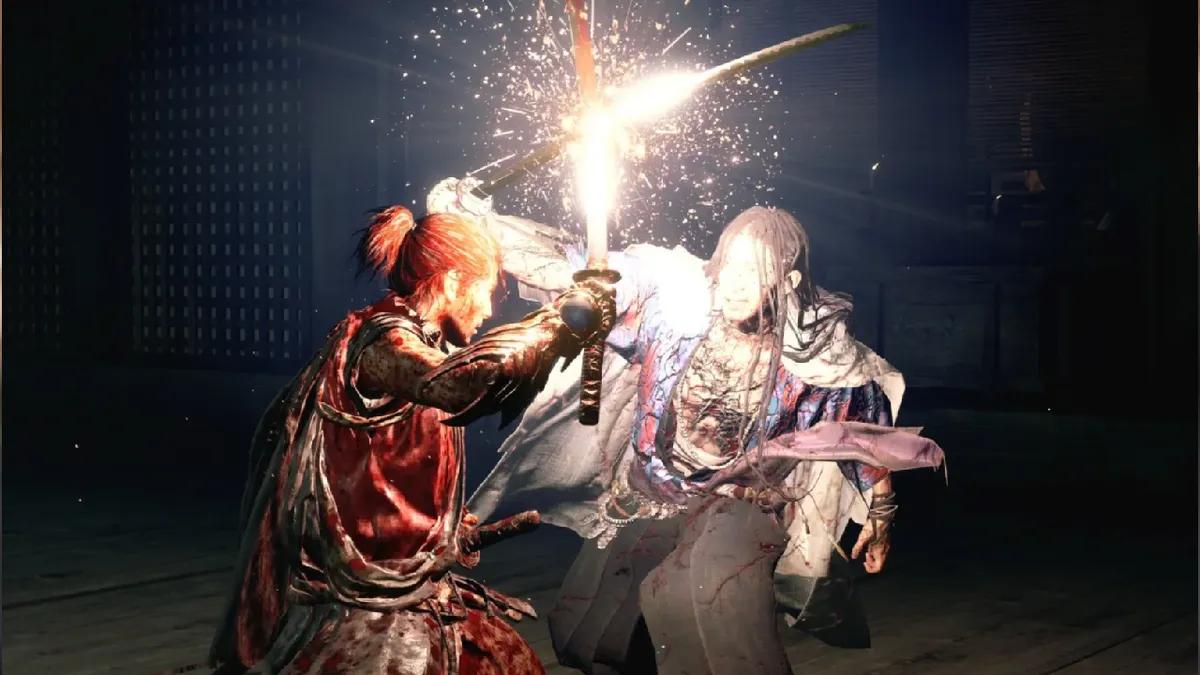
Dokyo kidnaps people, children included, and experiments on them, fusing them with animals to produce new Genma. In one scene she lifts a man fused with a large pig into the air and disposes of him. None of this can happen in the daylight of early Edo-period Kyoto, so the team built her an underground lab to match. Shadows on the shoji show body mutations and animal experiments that went wrong, blood catches torchlight in the halls, and kimonos hang from the rafters above, still belonging to the people screaming through the stage. Director Satoru Nihei calls it a "classic Japanese ghost house". LeBlanc says the jump scares got him more than once.
Capcom's position is that Way of the Sword is not a horror game. Yamashita told LeBlanc there was no intention of making one, and that the lab came out of building Dokyo herself, showing her twisted side and tying it to the eerie occult layer of Kyoto myth. Nihei frames the stage as a tool for tension rather than a genre shift, using it to push on what Musashi and Shizuka, the woman trapped in his Oni Gauntlet, are feeling at that point in the story. The rest of the game, both of them say, does not play like this.
The release itself has already moved once. Capcom confirmed for 2026 back in April without a date, settled on September 25, then in July shifted it earlier - to September 4, three weeks ahead. The publisher did not explain the change, though the original slot sat on the same day as Remedy's Resonant Control and Silent Hill: Townfall. Way of the Sword launches on PC, PlayStation 5, Xbox Series X/S and Nintendo Switch 2.
Capcom published console targets and requirements for the PC version in June, and the PC floor is low for a 2026 release: an i5-8400 or Ryzen 3 3100, 16GB of RAM, a GTX 1660 or RX 5500 XT, and 50GB on an SSD for 1080p30 on the low preset. PS5 and Xbox Series X run 4K at 60fps in performance mode or 30 to 40fps in quality, Series S drops to 1080p, and Switch 2 targets 30fps at 1080p docked and 1600x900 handheld. My laptop runs a GTX 1650, one tier under that minimum, so this is a PS5 game for me regardless of how well the demo was optimised.
Producer Akihito Kadowaki has said the earlier games are not required reading, since this is a separate world built so returning fans and newcomers start from the same point, with the older titles useful only for lore. The structure is a linear adventure broken up by separate open areas, closer to Resident Evil than to anything sprawling, and the combat runs on sword duels, parries, counterattacks and instant finishers, with soul absorption returning alongside new mechanics. That combination is exactly where I expect to struggle, because timing-gated parry duels are the same friction that pushed me out of Kingdom Come, and a linear route through good areas is something I respect more than I enjoy.
The Dokyo stage is also Capcom brushing against an audience Konami has just proven exists. Silent Hill f, a slow psychological horror set in 1960s rural Japan and built around a young woman's fears, cleared 2 million copies sold by April, and the game's reception ran through moments like the Silent Hill f actress streaming her own playthrough and reacting to monsters she performed. A samurai action game with a two-hour ghost house in the middle of it is not competing with that directly, but it is aiming at players who will recognise the shoji shadows and the hanging kimonos immediately.
Okuni is the part that makes me want to boot this up in September. A writer who spent two decades waiting to use a historical figure tends to build something specific around her rather than a cameo, and the fact that she is the reason Musashi walks into the worst place in the game suggests she carries more than a name-check. Whether that survives contact with the parry timing is the open question, and I would put Way of the Sword closer to interesting-and-worth-covering than to something I finish twice.


 Successfully copied... Thank you for sharing our content!:



5% deposit bonus up to 100 gems

a free Gift Case





EGAMERSW - get 11% Deposit Bonus + Bonus Wheel free spin


EXTRA 10% DEPOSIT BONUS + free 2 spins

3 Free Cases + 100% up to 100 Coins on First Deposit


5 Free Cases, Daily FREE & Welcome Bonuses up to 35%

3 free cases and a 5% bonus added to all cash deposits.

+5% to deposit




Comments