




Sol Cesto Review
 Steam
Steam Review
Sol Cesto left early access on April 10, 2026, after selling over 70,000 copies and accumulating nearly 170,000 wishlists during its eleven months in development. Built by a two-person team — programmer Géraud Zucchini and comic book artist Chariospirale — and published by France-based Goblinz Publishing, the game strips the dungeon crawler to its mathematical bones. Players descend underground to find a lost sun, navigating a 4x4 combat grid where every action resolves as a visible probability. The full 1.0 release adds a new final boss, a hidden area, unique endings for all seven characters, reworked progression, and a complete interface overhaul.
A Dungeon Crawler Reduced to Percentages
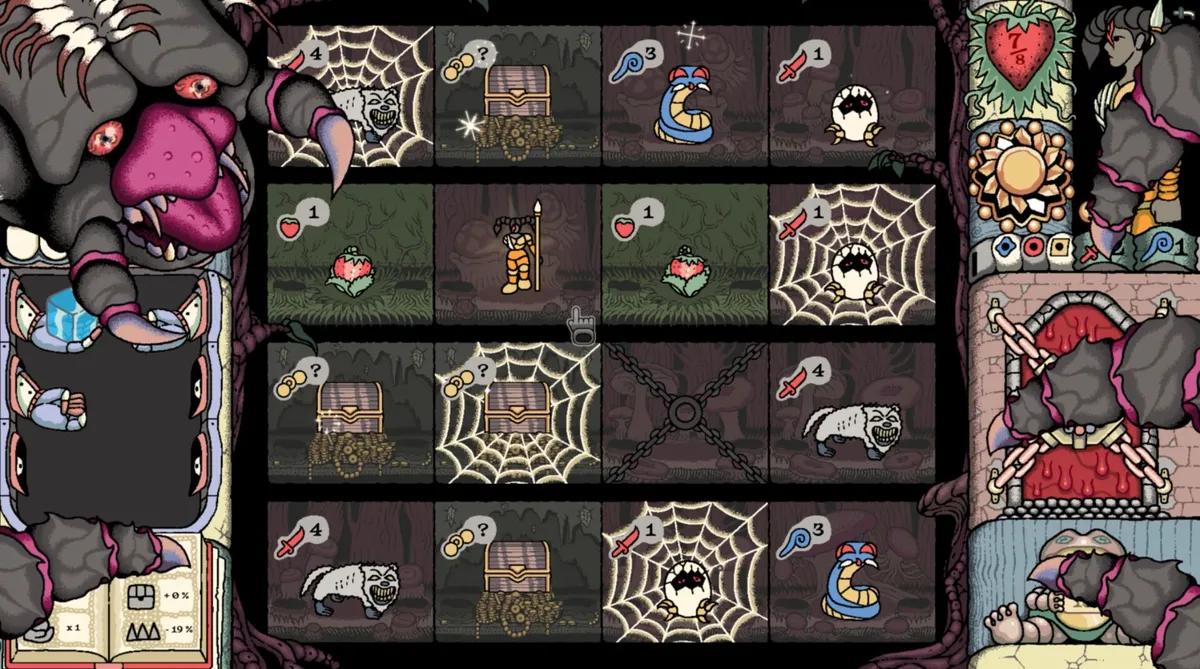
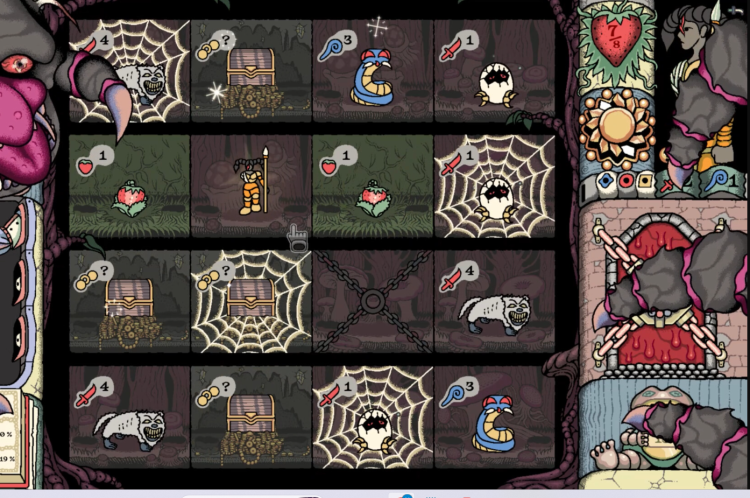
Sol Cesto presents each dungeon floor as a grid of four rows and four columns. Each cell contains a monster, trap, treasure chest, or healing strawberry. Players clear a required number of cells to unlock the exit and advance deeper. The twist sits in the input: clicking a row sends the character to one of its four cells at random, each with a base 25% chance. There is no direct selection, no cursor placement, no aiming. The game tells the player exactly what the odds are before each click.
As cells get cleared, the remaining odds on that row shift upward. A row with three cells cleared leaves only one option at 100%. This forces players to move between rows, reading the grid state and weighing which gambles to take first. A row with two enemies and two chests presents a clean 50/50 split. The question is never what might happen — the game shows that plainly — but whether the risk justifies the reward.
Push-Your-Luck as Core Design
Every floor in Sol Cesto demands a minimum number of cleared cells before the exit opens. After hitting that threshold, players can leave or keep clicking for more loot. A 75% chance at gold sounds safe. But one unlucky click on that remaining 25% can undo a careful run. The game converts the abstract risk-reward logic that drives most action games into raw arithmetic, then forces players to act on it.
Healing strawberries complicate these calculations further. A row with a strawberry in it represents recovery potential, but spending a click there means not spending it elsewhere. Sequencing matters: a player might clear a dangerous row of enemies first, absorb some damage, and then return to the strawberry row when healing becomes necessary. Traps add another variable, punishing reckless clicking with status effects or direct damage. The exit is always available once the threshold is reached, and knowing when to stop is often the difference between a successful run and a wasted one. Greedy players who stay for extra treasure after the exit opens can lose entire runs to a single bad roll. The game does not punish gambling through narrative or cutscene — it punishes through arithmetic, and arithmetic does not negotiate.
Teeth, Stats, and the Art of Loading the Dice
Buildcrafting in Sol Cesto revolves around teeth — passive upgrades collected from statues during a run. The game distinguishes between stone teeth, which alter probabilities, and metal teeth, which unleash powerful curses. Each stone tooth shifts the base odds in a specific direction. One might raise the chance of landing on a chest while lowering the chance of landing on a strawberry. Another could increase the likelihood of encountering a magic-type enemy while decreasing physical attackers. None of them grant flashy abilities or new attacks. They move numbers.
Characters have separate resistance values for physical and magical damage, and these can be adjusted mid-run. A focused build might stack teeth that increase magic enemy encounters while raising magic defense, effectively turning dangerous cells into harmless ones. The base 25% odds on a four-cell row can skew to something like 20/80 with enough teeth stacked in one direction. I think this system is the game's defining achievement — it transforms what looks like pure chance into something that rewards deliberate, incremental optimization across every floor. Items like bombs, protective bubbles, and stun hammers provide additional safety nets, letting players neutralize a bad outcome before it happens.
Seven Characters, Seven Strategies
Sol Cesto launched its 1.0 version with seven playable characters, each carrying a unique special ability that recharges after clearing a set number of cells. The Wizard marks two cells and clears both when landing on one of them. The Knight selects a vertical column instead of a horizontal row, cutting across the grid's normal axis. These abilities create distinct strategic frameworks. The Wizard rewards careful cell selection and doubles clearing efficiency. The Knight opens diagonal planning that other characters cannot access.
The Peasant, the starting character, received a dedicated progression branch in the 1.0 update to make the class more viable for extended play. Characters unlock through challenges rather than simple currency spending, tying roster expansion to specific in-game accomplishments. The Huntress arrived as a crossover character from Pyrene, another game in the same publishing orbit. Each character now has a unique ending, giving repeat playthroughs a narrative payoff that early access lacked. Certain enemy types add further variety to how each character plays: gremlin-like monsters alternate between magic and melee attacks between turns, forcing players to track damage type rotations alongside their probability calculations. A character built for magic defense handles these enemies differently than one built for physical resistance, and the grid state shifts accordingly.
Hand-Drawn Monsters on a Pulsing Grid
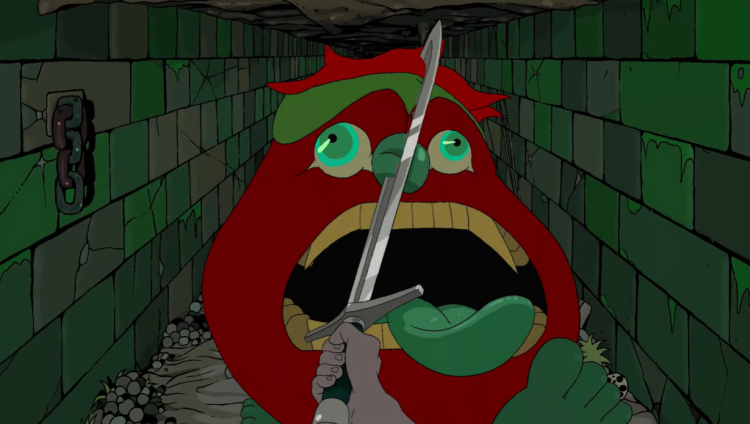
Chariospirale, a comic book author by trade, drew every visual element in Sol Cesto by hand. The art style evokes ancient illustration — figures that look pulled from tapestries or carved into stone walls. Enemies wobble with minimal animation, giving the screen a gentle, rhythmic pulse rather than fluid motion. Simple monsters like slimeballs reference foundational RPG design. Boss creatures go further: twisted fangs, bulging eyes, lumpy anatomy rendered in dense, expressive linework. The comparison to pre-Columbian Mesoamerican art has been raised, and the abstracted shapes of the character designs support it.
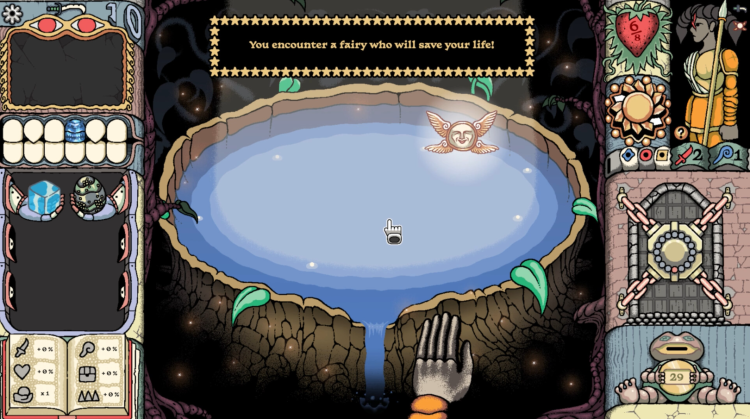
The interface matches the art in clarity. Tile information displays probability percentages, damage predictions, and outcome labels directly on the grid. Stats sit in the corners of the screen. Teeth appear as icons on a statue in the top left. Inventory items line up visibly. Every piece of data a player needs to make a decision is on screen at all times, without requiring menus or tooltips. The 1.0 update overhauled this interface further, refining layouts and adding new visual elements for each character.
What 1.0 Adds to the Descent
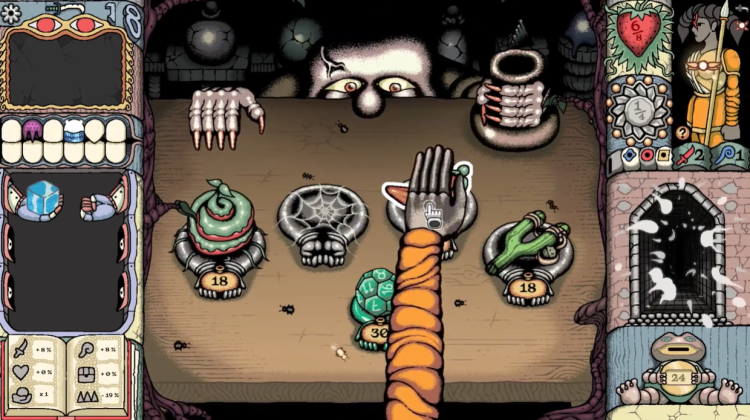
The version 1.0 release restructured progression across the board. A new final boss caps the main descent. A hidden mini-area sits deeper in the dungeon for players who push past the expected endpoint. Meta-progression now uses a challenge-based unlock system for items and characters, replacing simpler gates. Shops, statue interactions, and the denture upgrade system all received adjustments. New item synergies open additional strategic possibilities that did not exist during early access, and the five distinct biomes each carry their own hazards and enemy pools.
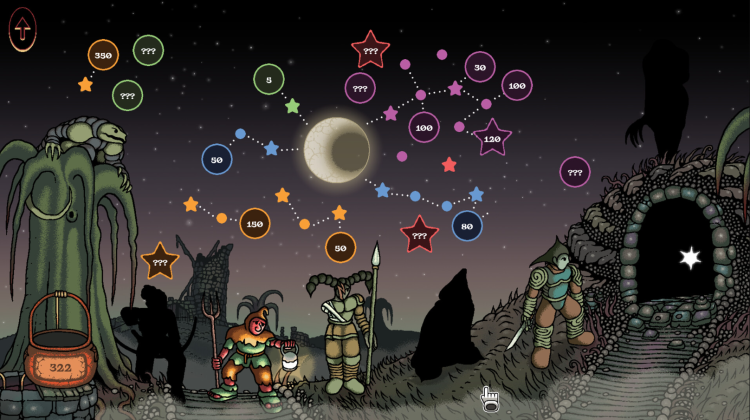
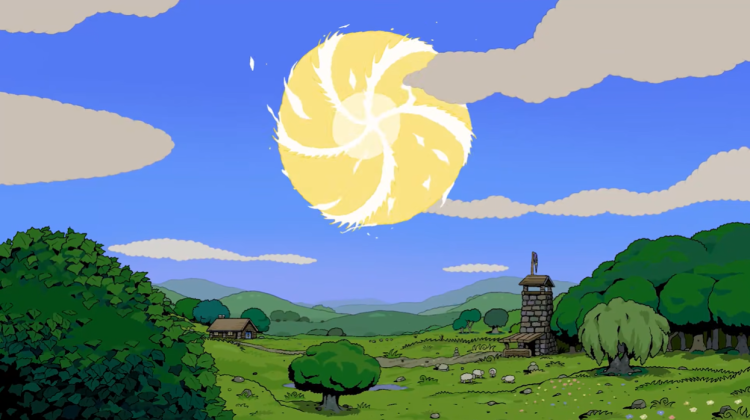
An extraction-style mechanic lets players send gold to the surface at regular intervals during a run. Banked gold funds permanent upgrades between runs, including new in-run features and character unlocks. Spending gold this way reduces the amount available for in-run shops, creating another layer of risk calculation. Steam achievements shipped with the update. A new introductory cinematic sets the tone for the sunless world. I find that run times stay short enough to encourage repeated attempts — each grid clears quickly, and event rooms between floors resolve in seconds, which keeps the loop from dragging even across dozens of runs. The game launched at $13.99 with a limited-time 33% discount.
Sol Cesto earned finalist status at the Pégases 2026 Awards in two categories: Best Indie Game and Best Game Design. Géraud Zucchini previously won an IGF award for his first game, Un Pas Fragile, which took Best Student Game in 2017. Musician Antoine Druaux, who has collaborated with Zucchini for over a decade, composed the score.
Verdict
Sol Cesto takes a genre built on hidden math and makes every number visible, then builds an entire game around the tension of acting on what those numbers mean. Sol Cesto is a 10/10 game.
Score: 10/10
Pros
- Probability-based grid system creates genuine strategic depth from simple inputs
- Tooth buildcrafting turns luck management into a rewarding optimization loop
- Hand-drawn art by Chariospirale gives every screen a distinct, memorable identity
- Seven characters with unique abilities and endings provide strong replay variety
Cons:
- Heavy RNG foundation will frustrate players who dislike variance-driven outcomes
Sol Cesto dissects the dungeon crawler into its most fundamental parts and rebuilds the genre as pure, visible probability. The 1.0 release delivers a complete package with seven characters, reworked progression, a new final boss, and an art style that stands apart from anything else in the roguelite space. It launched on Steam for PC on April 10, 2026.


 Successfully copied... Thank you for sharing our content!:



5% deposit bonus up to 100 gems

a free Gift Case





EGAMERSW - get 11% Deposit Bonus + Bonus Wheel free spin


EXTRA 10% DEPOSIT BONUS + free 2 spins

3 Free Cases + 100% up to 100 Coins on First Deposit


5 Free Cases, Daily FREE & Welcome Bonuses up to 35%

3 free cases and a 5% bonus added to all cash deposits.

+5% to deposit




Comments