



League of Legends Patch 26.8: What the New Meta Changes Mean for Players and Streaming
 Patches
 META
METAWhen a popular competitive video game is as dominant and widespread as League of Legends (LoL), every single update is more than enough cause for internet buzz. With the newest patch coming our way, the biggest MOBA and eSports title ever is once again the talk of the town. How much will the new update change the meta? Which heroes are getting buffs or nerfs, and what does it all mean for players and streaming? Whenever a big patch like this is announced, the game tends to feel fresh and new with different hero dynamics, trends, and playstyles that can disrupt the scene in the best way possible.
Whether you are a frequent player who competes in ranked or a casual who enjoys the genre and plays for fun, you have to know what changes are in store. Moreover, those who love to watch League of Legends live streams will particularly enjoy the next period of LoL meta, as every new update brings a new influx of streamers looking to play the new meta and compete once again at the highest level. Your favorite content creator is sure to get back in it as they test out patch 26.8 starting today, April 15. Let us dive into it and discuss the details.
Patch 26.8 Champion Changes

Although League of Legends Patch 26.8 is relatively small compared to some of the other updates, it is a meaningful change focused on fine tuning the current meta, improving quality of life systems, and preparing the game for upcoming competitive milestones. Rather than introducing sweeping gameplay overhauls, this patch emphasizes targeted balance adjustments to stabilize popular champion performance and ensure a healthier environment as the first ranked split of the season comes to a close. Riot Games explicitly framed this update as one that trims dominant picks while lifting weaker ones, a change that keeps gameplay consistent while still evolving the so called meta.
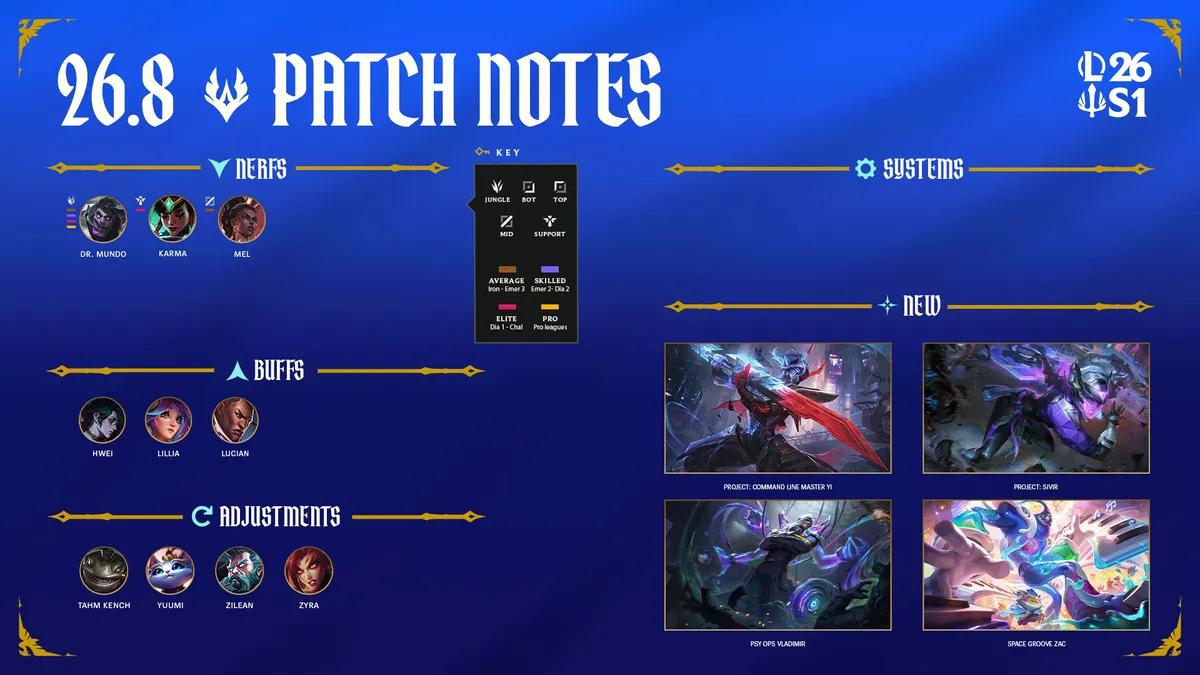
Therefore, it could be said that the major focus of Patch 26.8 is champion balance. Several strong meta champions received nerfs, including Dr. Mundo, Mel, and Karma, all of whom had been performing too reliably across multiple skill brackets and roles. These nerfs are intended to reduce their overall durability, damage output, or utility, making them less oppressive in both solo queue and coordinated play. At the same time, Riot buffed a handful of underperforming champions such as Lucian, Hwei, and Lillia. They gave them improved scaling or effectiveness so they can better compete in the current meta against the preferred picks. These push and pull adjustments show ongoing effort to keep the champion pool diverse and prevent stagnation, a thing that can kill any game if left unchecked.
The patch also introduces subtle gameplay and usability improvements, like the early game frustration as it prevents certain champions (Zyra and Zilean) from selecting ineffective or “trap” abilities at level one, smoothing out their early gameplay experience. Champion specific keybind customization is a highly requested feature that allows players to tailor controls for each champion individually. This system overhaul also includes broader input and accessibility improvements, such as more flexible control schemes and expanded options for alternative inputs, making the game more adaptable to different playstyles and player needs.
Game Modes and Ranked Calendar

Patch 26.8 also brings updates to alternative game modes and overall content. Changes to ARAM, Arena, and ARAM: Mayhem aim to keep these modes fresh and engaging, though they are generally less impactful than Summoner’s Rift adjustments. On the cosmetic side, the patch introduces several new skins, including themed releases like PROJECT and Space Groove lines, continuing Riot’s regular cadence of visual content updates. These additions help maintain player engagement even during smaller gameplay patches.
Another important aspect of this patch is its connection to the ranked calendar. Patch 26.8 marks the end of Ranked Season 1, with the split concluding near the end of April and the next season beginning immediately afterward. This timing explains why the patch avoids drastic balance swings, as stability is crucial for competitive integrity during the closing stretch of a ranked season, as well as the competitive, tournament scene, and the eSports side of the game.
Best Places and Streamers to Watch LoL Live
For a lot of the fans, live streaming has become the ultimate way to experience the game beyond just playing it. Platforms that offer real time interaction, high energy gameplay, and strong community engagement stand out. As more and more fans keep tuning in, streaming has become their number one way to get familiarized with new changes and to experience patches before they play them.
Kick has rapidly positioned itself as one of the best destinations for watching LoL content live. With a growing roster of creators and a focus on entertainment first streaming, the green platform delivers a dynamic viewing experience where chat interaction, community rewards, and long form streams create a more immersive environment compared to traditional platforms and competitors.
One of the standout League of Legends categories players to follow is BaianoTV on Kick. A former professional player and one of the first Brazilians to compete internationally, Baiano brings both high level knowledge and personality driven content to his streams. His broadcasts often revolve around Brazilian competitive scenes like CBLOL, co streaming matches, or hosting community events such as “Ilha das Lendas,” which focuses on entertainment and fan interaction. With over 213,000 followers and peak viewership reaching tens of thousands, his channel demonstrates the strong demand for LoL content on Kick.
BaianoTV’s playstyle and content approach are less about pure ranked grinding and more about analysis, humor, and community engagement. He combines commentary, reactions, and casual gameplay, making his streams accessible to both hardcore and casual viewers. His schedule typically aligns with major League events, often streaming for several hours at a time and even running retransmissions for global audiences. Unique features like his “Baicoins” reward system earned through watching and interacting further gamify the viewing experience and keep audiences engaged over long sessions. This combination of expertise and entertainment makes his channel a must watch for fans looking for more than just gameplay.
Other emerging Kick streamers, such as baulo, have a different approach. He often focuses on high energy gameplay, ranked climbing, and direct interaction with viewers for a more grassroots and personal vibe. Their streams emphasize consistency and relatability, offering viewers a chance to connect with streamers in a less saturated environment. This diversity of content, from professional analysis to casual grinding, helps Kick build a well rounded League of Legends ecosystem that players and fans of all types can tune into and enjoy in different ways.
Compared to Twitch and YouTube, the platform’s two biggest competitors, Kick’s LoL scene feels more creator friendly and relaxed. Streamers often benefit from more favorable revenue splits and fewer restrictions, encouraging longer, less structured broadcasts. This results in a more laid back and fun atmosphere where creators experiment freely and engage deeply with their communities.
While Twitch and YouTube still dominate in scale, Kick’s growing LoL category offers a refreshing alternative, one that prioritizes interaction, rewards creativity, and gives both established and up and coming streamers room to thrive. The LoL scene is a microcosm of the dynamics between the three streaming services, where green has a lot of advantages over the red and purple ones, both for the streamer and their followers.
Upcoming Tournament Events
The League of Legends Esports Season 2026 is structured around three regional splits feeding into international events. After Split 1, which ran from January to March, and Split 2, scheduled from April to June, teams qualify for the Mid Season Invitational 2026 from June 28 to July 12, in Daejeon. That is followed by Split 3, leading into the League of Legends World Championship 2026 in October and November across the USA. Regional leagues, like the LPL and LCP, run three splits, with MSI acting as the mid year international benchmark and Worlds as the final event featuring 19 teams and systems like Fearless Draft. The first major post Split 2 global competition is the MSI 2026, and will be the earliest event significantly shaped by Patch 26.8.
Patch 26.8 lands right before the latter half of Split 2 playoffs, meaning MSI qualification and the tournament itself will reflect its meta and be heavily impacted by it, as Key buffs to Lillia, Lucian, and Hwei, jungle nerfs hit picks like Dr. Mundo, and bot lane staples like Karma are toned down. This shifts priority toward faster tempo junglers and scaling bot lanes. For example, LPL teams such as Bilibili Gaming, already known for aggressive jungle pathing, are likely to favor Lillia for tempo and teamfight setups, while LCK teams like T1 could re enable Lucian-Nami or Lucian mage pairings to pressure early drakes.
Tactically, fans can expect MSI to emphasize tempo stacking and flexible drafting. Lillia enables fast clears into objective control, an approach that synergizes well with mid picks of Hwei for zone control and poke. Bot lanes may shift from pure enchanter scaling to hybrid lanes, for example, Lucian with situational support, that spike earlier. With Karma weakened, teams lose a universal blind pick, increasing draft volatility, especially under systems like Fearless Draft later at Worlds.
What all of this means is more target bans against comfort junglers, earlier dragon stacking, and skirmish heavy mid games. The new meta will be as tactical as all of the other ones before it, albeit in a different manner. It should be very interesting and different enough to change the scene a bit, as certain teams could go up or down the rankings due to these seemingly small shifts in champion power. Overall, Patch 26.8 does not overhaul the meta but sharpens execution. The best teams at MSI will be those that optimize tempo and draft flexibility rather than rely on stale, scaling heavy compositions.
League of Legends Biggest Changes FAQs
What was the biggest gameplay overhaul in LoL history?
The largest overhaul came with the Season 5 (2015) Juggernaut update and later the Season 11 item rework (2021). The item rework completely redesigned how players build champions, introducing Mythic items that fundamentally changed gameplay strategy.
What are Mythic items? Why were they controversial?
Mythic items were powerful items that defined a champion’s build path. Players could only own one, forcing strategic decisions. They were controversial because they reduced build flexibility and made certain champions overly dependent on specific items.
Which patch had the biggest impact on junglers?
Patch 4.20 (nicknamed the “Weedwick” patch) dramatically changed jungle camps, added Smite upgrades, and reshaped jungle pathing. It made the role more strategic and less punishing for beginners.
What was the rune system overhaul?
In 2017, League of Legends replaced the old rune and mastery systems with Runes Reforged, which simplified customization while adding powerful keystone effects like Electrocute and Conqueror.
Why was Patch 8.11 controversial?
Patch 8.11 drastically changed marksman (ADC) items and stats, which in turn made traditional bot lane carries much weaker. Many players were upset because it disrupted the core team composition meta that had existed for years.
What was the biggest map change?
The biggest map update came in 2014 with the Summoner’s Rift visual and gameplay update, improving clarity and adding new environmental details. Later, Elemental Dragons (2016) introduced dynamic terrain changes depending on dragon type.
What are elemental dragons?
Elemental dragons grant different buffs (Infernal, Mountain, Ocean, Cloud) and can alter terrain. This added macro strategy and forced teams to prioritize objectives and adapt to changing map conditions.
Which update introduced role selection?
Riot introduced Dynamic Queue and role selection in 2016. It allowed players to choose preferred roles before matchmaking. This significantly improved team composition consistency.
What was the durability update?
In 2022, Riot released the Durability Update that increased champion health, armor, and magic resist across the board. This slowed down gameplay and reduced burst damage, making fights longer and more strategic.
What is the biggest ongoing change in LoL today?
One of the biggest ongoing shifts is Riot’s focus on seasonal updates and mid season patches with frequent balance tweaks, new champions, and evolving systems like items and objectives to keep the game fresh and competitive.


 Successfully copied... Thank you for sharing our content!:

Comments