




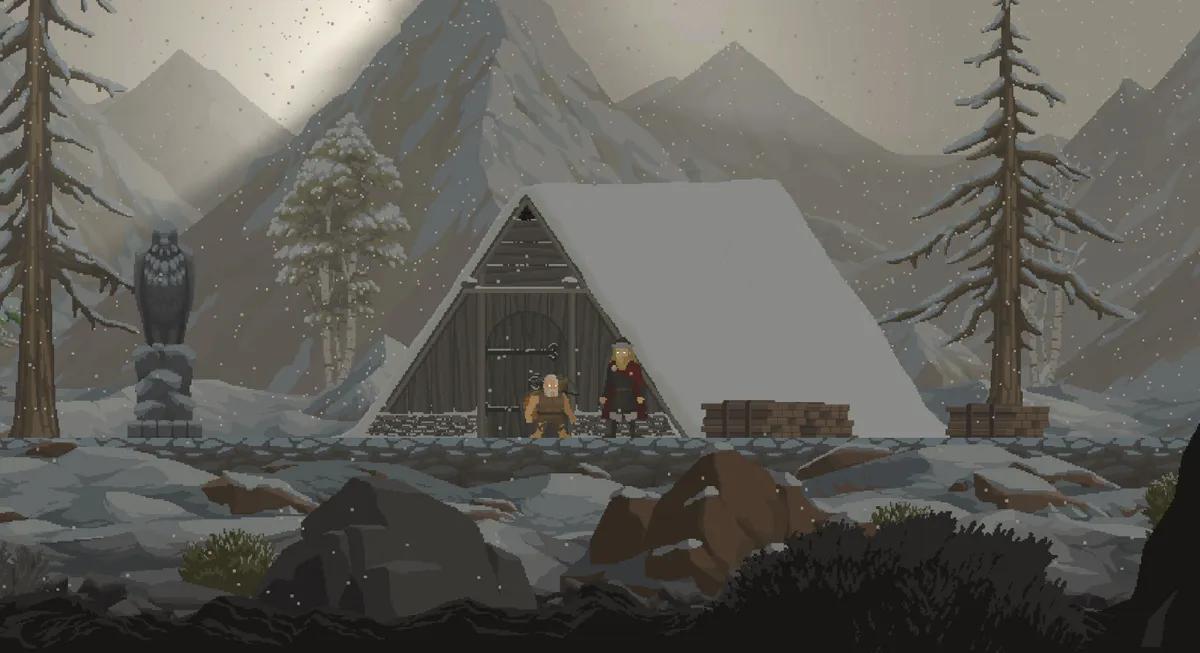
Regions of Ruin: Runegate Review — Portal-Hopping Dwarves
 Steam
Steam Review
 PlayStation
Gameclaw Studio's original Regions of Ruin launched eight years ago as a 2D side-scroller about a dwarf fighting goblins and rebuilding a homeland. The sequel, Regions of Ruin: Runegate, follows the same premise with a wider scope: a network of magical portals, two full regions to explore, a crumbling keep to restore, and a skill tree deep enough to support multiple combat builds. Published by Raw Fury and released on PC on April 14, 2026, the game blends hack-and-slash combat with resource gathering and town construction. The result is a package with visible strengths in presentation and progression that struggles to hold together once the seams between its systems start showing.
Dwarven Setup

Dwarven civilization has collapsed. The player takes on the role of one of the last surviving dwarves, part of a small band that stumbles upon a Runegate, a portal built by ancient ancestors. The gate leads to an abandoned keep called Rivenbrook, surrounded by rubble and overgrown ruins. From this broken starting point, the objective is straightforward: use the Runegate network to travel across two regions, collect resources, rescue scattered dwarven survivors, and rebuild the keep into a functioning settlement. The stakes are established immediately. Goblins, orcs, and bandits occupy the lands connected by the portals, and the handful of dwarves left alive need shelter, supplies, and allies. There is no slow drip of exposition. The game puts you into the situation, explains what has gone wrong, and sends you through the first gate within minutes.
Pixel Art and Atmosphere

The game's pixel art is one of its clearest achievements. Environments are rendered on a 2D plane with layered foregrounds and backgrounds that give each area visual depth despite the flat perspective. Nighttime levels filter moonlight through tree canopies. Fire and lightning effects punctuate combat encounters with bursts of color. Each dwarf character is distinguished by clothing and facial hair, making NPCs readable at a glance even at the game's small sprite scale. The attention to animation extends to the player character. Choosing a longer hairstyle means watching it billow behind the dwarf while running, a small touch that reinforces the sense of a world that responds to movement. The environments strike a balance between detail and clarity. Nothing feels cluttered, and nothing feels empty. The sound design supports the visual tone, contributing to an atmosphere that several reviewers have independently described as cozy, a word that might seem at odds with a game about civilizational collapse but fits the experience of slowly transforming a ruin into a home.
Combat Mechanics

Combat operates as a 2D hack-and-slash system. The dwarf can equip a light weapon, a two-handed weapon, a knife, and a ranged weapon such as a crossbow or musket. Light and heavy melee attacks form the basic toolkit, supplemented by throwable spears and ranged fire. The skill tree branches into tanky, offensive, stealth, and ranged specializations, and it is extensive enough to reward commitment to a single path. Late-game abilities deliver on the power fantasy: one skill sets thrown spears on fire, which ignites enemies, who then ignite nearby enemies, turning entire camps into chain-reaction infernos. The early hours, however, lack that payoff. Before unlocking meaningful upgrades, combat sits at a simplistic baseline. Knockback from enemy attacks sends the dwarf flying with exaggerated force, followed by a button-mashing quick-time event to stand back up. The healing animation runs long enough that using a potion mid-fight is rarely practical, even after increasing potion capacity. Ranged weapon reload speeds start painfully slow and only become tolerable after skill investment. Equipment degrades during combat, and there is no way to repair gear in the field, which forces repeated warps back to the keep's forge between encounters. A controller handles the directional demands of combat better than a keyboard and mouse, particularly when flipping to face enemies approaching from both sides. The stealth system exists but feels underdeveloped, functioning more as a skill-tree curiosity than a viable playstyle without heavy point investment. I think the combat finds its footing eventually, but the path there asks for patience that the short campaign does not fully reward.
Town-Building and Resource Gathering

Rivenbrook Keep starts as a pile of rubble. Small signs mark each buildable location, and interacting with a sign displays the required materials. Collect the materials, return to the sign, and the structure goes up. Apothecaries, forges, and mead halls replace debris in a visual progression that delivers consistent satisfaction. The problem is how resources arrive. Early on, dismantling looted equipment and finding materials during raids covers some of the cost. But the primary method of resource acquisition quickly shifts to assigning recruited dwarven workers to harvest food, wood, stone, or metal in the background. This is an entirely passive process. The player opens the map, assigns workers to discovered locations, and waits. Upgrading the keep, which is often required to advance the main story, depends on accumulating enough passively gathered materials. Allocating more workers to one site speeds things up, but the underlying mechanic remains the same: waiting. The lack of active engagement in resource collection creates dead stretches. There is no risk to manage, no random events to respond to, and no strategic tension in worker placement. The materials gathered during direct exploration feel too sparse to meaningfully supplement what the workers produce, which undermines the sense of personal contribution to the settlement. The town-building itself has no positional strategy either. Buildings go in fixed spots, and upgrades follow linear paths. The satisfaction comes from the visual transformation and the gameplay unlocks tied to new structures, not from any decision-making about layout or prioritization.
Campaign Length and Replayability

The main story wraps up in roughly five hours. One reviewer earned the speedrunning achievement on Steam without attempting it. The quest structure follows a repeating pattern: travel to a region, speak with a local leader, complete a task like raiding a camp or rescuing a captive, gain their support, and move to the next area. The finale arrives abruptly, without clear signposting that the story is approaching its end. The brevity is not inherently a flaw. A tight, focused campaign can work if each hour feels purposeful. But the repetitive quest design and the passive resource grinding dilute the pacing rather than tightening it. Time spent waiting for workers to gather stone is time not spent advancing through content. The game includes a custom campaign creator, which represents the most significant long-term value proposition. Players can build and share their own scenarios, and if a community develops around this tool, it could extend the game's life well beyond the included content. That potential depends entirely on adoption. Without a built-in hub for sharing and discovering user-created campaigns, the feature risks going underused.
Exploration and World Design

I find the open-world structure surprisingly effective for a 2D game, largely because of how the map and travel system work together. A regional map lets the player choose which section to explore next, and each area connects back through the Runegate network. Fast travel requires food, which creates a light resource-management layer: run out of food and the expedition ends, so prioritizing destinations and planning routes matters. The food cost is never punishing. Gathering enough to travel is quick, and the system functions more as a pacing mechanism than a hard gate. NPCs keep dialogue brief. Optional questions exist for players who want lore, but nothing forces extended conversations. Workers handle background gathering. The save system allows exiting at any point without progress loss. These design choices collectively communicate respect for the player's time, a quality that stands out in a genre where padding is common. The two regions accessible by Runegate offer varied environments, and each location typically contains an event, a rescue, a fight, or a resource cache to discover. The density of content per area stays consistent enough that exploration rarely feels wasted, even when the rewards feed back into the passive worker system.
Verdict

Regions of Ruin: Runegate delivers strong pixel art, a satisfying skill tree, and a town-rebuilding loop that looks great even when its resource mechanics fall flat. The short, repetitive campaign and passive gathering system hold it back from reaching the potential its presentation suggests. Regions of Ruin: Runegate is a 7/10 game.
Pros:
- Pixel art visuals and atmospheric sound design create a consistently appealing world.
- The skill tree offers meaningful specialization that transforms combat by the late game.
- Rebuilding Rivenbrook Keep provides clear, visible progress that ties exploration to a tangible reward.
Cons:
- The main campaign runs roughly five hours with repetitive quest structures and an abrupt ending.
- Resource gathering relies on passive worker assignment, creating dead time with no active player engagement.
The foundation Gameclaw Studio built here is solid, particularly the custom campaign tools and the Runegate portal concept that could support a much larger game. Players drawn to 2D hack-and-slash combat and cozy town-building will find enough to enjoy across a short playthrough. Whether the game grows beyond that depends on community adoption of its creation tools and whether future updates address the pacing gaps in its core loop.


 Successfully copied... Thank you for sharing our content!:



5% deposit bonus up to 100 gems

a free Gift Case





EGAMERSW - get 11% Deposit Bonus + Bonus Wheel free spin


EXTRA 10% DEPOSIT BONUS + free 2 spins

3 Free Cases + 100% up to 100 Coins on First Deposit


5 Free Cases, Daily FREE & Welcome Bonuses up to 35%

3 free cases and a 5% bonus added to all cash deposits.

+5% to deposit




Comments