




Minos Review — A Mythological Roguelite Tower Defense Worth the Descent
 Steam
Steam Review
Minos, developed by Artificer and published by Devolver Digital, is a roguelite tower defense game that puts players in control of Asterion, the Minotaur of Greek legend. Instead of slaying the beast, the task is to be the beast — building traps, sculpting maze corridors, and watching waves of adventurers walk into carefully orchestrated death. The game combines classic tower defense placement with direct control over labyrinth architecture, a pairing that produces some of the most satisfying kill chains the genre has managed in years. It also carries the friction of uneven pacing and a hands-off approach to teaching its own systems.
Playing the Monster

Minos opens with Asterion and his mentor Daedalus fleeing into the labyrinth to escape Greek warriors hunting them down. The story unfolds slowly across multiple runs, doling out fragments about Theseus's pursuit, family members working to bring Asterion back to the surface, and whatever lurks in the labyrinth's deepest layers. After reaching a certain depth for the first time, Asterion transforms into a full minotaur — a narrative beat that doubles as a gameplay upgrade, granting increased toughness and stronger melee strikes. The game warns players early that it will not explain much, and it keeps that promise. Story details surface at irregular intervals, functioning more as rewards for progression than as a driving force. Minos treats its narrative the way it treats its mythology: as texture that keeps the setting grounded without ever demanding the spotlight.
Traps, Walls, and Kill Corridors

The core of every run is trap placement. Each level presents a small maze section with entry points for enemies and a central position Asterion must defend. Between waves, players drop traps along enemy paths — spike pits, ballistas, buzzsaws, catapults, sirens that lure enemies off course, and pressure plates that trigger chain reactions. The variety is wide, and the interactions between traps reward creative setups. Place a siren near a spike corridor and enemies reroute directly into a wall of damage they never anticipated.
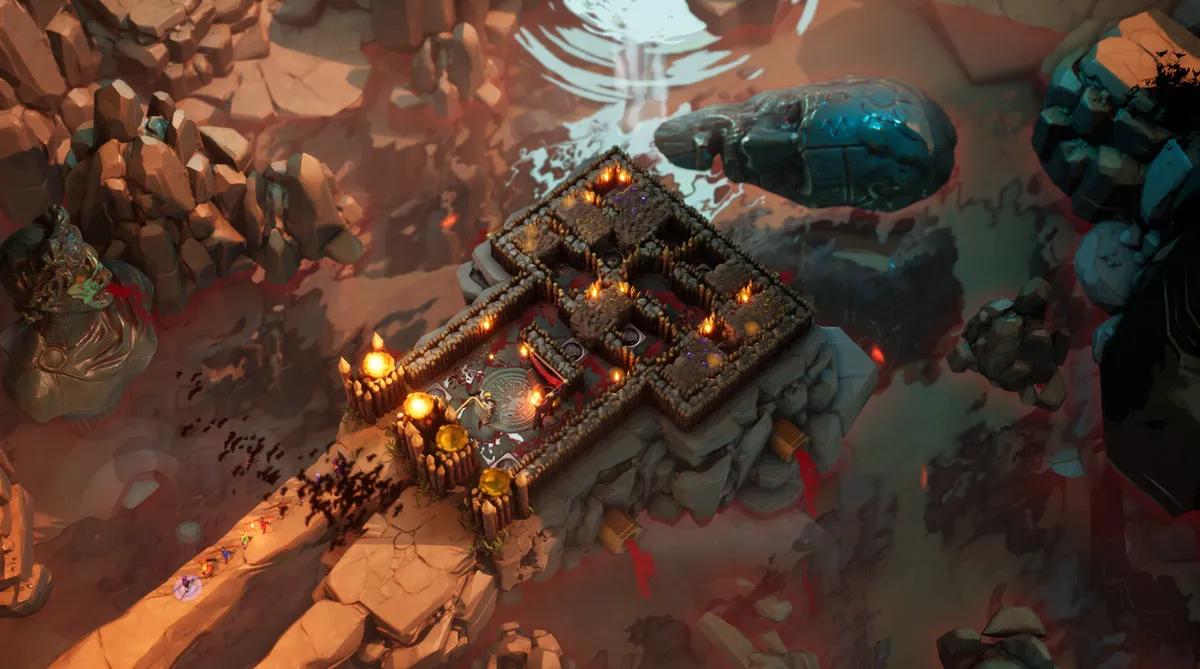
The defining mechanic is maze construction. A building tool lets players create and erase non-permanent walls, reshaping the routes enemies must take through each level. Blocking a short path forces adventurers onto a longer one, and a longer path means more opportunities for trap placements. Players with strong spatial reasoning can snake four separate enemy groups through a single screen, funneling each one through every trap along the way. Making an impossible path — sealing off all routes entirely — does not work; the game enforces at least one viable route at all times. The combination of placement strategy and architectural control is the game's strongest asset, a twist on tower defense that feels both familiar and genuinely distinct from the rest of the genre.
Spilling enough blood during a run earns resources to expand the trap arsenal further. New traps, temporary power-ups, and artifacts that alter gameplay all become available as rewards for efficient killing. The game actively encourages experimentation across runs, and the breadth of options means two players can approach the same level layout with entirely different strategies and succeed.
The Roguelite Loop

Minos splits its structure into rest phases and challenge phases. Rest levels offer healing, new trap acquisitions, and planning time. Challenge levels send waves of adventurers through the labyrinth, with Daedalus providing guidance on new mechanics as floors get deeper. Completing levels and meeting specific conditions — finishing a wave without taking damage, for instance — earns resources that fund trap upgrades and stat boosts for Asterion.
Death strips nearly everything. Trap arsenals vanish. Most accumulated riches disappear. Players restart at the first layer of the labyrinth. But permanent progression exists outside individual runs: experience earned across all attempts feeds into a skill tree that grants lasting upgrades. More health, faster movement speed, the ability to rearm traps during active waves, and shortcuts that allow future runs to begin on lower floors all persist between deaths. Even a run that collapses spectacularly still pushes that skill tree forward.
The meta-progression softens defeat enough to keep experimentation viable. Trying an entirely different trap configuration on a doomed run still moves the needle on permanent upgrades. The tradeoff is that this system also creates stretches where runs feel less like strategic attempts at a clean clear and more like resource-harvesting sessions, grinding experience points until enough upgrades accumulate to push past a wall. Occasional twists help — treasure-hunting exploration challenges and maze layouts with alternate rules like revolving floors or decaying traps break up the standard formula. Unlocking shortcuts at floor milestones also reduces repetition by letting players skip early layers on subsequent attempts.
Where It Stumbles

Pacing is the most persistent problem. Individual levels can drag, and even with a fast-forward button available, cautious play extends single runs well past the point where they feel tight. The roguelite genre thrives on a quick-restart rhythm, that pull to immediately jump back in after a failed attempt. Minos struggles to maintain that pull when one run demands a significant time commitment before it succeeds or falls apart.
The tutorial philosophy cuts both ways. Minos provides basic trap stats — damage numbers, whether a device can be rearmed — then steps back entirely. Figuring out which traps perform in which situations falls to the player alone. Some traps appear weak at first but prove effective in narrow contexts. Others seem consistently outclassed by alternatives. Without clearer explanations of how trap synergies function, including the hidden interactions between devices, early runs involve trial and error that feels wasteful rather than educational.

Complex trap setups introduce mechanical friction. Linking devices to pressure plates requires Asterion to physically step on triggers during active waves. Timing these activations precisely while enemies flood through the maze proves difficult in practice. The result is that simpler, automatic configurations — spike pits, fire traps, standalone ballistas — tend to outperform elaborate chain reactions because reliability matters more than spectacle when a run is on the line. Asterion's auto-attack against enemies who reach him in melee also misfires in spots, failing to trigger unless the player positions him on an exact tile. The broad strokes of combat and trap design work well, but anything demanding tile-perfect accuracy feels clunky against the otherwise fluid planning phase.
The absence of any level retry option also stands out. A tower defense game that expects players to discover optimal strategies through experimentation would benefit from a mid-run reset mechanism, even one that comes at a resource cost or run penalty.
Certain enemy types add frustration on top of the learning curve. Units that can disarm all traps along their path force reactive adjustments mid-wave, and encountering them for the first time during a deep run — when the stakes are highest — can end an otherwise strong attempt without warning.
Visual Design

Minos sidesteps the visual style of Hades, the most prominent Greek mythology roguelike currently in the market. Character portraits during dialogue sequences use a visual novel aesthetic, with Asterion and Daedalus rendered in detailed, expressive illustrations that suit the tone of their roles — Asterion as the reluctant monster, Daedalus as the pragmatic mentor. The labyrinth itself shifts in appearance across layers. Some floors feature hard granite stonework. Others look like hastily assembled wooden fortifications, as though a previous adventurer tried to hold out against whatever waits below and failed.
Enemy models stay simple and functional. The top-down camera angle means detailed enemy art would go largely unnoticed, and the game compensates with floating icons that identify enemy types at a glance — archers, soldiers, trap-disablers, each tagged clearly. I find the ragdoll physics on dying adventurers genuinely entertaining, with heroes flung by catapults and launched off spike traps tumbling with enough exaggeration to give every successful kill real personality. Trap elements and interactable objects remain visually distinct across all labyrinth themes, ensuring that readability holds even as the environment shifts around them.
The settings menu offers a broader range of customization than expected for a game of this scope. Gore levels, kill cameras, and functional tools like auto-rotate for trap placement all sit under accessible options, giving players meaningful control over how they experience the game's violence and interface.
Sound and Atmosphere

Audio design in Minos serves atmosphere and function in equal measure. Every trap carries a distinct sound cue, letting players track activations across the entire maze without needing eyes on every corner simultaneously. Zooming the camera close reveals the mechanical hum of armed traps — a detail small enough to miss but effective at making the labyrinth feel like a living machine.
Music shifts cleanly between gameplay phases. Planning stages play subdued, moody strings that lean into the isolation of labyrinth life. When waves begin, drums and more energetic string arrangements replace the quiet, matching the tension of active defense. A brief musical dip at the start of each new wave — a small pause in volume before the action resumes — creates the effect of a held breath. I think that specific touch captures Asterion's headspace more effectively than any line of dialogue in the game manages to. No individual track stands out as a memorable standalone composition, but the score works as adaptive ambient sound design that reads the gameplay state and responds to it. That functional quality matters more than a catchy theme in a game built around repeated runs.
Verdict
Minos delivers a tower defense roguelite with a strong central hook — maze construction paired with trap placement — wrapped in Greek mythology that knows when to stay quiet. Pacing issues, unclear trap interactions, and occasional control friction prevent it from reaching the top tier of the genre. Minos is a 7/10 game.
Pros:
- Maze construction adds genuine strategic depth to the tower defense formula
- Permanent progression keeps failed runs from feeling like wasted time
- Audio design works as a reliable gameplay tool beyond simple atmosphere
Cons:
- Level length undermines the quick-run rhythm that roguelites depend on
- Insufficient explanation of trap synergies makes early experimentation feel costly
Artificer built a roguelite that finds real identity in letting players design the death trap rather than just survive one. Devolver Digital continues backing games with distinctive premises and enough mechanical substance to hold them together. Minos carries rough edges, but the satisfaction of watching a perfectly engineered kill corridor fire on cue is a feeling few other games in the genre currently deliver.


 Successfully copied... Thank you for sharing our content!:



5% deposit bonus up to 100 gems

a free Gift Case





EGAMERSW - get 11% Deposit Bonus + Bonus Wheel free spin


EXTRA 10% DEPOSIT BONUS + free 2 spins

3 Free Cases + 100% up to 100 Coins on First Deposit


5 Free Cases, Daily FREE & Welcome Bonuses up to 35%

3 free cases and a 5% bonus added to all cash deposits.

+5% to deposit




Comments