




Gecko Gods Review
 Review
 Steam
Steam PlayStation
Gecko Gods is the debut title from developer Inresin, published by Super Rare Originals and Gamersky Games. The game puts players in control of a small gecko washed ashore on a mysterious archipelago, tasked with solving puzzles across multiple islands to awaken ancient lizard deities. It fits squarely into the cozy 3D platformer subgenre carved out by games like A Short Hike and Little Gator Game, aiming for a friction free, relaxing experience over any real difficulty. The game released on April 16, 2026 for PC and PlayStation, rated E for Everyone.
A Lizard on a Log

The opening cutscene uses a hand-drawn art style to establish the premise. A gecko chases a butterfly, falls into the ocean, and drifts on a log across open water until washing up on an island dotted with ancient ruins. From there, the game drops players into control with no tutorial and no guide. There is no character to explain the objectives and no on-screen prompts walking through the controls.
The setup works because the controls are minimal. The gecko can run, jump, dash, and climb. Movement across flat ground feels floaty, with jumps lacking the precision expected from a platformer. Sprinting and dashing compensate somewhat, making traversal fast enough that the imprecision rarely causes frustration in open areas. The dash also doubles as the sole attack, used to smash enemies and gobble up insects scattered around each island.
Enemies exist in the form of crab-like creatures, but they pose almost no threat. Running past them at full speed or climbing a nearby wall puts them out of reach instantly. Attacking them with a dash takes them out in one hit. Combat amounts to a brief interruption rather than a mechanic with any depth, and the game does not punish avoidance. Players who never engage a single enemy will progress just fine.
Stone tablets inside a central ruin on the first island provide objectives, which populate a map and checklist accessible through an in-game guide. Birds scattered around the world also dispense hints about puzzle locations and progression. The structure gives just enough direction to keep things moving without forcing a specific route.
Walls, Ceilings, and the Freedom to Climb

The gecko's defining ability is climbing any solid surface without restriction. Walls, ceilings, cliff faces, interior chambers: everything is scalable, and there is no stamina meter limiting how long the gecko can cling. Seeing a ruin on a distant ledge and simply crawling up the rock face to reach it gives the exploration a distinct feel. The world becomes a vertical playground, and the game leans into this by placing secrets and collectibles on surfaces that reward players who look up.
This freedom creates problems once the spaces get tight. The camera struggles to keep up as the gecko transitions from floor to wall to ceiling. In narrow corridors and enclosed puzzle rooms, the camera clips into surfaces, zooms erratically, and sometimes points in directions that make it impossible to see where the gecko is heading. The disconnect between movement inputs and camera orientation gets worse on ceilings, where pushing the stick in one direction can send the gecko somewhere unexpected. There is also a recurring issue where the gecko simply detaches from a ceiling when the camera is moved at certain angles, causing a fall with no player input.
For a game built around the premise of a lizard that sticks to anything, the camera undermines the central mechanic in enclosed spaces. Open-air climbing on cliffs and ruins works well enough, but the interiors where many puzzles live expose the system's limits. The camera is the single most persistent source of friction in an otherwise low-friction game.
Puzzles That Lose Their Grip

Puzzle variety is one of Gecko Gods' stronger points on paper. The game features light beam puzzles where mirrors must be aimed to redirect a beam across a room. There are 3x3 sliding panel puzzles that require matching a pattern displayed on a nearby wall. Cable connection puzzles involve turning cranks to route wires through a space. Magnetic balls need to be headbutted up walls to reach a goal. Some areas require jumping into a sequence of bells to trigger progression. Others hide levers connected to long winding wires that must be traced across rocky surfaces.
The quantity of puzzle types does not translate into quality. The 3x3 panel puzzles reuse solutions, so completing one reveals the answer to every subsequent instance. The magnetic ball puzzles suffer from imprecise physics: the angle and force of the gecko's headbutt do not reliably correspond to the direction the ball moves. Mirror puzzles and lever puzzles often reduce to trial and error, rotating or pulling until the correct configuration triggers the next gate. I think the variety of puzzle templates shows ambition, but almost none of them deliver the satisfaction of actually solving something.
Relics, one of two collectible types, often sit behind these puzzles. The other collectible type is insects, which inhabit specific areas on each island and require the player to sprint up and dash into them. Catching bugs fits the gecko theme and adds a small hunting loop to exploration. A checklist tracks both relic and bug collection per island. Neither type of collectible unlocks gameplay advantages. Currency drops from smashing pots scattered throughout ruins, and that currency feeds into a cosmetic mirror where players can change the gecko's color and pattern. Additional cosmetic options unlock through play, but the system is purely visual.
Sailing Between Islands

Completing the first island's puzzle sequence unlocks a small sailboat, built to gecko scale. The boat opens the full archipelago to exploration, and from this point the game allows players to visit islands in any order. Objectives on each island can be pursued or ignored entirely. The open structure gives the midgame a sense of freedom that the initial island, as compact as it is, only hints at.
Sailing controls are simple. The gecko operates a crank to steer, and the boat moves at a steady pace. Stopping requires releasing the crank, which means there is no brake or anchor function. Larger islands have horns that call the boat if players lose track of it, though smaller islands lack this feature. One reviewer reported getting stranded on a small collectible island after saving and quitting, with no horn available and the boat too far away to retrieve, forcing a restart.
Rings float on the water between islands, glowing until the boat passes through them. Completing ring sequences unlocks pathways to certain areas and provides a reason to spend time on the water rather than just beelining between landmasses. The sailing sections do not demand speed or precision, and no timer seems to enforce urgency. After the initial appeal wears off, though, the boat becomes a slow ferry between the actual content. The ocean is large relative to what it contains.
I find the Wind Waker influence on the sailing obvious, from the small boat on a big ocean to the island-hopping structure, but Gecko Gods lacks the variety of encounters and discoveries at sea that made that older game's ocean feel populated.
Color, Sound, and the Look of the Islands

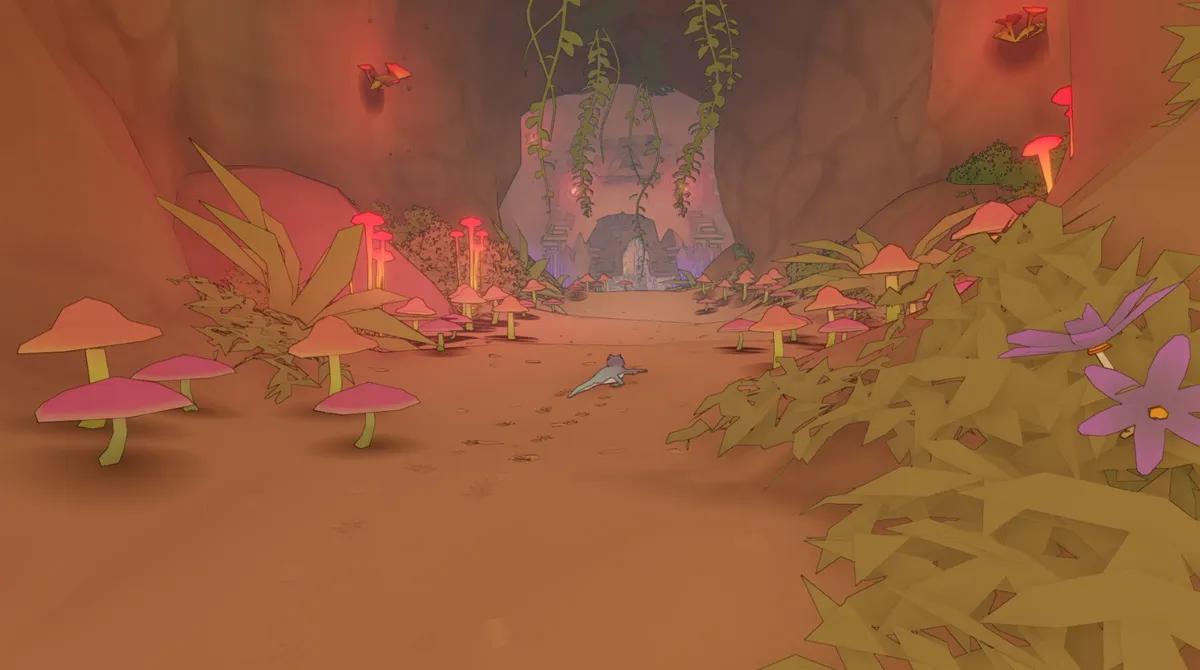
Gecko Gods uses a cel-shaded art style that gives the world a clean, readable look. The gecko is small and expressive. Birds, bugs, and the pot-dwelling alien creatures that populate the islands have distinct silhouettes. The ruins carry an Aztec-inspired aesthetic, with carved stone, ancient art on walls, and weathered structures that reward close inspection. A day and night cycle shifts the lighting across the archipelago, though the transition animations for shadows appear choppy on certain surfaces and objects.
Texture quality varies. Desert areas lack the surface detail found on the tropical islands, with flat ground missing environmental touches like footprints or erosion marks. Object pop-in is noticeable when sailing between islands and sometimes occurs at close range on land, with stone structures and environmental objects appearing abruptly. Some gate and barrier designs have visible gaps in their geometry, large enough that players can clip through and bypass puzzle locks entirely.
The soundtrack, composed by Jasmine Cooper, matches the setting. Tracks range from calm, ambient pieces during exploration to an upbeat tune that kicks in when the sailboat launches. The instrumentation uses a tribal tone with occasional chanting that fits the island ruins. A few moments produce mismatches between the music and the on-screen action, and stray sound effects sometimes trigger without a clear source, but these instances are infrequent. The audio design supports the atmosphere without drawing excessive attention to itself.
The opening cutscene deserves a mention for its storybook quality. The hand-drawn style presents the gecko's butterfly chase and ocean voyage with a simplicity that fits the game's tone. The cutscene is skippable for repeat players.
Technical Problems That Block the Path

Pre-release and launch builds of Gecko Gods carry a significant list of technical issues. Two separate reviewers reported progression-blocking bugs tied to puzzles not loading correctly. In one case, a puzzle on the Volcano island failed to spawn a light beam required for a mirror puzzle, trapping the player in a room with no exit and no solution. In another, a tile-based puzzle crushed the gecko and respawned it outside the puzzle area with no way back in, requiring a full restart.
Puzzles that depend on precise lever positions have a reported bug where levers drift from their set positions on their own, invalidating solutions. Cutscenes triggered by puzzle completion or area unlocks sometimes linger far past their useful length and cannot be skipped. The cosmetic mirror menu has reported functional glitches. Wall collision is inconsistent enough that clipping through solid surfaces happens with some regularity, occasionally trapping the gecko and forcing a reload.
A patch deployed during the review period addressed at least one puzzle-related bug and added quality-of-life improvements. The developer appears active in fixing reported issues. But the volume of bugs at launch raises a practical concern: in a game where progression depends entirely on puzzles, players cannot always distinguish between a puzzle they have not solved and a puzzle the game has not loaded properly. That uncertainty poisons the core loop. Every dead end becomes suspect.
Quest log entries sometimes fail to clear after objectives are completed. Loading screens stutter on transition. Physics on certain objects behaves unpredictably. The cumulative effect is a game that feels like it needed more time before release, despite the evident care in its design and presentation.
Verdict

Gecko Gods has a well-realized setting, a likable protagonist, and a structure that respects the player's time and curiosity. But thin puzzles, an unreliable camera, and a stack of technical bugs drag the experience below what its premise promises. Gecko Gods is a 6/10 game.
Pros:
- Climbing any surface without limits gives exploration a satisfying vertical dimension.
- Cel-shaded art and Jasmine Cooper's soundtrack create a cohesive, attractive island world.
- Open island-hopping structure lets players set their own pace and priorities.
Cons:
- Puzzles lack mechanical depth and several types suffer from imprecise controls or repeated solutions.
- Technical bugs, including progression blockers, undermine trust in the core puzzle loop.
The foundation Inresin built here has clear potential. The gecko's universal climbing, the archipelago structure, and the cozy tone all point toward something that could work well with tighter puzzle design and extended testing. For now, the game is a pleasant but uneven few hours that asks players to tolerate more rough edges than a cozy title should.


 Successfully copied... Thank you for sharing our content!:



5% deposit bonus up to 100 gems

a free Gift Case





EGAMERSW - get 11% Deposit Bonus + Bonus Wheel free spin


EXTRA 10% DEPOSIT BONUS + free 2 spins

3 Free Cases + 100% up to 100 Coins on First Deposit


5 Free Cases, Daily FREE & Welcome Bonuses up to 35%

3 free cases and a 5% bonus added to all cash deposits.

+5% to deposit




Comments