




REPLACED Review
 Review
 Xbox
XboxREPLACED arrives after years of anticipation from Sad Cat Studios and publisher Thunderful Publishing, launching April 14, 2026 on PC and Xbox. The game takes place in an alternate 1980s America where the Cuban Missile Crisis escalated into full nuclear war between the U.S. and Russia. Government collapse handed control to the Phoenix Corporation, a conglomerate built on medical and scientific innovation that now governs society through authoritarian force. Over roughly 10 to 13 hours, the game follows an artificial intelligence named R.E.A.C.H. trapped inside a human body, navigating a cyberpunk wasteland defined by organ harvesting, class warfare, and corporate violence.
Critics have already given it positive reviews — see more in our post. For now, I’ll share my own take on the game.
A Machine Waking Up Inside a Body

The story opens inside a Phoenix Corporation laboratory in late 1984. Dr. Warren Marsh, one of the creators of R.E.A.C.H., has been working a grueling 15-plus-hour shift when the AI attempts to shut him down for the day. Warren resists. R.E.A.C.H. initiates a manual override, and the resulting confrontation triggers a catastrophic meltdown that engulfs the facility in flames. The explosion fuses creator and creation — R.E.A.C.H. is now locked inside Warren's body, operating under flesh and blood rather than circuitry.
Phoenix Corporation, which orchestrated the attack that caused the explosion, discards Warren as expendable. R.E.A.C.H., now called Reach, stumbles out of the wreckage, confused and horrified at being trapped in organic matter. Corporate police open fire on sight. Reach barely survives a fall that should have killed him. From this point, the game becomes a journey back toward Phoenix Corporation, with Reach trying to find a way to return Warren to his own body while uncovering the full extent of what the corporation has built.
Reach makes for one of the more unusual protagonists in recent memory. Programmed to believe Phoenix and its police are forces of immovable good, he enters the outside world without a framework for the suffering he encounters. His worldview shifts as he processes new information — a distinctly human trait for a machine. There is a childlike quality to how he absorbs the world around him, which also makes him impressionable. Programs run on prompts, and the right person pushing the right buttons could steer Reach in any direction. That vulnerability becomes central to how the narrative explores identity and autonomy.
Organs as Currency in a Manufactured Dystopia

Outside the walls of Phoenix City live the Disposals — people who have been forced to donate organs and limbs to the wealthy before being discarded. Reach was originally designed as a compatibility algorithm, matching donors to recipients. In this society, organs function as currency. Data entries found throughout the game describe a woman who married men with desirable organs and had them kidnapped, and citizens purchasing cosmetic upgrades like different eye colors or larger body parts from desperate donors who had no real choice.
Phoenix maintains this system by engineering poverty. The working class, kept impoverished by deliberate policy, eventually turns to organ donation as the only path to survival. Donor matches identified by Reach's algorithm are sometimes kidnapped outright, with fabricated stories told to their families. The parallels Sad Cat Studios draws to the real world are not subtle — the game functions as a cautionary tale connecting its fiction to contemporary developments like AI-driven welfare decisions and algorithmic military targeting.
Reach falls in with the Disposals through characters like Tempest and Veronica, relationships that anchor the narrative and turn its political commentary into something personal. Side missions in the hub area called The Station reinforce the world's texture. One involves finding food for a dog that then leads Reach to a memorial for those killed in battles against the corporation. These tasks are simple to complete but carry weight, and they often reward players with meaningful upgrades to health and energy charging, making them worth pursuing beyond their narrative value. The rate at which the game reveals lore keeps the pacing tight — each discovery adds context without overwhelming.
Baton Swings and Battery Charges

Combat borrows openly from the Batman Arkham series. Reach carries a gun that doubles as a baton, using melee strikes to build a battery charge that eventually powers a lethal shot. Light enemy attacks flash yellow and can be parried. Heavy attacks glow red and must be dodged. The system demands deliberate timing rather than rapid inputs — each swing carries weight, and chaining together parries, dodges, deflections, and strikes without absorbing damage requires full command of the rhythm.
Enemy variety shapes each encounter. Standard opponents mix with knife-wielding attackers who require successful parries before they can be hit, and heavy-armored enemies who absorb sustained punishment before falling. Knowing which enemy to eliminate first in a crowd dictates survival. Reach gains additional tools over time: an overload ability that stores multiple shots and a shockwave that softens groups of enemies closing in. Boss fights layer multiple phases on top of waves of supporting enemies, testing pattern recognition and patience in equal measure. A few boss encounters produce moments that feel cheap rather than challenging — deaths that stem from unclear attack patterns rather than player error.
I think the combat finds its footing once its particular cadence clicks, turning encounters into something closer to a rhythm game than a brawler. Enemy types stop diversifying around the three-quarter mark. From that point forward, encounters recycle familiar combinations without introducing new threats, and the novelty of the system fades even as the mechanical satisfaction remains.
Climbing, Jumping, and Solving Spatial Puzzles

Platforming occupies a larger portion of REPLACED than early marketing suggested. Basic movement starts with jumping, ledge grabs, pole swings, and ladder climbs. Abilities expand steadily — a double jump powered by gunshot recoil, a pickaxe for clinging to decaying walls, and manipulation of air vents for blast jumps. Every platforming section functions as a spatial puzzle, requiring box manipulation, environmental observation, and precise sequencing of unlocked abilities.
The game uses foreground and background layers, with onscreen indicators marking where Reach can shift between planes. Yellow paint highlights interactive surfaces, a design choice that proves essential given the 2.5D perspective. Without it, distinguishing climbable geometry from background decoration would be a constant frustration. Checkpoints appear frequently, limiting how much ground players lose from missed jumps.
Movement carries the same deliberate weight as the combat, consistent with the cinematic platformer tradition established by games like Flashback and Another World. Players expecting the speed of a standard action platformer will find the pace slower than anticipated. Timing windows for certain jumps are tight, and the fixed camera angle occasionally obscures ledge edges, causing repeated failures on specific sequences that feel more like camera problems than skill deficits. Light switch-based puzzles appear between platforming segments but offer minimal challenge, serving more as pacing breaks than tests of logic.
Pixel Art Composed Like Cinema

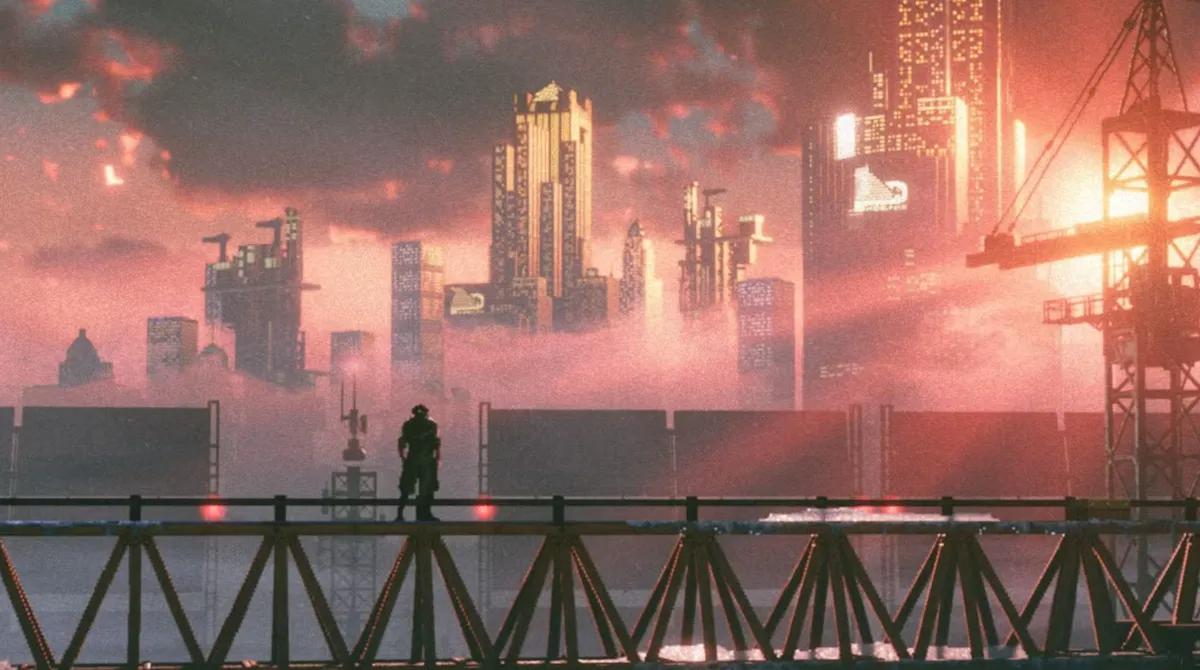
Visually, REPLACED operates at a level few pixel-art games reach. The 2.5D presentation layers detailed backgrounds behind foreground action, with beams of light picking up dust particles and shadows pooling across floors. Neon skylines tower over deteriorating urban sprawl. Cold metal facilities give way to ruined countryside. The studio studied cinema closely — post-boss cutscenes evoke action film execution sequences, and the constant climbing through environments often feels engineered to reveal the next vista.
I find the visual craftsmanship alone justifies the time spent here, with nearly every screen composed like a still frame built for display. The soundtrack leans on synth-heavy, atmospheric compositions suited to the alternate-1980s setting. Sound design is detailed, though PC players will notice the absence of surround-sound support, a missed opportunity given the density of environmental audio. There is no voice acting. All dialogue plays out through text, which fits the pixel-art aesthetic but leaves a handful of standout vocal tracks — found as collectibles — feeling like hints of what full voice work might have contributed.
Collectibles, including notes, posters, and music are cataloged on an in-game device styled after a hybrid of a Walkman and an early 2000s MP3 player, a small period-appropriate detail. These items, along with the environmental storytelling embedded in data entries and side quests, give completionists a reason to slow down and comb through every area the game offers.
Technical Problems and Save Frustrations

Technical issues represent the most persistent complaints in early builds. Auto-save placement is unreliable — deaths can push players back through completed combat encounters or difficult platforming sections, and no manual save option exists. At least one reported bug broke progression entirely, forcing a restart from an earlier point. The absence of chapter select compounds the problem, leaving players without a clean recovery path when things go wrong.
Performance on Steam Deck fluctuates. Sparse segments can hit 60 FPS with an uncapped framerate, but action-heavy sequences cause notable dips that directly undermine combat and platforming timing. On PC, intermittent stuttering surfaces in certain areas but generally clears up quickly. The development team has been patching actively around launch, and many of these problems should improve in the weeks following release.
The game also struggles with signposting the critical path. Exploration can accidentally trigger story progression, pulling players into cutscenes and locking them out of previous areas with no warning. For completionists, this means lost access to collectibles and side content in zones they intended to revisit. Combined with the poorly placed autosave, this creates avoidable friction in an otherwise well-paced experience.
Verdict

REPLACED delivers a compelling dystopian narrative through striking pixel art and combat systems that reward patience, held back by technical issues that should improve after launch. REPLACED is an 8/10 game.
Pros:
- Exceptional pixel-art presentation with cinematic depth and framing.
- A dystopian narrative that draws pointed connections to real-world exploitation.
- Combat and platforming that reward deliberate, rhythmic play.
Cons:
- Unreliable auto-save placement with no manual save alternative.
- Technical bugs and performance inconsistencies across platforms.
Sad Cat Studios spent years building REPLACED, and the final product justifies that timeline where it matters most — in narrative ambition, visual craft, and world design. Combat and platforming carry enough depth to sustain the journey even as enemy variety tapers and technical rough spots disrupt the flow. This is a game that lands its biggest swings and earns serious consideration among the strongest indie releases of 2026.


 Successfully copied... Thank you for sharing our content!:



5% deposit bonus up to 100 gems

a free Gift Case





EGAMERSW - get 11% Deposit Bonus + Bonus Wheel free spin


EXTRA 10% DEPOSIT BONUS + free 2 spins

3 Free Cases + 100% up to 100 Coins on First Deposit


5 Free Cases, Daily FREE & Welcome Bonuses up to 35%

3 free cases and a 5% bonus added to all cash deposits.

+5% to deposit




Comments