




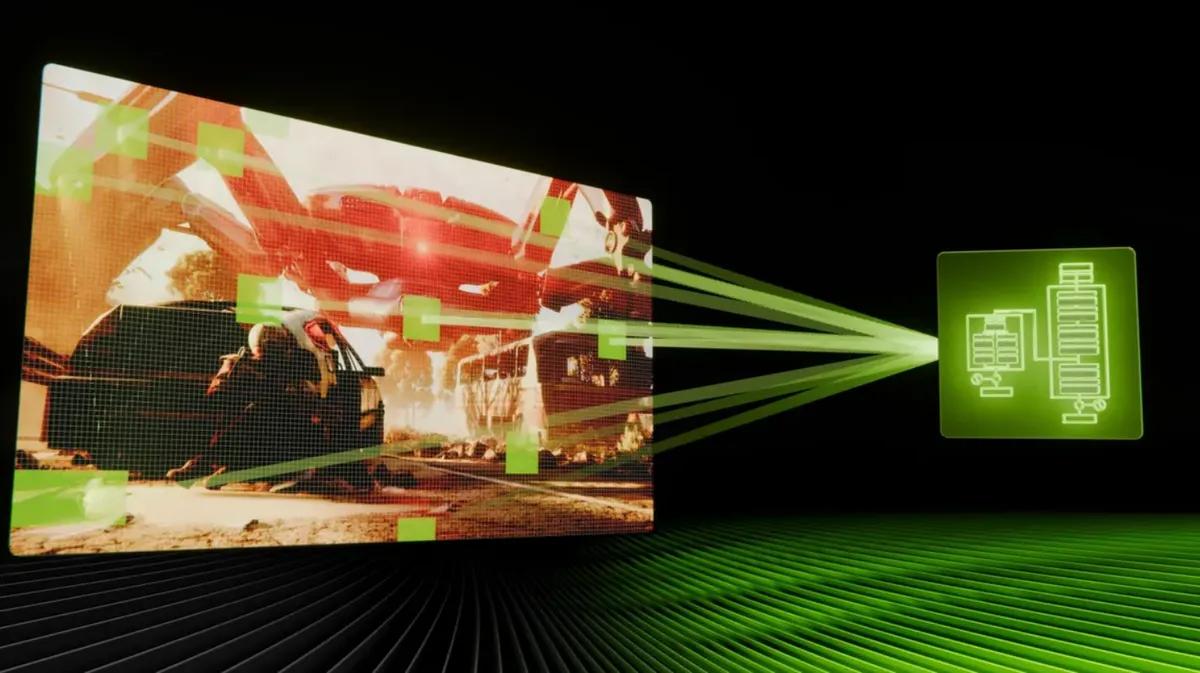
NVIDIA Sets March 31 Beta Launch for DLSS 4.5 Dynamic Multi Frame Generation With 6x Frame Support
 Nvidia
NVIDIA has confirmed that DLSS 4.5 Dynamic Multi Frame Generation will arrive in the NVIDIA App beta on March 31, giving RTX 50-series GPU owners access to on-the-fly frame generation switching that scales up to 6x. The feature has been technically available since DLSS 4.5 launched in January, but this specific capability — the dynamic switching between generation modes mid-session — is only now reaching users.
The system works by producing five AI-generated frames for every one traditionally rendered frame at its highest setting. Rather than locking users into a fixed multiplier, it adjusts the count depending on scene complexity and a user-defined frame rate target. In a demanding environment, it pushes to 6x; in lighter scenes, it pulls back to 2x or 4x. The goal is a consistent frame rate without manual intervention.
PC Gamer writer Andy Edser saw a version of the feature running at CES 2026, tested across two areas in The Outer Worlds 2 — a ship cockpit that stabilized at 2-4x and a busier interior that required 6x to hold its target. Switching between the zones produced no visible seam in the transition.
NVIDIA has cited a 53 ms PC latency figure for path-traced Black Myth: Wukong running at 6x frame generation, 4K resolution, and 246 fps — a data point the company offered earlier this year as evidence the feature remains usable at maximum output.
To access DLSS 4.5 Dynamic Multi Frame Generation when it launches, RTX 50-series owners will need to enable beta releases through the Settings and About page in the Nvidia App. Over 200 games will support the feature from day one.
Separately, Nvidia has added 20 more titles with native DLSS 4.5 integration. The list includes upcoming releases such as 007: First Light, Control Resonant, and Tides of Annihilation, alongside existing titles including Gray Zone Warfare, Where Winds Meet, and StarRupture.
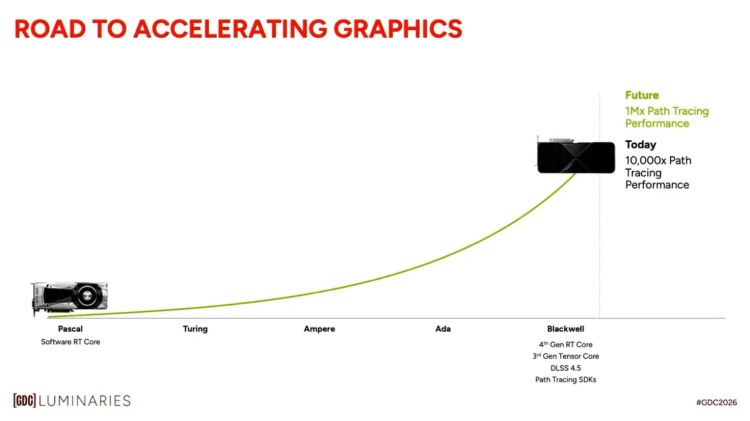
At GDC 2026 in San Francisco, Nvidia vice president of developer and performance technology John Spitzer laid out what the company is describing as Nvidia's big plan for game development — a future where real-time path-traced graphics are visually indistinguishable from film-quality rendering. The path there runs entirely through AI.
"We're still not to where we want to be. We want that the real-time images to look indistinguishable from reality. We want them to look like a film."
— John Spitzer
Current path tracing implementations already carry a significant performance cost. Games such as Resident Evil Requiem, Doom: The Dark Ages, and Alan Wake 2 all support the feature, and all take a serious hit when it is enabled. Nvidia uses RT cores — application-specific integrated circuits built into its GPUs — to handle ray intersection calculations, but even dedicated silicon isn't enough to close the gap without upscaling and frame generation on top.
NVIDIA has already previewed elements of its longer-term roadmap, including RTX Mega Geometry for foliage rendering and the 6x frame generation mode now arriving in beta. The company frames AI not as an enhancement to traditional rendering, but as the primary mechanism for achieving performance targets that brute-force hardware cannot reach.
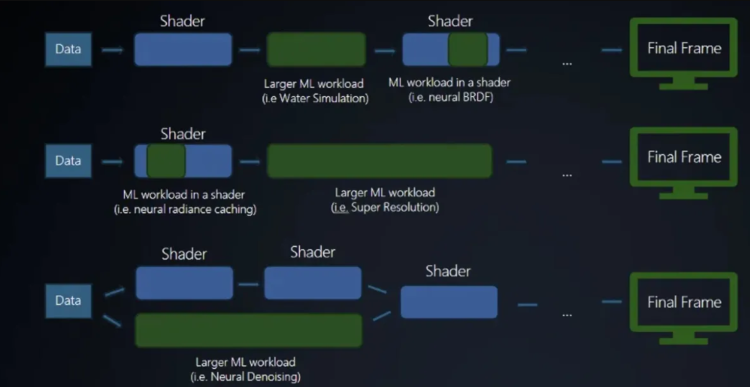
Also at GDC, Nvidia announced support for two specific DirectX features from Microsoft. The first is an API for shader-level machine learning paired with a specialized compiler. The second is Advanced Shader Delivery, or ASD — a pre-compiled shader packaging system designed to eliminate the stutters that occur when games compile shaders during play or at load. ASD was previously announced only in connection with the Asus ROG Xbox Ally family, but Nvidia confirmed it is working with Microsoft to bring the system to GeForce RTX users later this year. AMD, Intel, and Qualcomm have all committed to ASD support, which suggests broad adoption across PC hardware when it rolls out.
I think the shader stutter fix is the more immediately meaningful development for the average PC gamer — path tracing remains a feature for a narrow slice of the hardware market, while shader compilation problems affect anyone who plays new releases.
The economics of gaming hardware are already shifting in ways that make Nvidia's film-quality ambitions feel distant for most players. I see a future where ultra-realistic path-traced gaming, powered by AI and high-end memory-dependent GPUs, becomes the exclusive territory of premium players — the gaming equivalent of a specialty ingredient priced out of everyday reach — while mainstream players manage with whatever performance headroom remains affordable.
For example, Valve has acknowledged that memory and storage shortages may push the Steam Machine, Steam Frame VR headset, and Steam Controller past 2026 entirely. As recently as February, the company expected all three products to ship in the first half of the year.
The question for DLSS 4.5 Dynamic Multi Frame Generation in the near term is narrower: whether the smooth mode-switching seen in controlled demos holds across a broad library of supported titles, and whether input latency stays predictable as the multiplier shifts. Those answers arrive when the beta opens on March 31.
Read also, Nvidia has officially confirmed pricing for the RTX 5060 and RTX 5060 Ti, its upcoming mid-range cards for 2026, offering a clearer picture of where the company positions its more accessible GPU options relative to the high-end RTX 50-series hardware, driving features like DLSS 4.5 Dynamic Multi Frame Generation.


 Successfully copied... Thank you for sharing our content!:



5% deposit bonus up to 100 gems

a free Gift Case





EGAMERSW - get 11% Deposit Bonus + Bonus Wheel free spin


EXTRA 10% DEPOSIT BONUS + free 2 spins

3 Free Cases + 100% up to 100 Coins on First Deposit


5 Free Cases, Daily FREE & Welcome Bonuses up to 35%

3 free cases and a 5% bonus added to all cash deposits.

+5% to deposit




Comments