




A High On Life 2 Review
 Review
 Games
Games Steam
Steam PlayStation
 Xbox
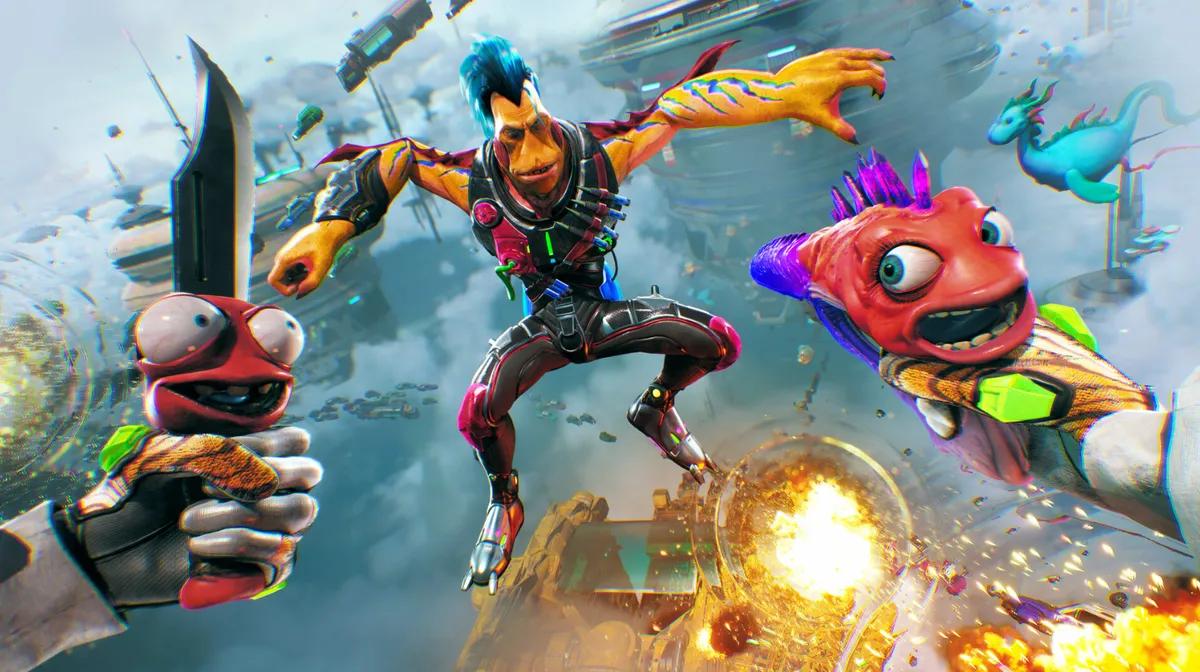
XboxHigh On Life 2 begins almost immediately where the first game concluded. An incredibly fast introduction summarizes prior events to bring players back into the action. You are positioned as a rogue assassin, now operating outside the law. Your main objective involves hunting down a list of targets to dismantle an organization, but this time the enemy is not a drug cartel. Instead, the villain is a pharmaceutical company. This change provides a new context for the campaign's string of missions. Its setup feels familiar, almost identical to the original game's structure, but the shift to playing an illegal agent of death offers a fresh perspective on the roughly 10-hour campaign.
The narrative built around these missions, however, does not hold up as strongly as the premise. Its story feels sloppy, with several major reveals that fail to make an impact. There is a surprising reliance on monologues to explain character motivations and new technologies. It often tells the player information directly instead of showing it through action or environment, a strange choice for a series that typically prioritizes a carefree and cool approach over granular details. Its plot moves at a rapid pace, which keeps things from stagnating, and a constant flow of silly gags ensures the experience remains unpredictable, even when the central story becomes messy and convoluted.
The experience is reminiscent of a tabletop role-playing campaign that has extended for too long, where the game master seems to be contorting the narrative to reach a specific, planned payoff, but frequently misses the intended mark. Despite its narrative shortcomings, momentum and humor prevent the story from becoming a significant burden.
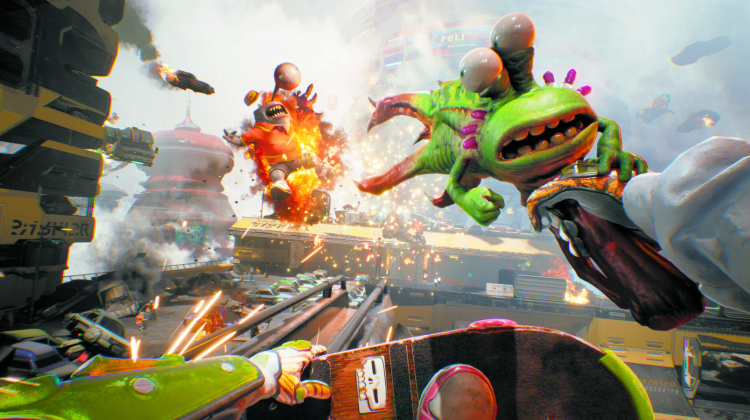
Jokes and general silliness are a core part of the experience, just as they were in the first game. There are many genuinely funny moments. One memorable high point involves a fight against an incredibly irritating boss who teleports himself inside the game’s menus and begins to alter the settings. Another mission concludes not with a gunfight, but with a murder mystery that requires gathering clues and interrogating witnesses. Its lowbrow humor also has its moments, such as a side quest centered on helping someone locate a bridge troll. This sequel is at its most effective and enjoyable when it experiments with these kinds of weird and creative ideas. When these unique segments succeed, they create an experience unlike anything else. I was having the most fun when the game was trying new things.
Humor is not always successful, however. Jokes fall flat a bit too often in this sequel, and these failed attempts are difficult to ignore. It is inherently harder to generate successful gags in a world that has already been thoroughly explored. The novelty of a universe with sentient, talking guns has diminished, and many of the funny moments that could be derived from that surreal concept were already realized in the first game. Some jokes in the sequel are quite literal repetitions of gags from the original. My least enjoyable moments were those spent retreading old bits or listening to dialogue that simply appended a few curse words to a sentence instead of delivering an actual punchline.
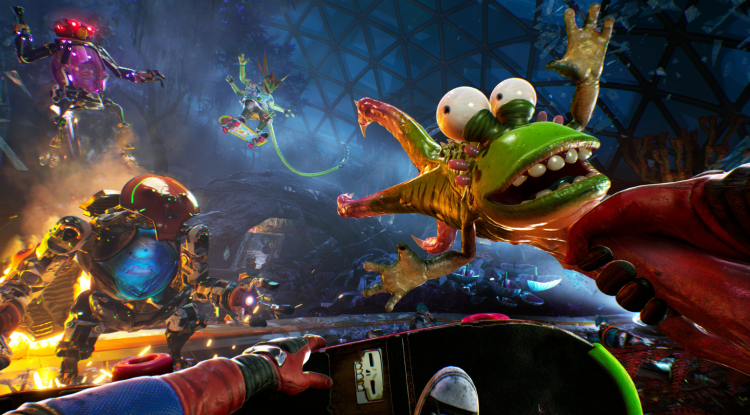
Talking gun companions were the stars of the first game, and this remains true for the sequel. I met a down-on-his-luck pistol named Travis, and his character arc, which involves reuniting with his estranged wife, serves as a clever introduction for the first dual-wielded weapon when she joins the arsenal. Their constant affection, however, can be a bit much. All four new gun companions are excellent additions, each offering helpful abilities for both combat and puzzle-solving scenarios. Sheath, for example, has a harpoon "trick hole" attack that can impale enemies during fights and be used to create ziplines for platforming. Most of the original Gatlians also make a return, including the frog-like shotgun named Gus. Unfortunately, a wider variety of guns has not done much to improve the sloppy and overly simplistic gunplay. In fact, it feels a touch worse this time around. Some new weapons are quite crisp, particularly Sheath’s burst-fire, which is reminiscent of the battle rifle from Halo. However, with so many enemies and projectiles on screen at once, combat leans heavily into chaos.
Fights often take place in claustrophobic rooms with odd geometry that enemies get stuck behind, and weapon accuracy is inconsistent. For a game focused on over-the-top nonsense, this is usually acceptable, but it becomes frustrating when a death feels unearned or a fight drags on for too long. Enemy variety is mostly decent, with a steady introduction of new creatures to blast apart, from flying robots to skeletons. Still, anyone looking for a polished first-person shooter with coherent gunfights should look elsewhere.
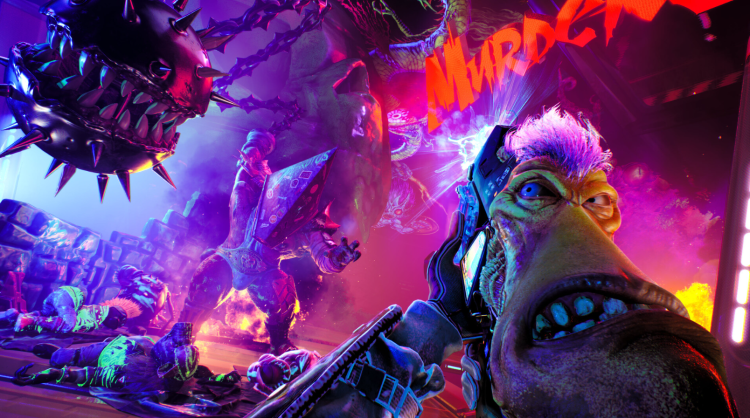
Mobility is the most significant and interesting change in High On Life 2. A skateboard is provided in the opening minutes and serves as a primary mode of transportation throughout the adventure. Most encounters either encourage or outright require grinding on rails, riding on walls, and soaring through the air. For traveling between locations or navigating platforming sections, this system is fantastic. A surprising amount of time is spent rolling around in a manner similar to a professional skateboarding game. I cannot imagine returning to the relative sluggishness of running on foot. In combat, the skateboard's influence is less positive.
Players are seemingly expected to never stop moving while fighting hordes of aliens, which makes the already chaotic encounters even more noisy and difficult to read. Many fights occur in open areas with more enemies than can be tracked at once. Standing still is not a viable option due to the lack of cover, so survival depends on taking shots at enemies while leaping between different environmental elements to maintain speed. This juggling act, combined with slippery weapons, teleporting enemies, and bizarre foes that are often hard to even identify, results in an absolute mess of pixels on the screen.
It also appears to be struggling from a technical standpoint. I saw frequent framerate dips, some of which caused my screen to freeze for several seconds. Progress-hindering bugs also occurred, requiring a reload from the last checkpoint to continue. Developer Squanch Games included "various performance issues across the game" on a list of known problems with the review build, with a promise that they would be addressed by a patch. How extensive these fixes will be remains unspecified, and in my experience, a day-one patch rarely resolves performance problems of this magnitude.
None of the issues were game-breaking beyond requiring a simple reset, but their consistency and severity are a cause for concern.
High On Life 2 is a fun sequel that expands on the original's best ideas, including its absurd boss fights and charming talking guns, while also introducing some neat new concepts like the skateboarding mechanic. Unfortunately, it also takes a step backward in several areas, such as its underwhelming story, even sloppier gunplay, and rough technical performance. It was a welcome opportunity to return to this goofy, completely foul world of offensive creatures and irreverent antiheroes. But like a joke heard multiple times before, this second attempt just doesn’t land quite as well as the original.


 Successfully copied... Thank you for sharing our content!:



5% deposit bonus up to 100 gems

a free Gift Case





EGAMERSW - get 11% Deposit Bonus + Bonus Wheel free spin


EXTRA 10% DEPOSIT BONUS + free 2 spins

3 Free Cases + 100% up to 100 Coins on First Deposit


5 Free Cases, Daily FREE & Welcome Bonuses up to 35%

3 free cases and a 5% bonus added to all cash deposits.

+5% to deposit




Comments