




Mio: Memories In Orbit Makes Exploration A Surgical Art
 Steam
Steam Review
I find the best game locations have bodies. I can zoom out on a map and see a complex system of veins that carry blood to a heart. Mio: Memories in Orbit, the new game from developer Douze Dixièmes, understands this better than most. It is a 2D action-adventure that commits to the act of exploration with surgical precision. The story unfolds aboard The Vessel, an abandoned ark of robots left floating in space. I played as Mio, a small bot with wires for hair, who lands in the ship’s core, a structure called The Spine. From there, I began a journey to restore the ship's robotic caretakers, known as Pearls, and save The Vessel. The moody story is filled out by collectible logs detailing the plight of the machines, providing the necessary setup for its sturdy Metroidvania structure.
The game is more indebted to Ori and the Blind Forest than to Hollow Knight, and I found that refreshing. Thanks to Polygon for highlighting how the focus is not on punishing combat against dozens of tough enemies. Instead, MIO: Memories in Orbit on Steam is more interested in fluid exploration that is continually expanded by a widening movement kit. The combat is achievable, with a masterful difficulty curve. Smart accessibility considerations, like an option to automatically make a boss fight slightly easier after each death, allow you to gradually lower the challenge without switching to an easy mode. Fights with Mio’s plinky hairpin are still present, but the core of the experience is movement and discovery. The Vessel is constructed from platforming puzzles, requiring me to chain together jumps, glides, and pogo slashes in creative sequences to reach collectibles.
Exploration frequently leads to caches of currency, which can be spent on playstyle-altering upgrades installed into Mio’s memory bank. Some of these objects are cleverly hidden, cloaked by dense layers of broken machinery that reward players who poke and prod at every scenic detail. My own loadout revolved around intentionally slowing my energy recharge, which in turn gave me a damage boost whenever the gauge was not full. This system encourages experimentation and tailoring the experience to a specific approach. It makes backtracking for missed items feel less like a chore and more like an opportunity to test a new build in a familiar area.
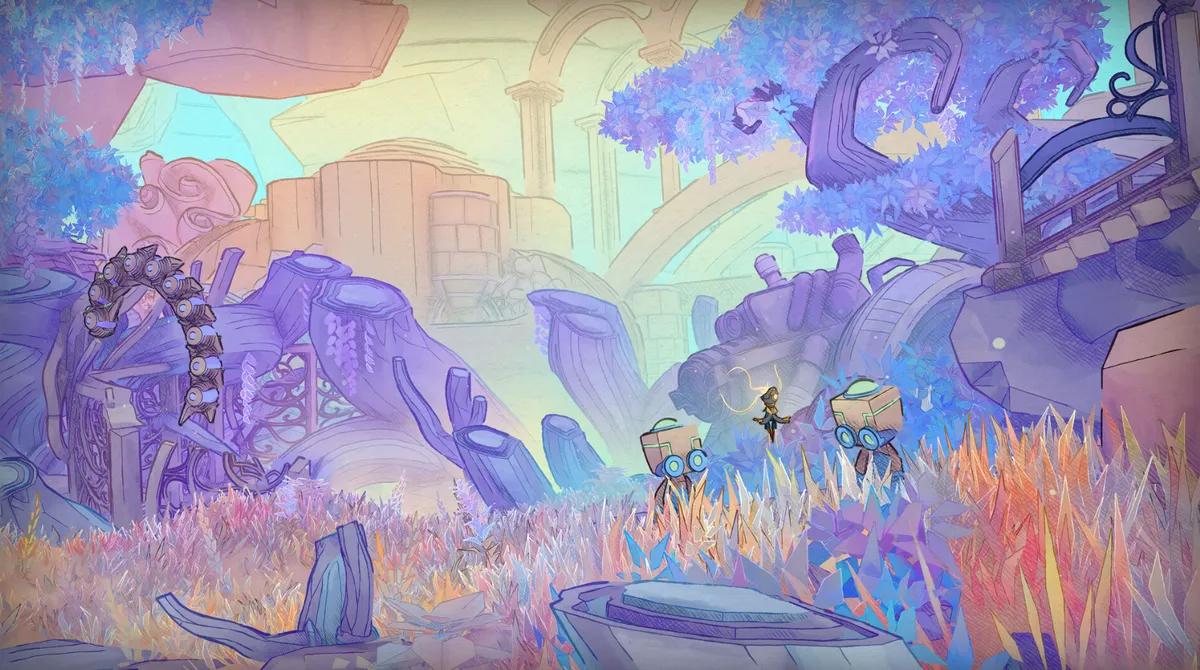
The setting is where Mio makes its mark. The 2D landscapes are visually mesmerizing, illustrated in a style that makes every environment look painstakingly hand-penciled, drawing a line between the mechanical and the human. The Vessel itself is an intricately designed series of pathways that connect back to one another with scientific efficiency. Early in the adventure, I found it frustrating that death seemed to send me back to a single checkpoint in The Spine. I would drop all my currency upon dying, though a corpse run was not required to retrieve it. As I explored more, I discovered unexpected shortcuts that led right back to The Spine. The runbacks to distant bosses became shorter as I found new ways to fast-track myself through the ship’s bloodstream.
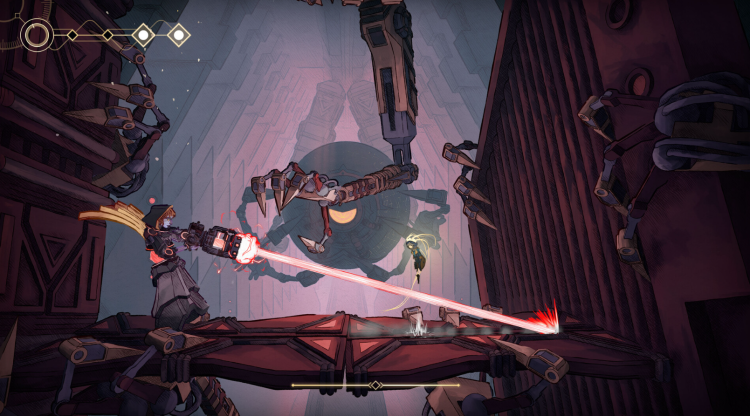
Despite being a giant machine, the Vessel began to feel like an organic body. The game makes this literal with the Pearls; each one is named after a different bodily function. The ship has eyes, it breathes, and everything connects back to that central Spine.
"Each time I unclog an elevator or find the backside of a locked door, it’s like I’m suturing the wounds on a body."
By the end of my adventure, looking over the fully discovered map felt like a surgeon observing stable vitals after a successful procedure. The world design fuses the mechanical with the organic, turning the map into a living being. Mio’s Spine feels spiritually linked to Axiom Verge’s own central backbone that connects its disparate biomes. The genre’s best games understand that exploration is not just something to do between battles; it is an act of anatomy. Mio brings that idea to the forefront in an immaculately constructed 2D adventure. Not a single hair on its head is out of place. Every nook aboard The Vessel serves a function, each one crucial to the health of a delicately crafted ecosystem. It was a pleasure to live in that space rather than conquer it, allowing the corridors of the game’s map to become as familiar as the lines on my own palms.


 Successfully copied... Thank you for sharing our content!:



5% deposit bonus up to 100 gems

a free Gift Case





EGAMERSW - get 11% Deposit Bonus + Bonus Wheel free spin


EXTRA 10% DEPOSIT BONUS + free 2 spins

3 Free Cases + 100% up to 100 Coins on First Deposit


5 Free Cases, Daily FREE & Welcome Bonuses up to 35%

3 free cases and a 5% bonus added to all cash deposits.

+5% to deposit




Comments