


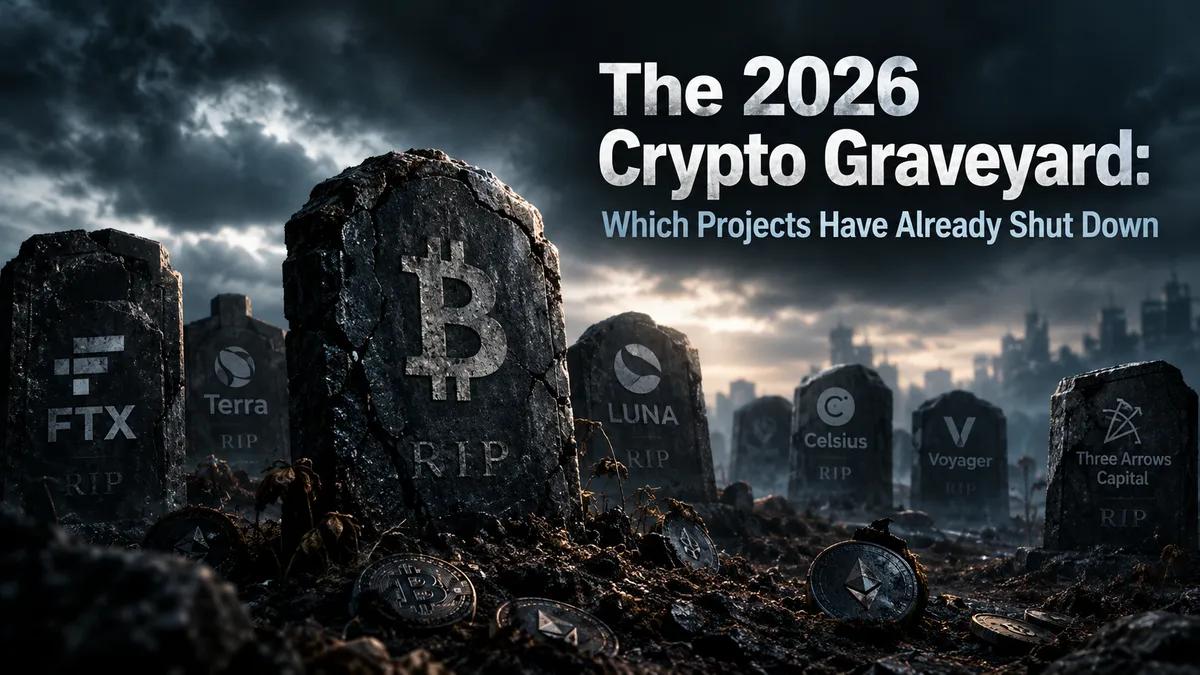
The 2026 Crypto Graveyard: Which Projects Have Already Shut Down
 DeFi
Stacy Muur, a crypto researcher, posted a list on Tuesday of 82 projects and protocols that have shut down this year. She said she had never seen anything like it. Balancer, Radiant Capital, Neon EVM and Step Finance are on it, along with dozens of names most people outside the industry would not recognize.
The count gets the headlines. The reasons behind it are more interesting.
82 is not even the highest number going around. DeFiLlama's August research counted 100 projects that announced shutdowns in 2026, 40 of them in the previous 90 days, as Cointelegraph reported. RootData had 99 by late July. The trackers disagree because they count different things: some include pivots, some include a company closing while its protocol lives on. Treat the numbers as a rough measure, not a census.
What The Dead Projects Have In Common
Bitcoin fell from an October 2025 high above $126,000 to below $60,000 earlier this year and is back around $81,000 now. That is the backdrop, but it is not the whole explanation.
DeFiLlama found that the most commonly cited reason was a lack of product-market fit. Depleted funding came next, then insufficient revenue, then a decision to pivot. Hacks matter less than the headlines suggest. Together the closed projects raised about $1 billion and generated about $250 million in cumulative fees, and nine of them had raised more than $50 million each. That last number is the one I keep coming back to.
The money did not leave crypto. DeFiLlama says venture funding rose in the first half of 2026 while the number of deals fell 80%, and M&A reached 87 transactions, 65% above last year. Capital is concentrating, and the long tail is not getting any of it. Layoffs tell the same story: CryptoJobsList data cited by Coin Edition shows at least 60 crypto companies announced job cuts this year, beating the old record of 38 from 2023.
Blast: Costs Above Revenue
Blast is the cleanest example of the economics problem. The Ethereum layer-2 announced its wind-down on X on October 2, saying the cost of running the chain now exceeds what it earns and that the team sees no "credible path" to making it sustainable. Users can withdraw through the normal interface until October 26. After that, funds stay recoverable, but only by calling Blast's bridge contracts on Ethereum directly.
The chain grew out of Blur's NFT boom and sold native yield on ETH and stablecoins plus a points program. It pulled in more than $2 billion in deposits before mainnet launched in February 2024. DeFi TVL has since fallen more than 98% from its roughly $2.2 billion peak in June 2024, per Cointelegraph's reporting on DeFiLlama data. On the day of the announcement, Unchained put DeFi TVL on the chain near $32 million and the BLAST token about 99% below its June 2024 high.
My read: a chain built on points and yield promises has a hard time keeping users once the airdrop is out. Blast just ran the experiment in public.
Step Finance and Radiant: Hacks That Never Healed
Step Finance disclosed a breach of its treasury wallets on January 31 and later put the drained amount at roughly $40 million. On February 23 it announced it was ending all operations. The shutdown took SolanaFloor, its Solana NFT analytics and media arm, and lending protocol Remora Markets down with it. The team said it had explored financing and acquisition options and was "unable to secure a viable outcome," according to Cointelegraph. The STEP token had already dropped 96% after the hack and lost another 36% on the closure news. STEP holders are due a buyback based on a pre-incident snapshot, and Remora rToken holders get a redemption process.
Radiant Capital took the longer road. North Korea's Lazarus Group drained about $50 million from the lending protocol in October 2024. TVL fell to $75 million and then to $5 million within the month, after a peak of $386.8 million in December 2023. On June 1 the DAO said on X that it could not keep the protocol going without recovered funds, new capital or growth.
It is not a full goodbye. Radiant moved to a maintenance state: the frontend stays up, the contracts stay accessible, and users can still withdraw and repay. The DAO simply stopped building.
Balancer: A Slow Wind-Down
The November 2025 Balancer exploit drained somewhere between $110 million and $128 million, depending on who you read. CoinDesk says about $110 million, Cointelegraph says $116 million, The Block and ForkLog say $128 million. Cointelegraph reports that TVL dropped by roughly another $500 million in the two weeks after the hack, from a 2021 peak of $3.3 billion.
In March, Balancer Labs, the company behind the protocol, said it would close. Co-founder Fernando Martinelli called the company a "liability rather than an asset" to the protocol, and told the community that the market signal was "brutal" as he weighed shutting everything down. CEO Marcus Hardt added on X that the team was spending too much to attract liquidity compared with what the protocol earned.
The lean restructuring did not rescue it. ForkLog reports protocol revenue of about $97,000 in June and about $30,000 in August. On September 29, BAL holders approved an orderly wind-down. BIP-928 passed with 99.2% of roughly 17.2 million BAL voted. Pools run as normal until October 30, this Friday, and then eligible pools switch to withdrawals only. A treasury of at least $9 million goes back to holders who burn BAL, starting in late May 2027. Hardt estimates about $0.16 per BAL and stresses that it is his own measurement, not an audited figure (Unchained). Because the contracts are non-custodial, users can still withdraw after active support ends.
BitMEX and BitMart
Exchanges went too. BitMEX told users on July 23 that it would close on September 23 after 11 years, in a post on its X account (@BitMEX) and in a support FAQ. The board of its owner, HDR Global Trading, cited a strategic review of the business and the wider industry. The exchange said its assets exceed its liabilities, and the FAQ says the decision did not come from financial distress, hacks or immediate regulatory pressure. Reuters noted the closure came amid weak crypto prices.

BitMart followed three days later. It stopped registrations, deposits and new orders on July 26, ended spot and derivatives trading on August 26, and plans to formally cease operations on January 31, 2027. Its announcement on X (@BitMartExchange) pointed to operating conditions, the market environment and future strategic direction, without saying which one drove the decision. The BMX token fell about 58% in 24 hours, per CoinDesk, and more than 80% across the week, per Decrypt. BitMart's former global CEO, Nenter Chow, said he was not involved in the decision and learned about it from the public announcement, Bitcoin.com reported.
Chains and venture-backed teams
Polygon Labs shut down Polygon zkEVM on July 1, according to Alchemy's deprecation notice. Zerion wound down Zero Network, its gasless Ethereum layer-2, after about 18 months and gave users until July 31 to bridge out, Decrypt reported.
Three a16z-backed teams raised about $87 million between them and are gone, per Crypto Briefing. Yupp, which raised a $33 million seed round led by a16z crypto's Chris Dixon, had 1.3 million users and still shut down this spring. Syndicate Labs, which raised $27.8 million for DAO tooling, announced its wind-down on May 21. Entropy, a custody startup, returned its remaining capital to investors. Coinbase-backed Satori Finance also closed after concluding that revenue could not cover its costs.
Not every name on the list is dead
Lists like these flatten very different outcomes. Radiant is in maintenance mode. Balancer pools keep running for now. Moonbeam shows up in some tallies, yet community discussions describe a migration of GLMR to Base, not a disappearance, according to Memeburn. DeFiLlama also counted strategic pivots, and CCN notes that Fantom's shift toward Sonic was one of them.
The practical side is less abstract. Wind-downs attract scammers, and BitMEX warned users about phishing offers of fast-tracked withdrawals that do not exist. If you hold funds on a project that appears on a list like this, check the team's own channels for a withdrawal deadline and use the official interface only.
Dates worth knowing right now: Blast's normal interface closes tomorrow, October 26. Balancer's pools move to withdrawals on Friday, October 30. BitMart formally closes on January 31, 2027. Balancer's treasury payout opens in late May 2027.


 Successfully copied... Thank you for sharing our content!:




5% deposit bonus up to 100 gems

a free Gift Case




EGAMERSW - get 11% Deposit Bonus + Bonus Wheel free spin


EXTRA 10% DEPOSIT BONUS + free 2 spins

3 Free Cases + 100% up to 100 Coins on First Deposit


5 Free Cases, Daily FREE & Welcome Bonuses up to 35%

3 free cases and a 5% bonus added to all cash deposits.

+5% to deposit



Comments