




Jay and Silent Bob Punch Their Way Across the View Askewniverse on 4/20
 Nintendo
 Steam
Steam PlayStation
 Xbox
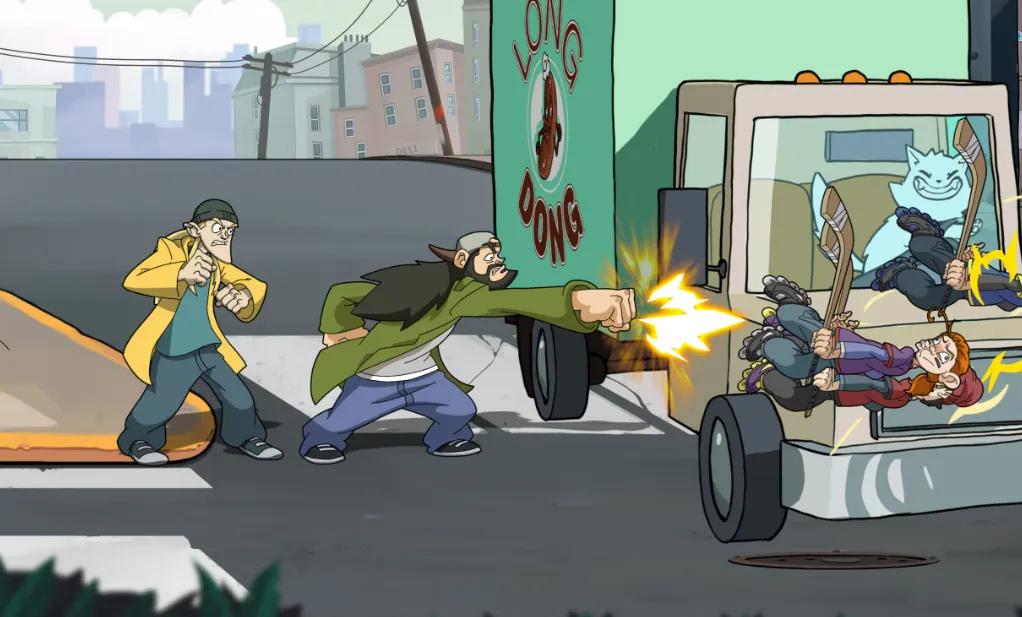
XboxJay and Silent Bob: Chronic Blunt Punch was released on April 20, 2026, on PC, PlayStation, Xbox, and Nintendo Switch, developed by Interabang Entertainment and published by Atari and Digital Eclipse. The 2D beat 'em up walks the pair through Kevin Smith's View Askewniverse, with stops at the Quick Stop, the Eden Prairie Center from Mallrats, and Mooby's, threaded through a combat system that mixes light and heavy attacks with meter-driven supers that briefly transform the duo into their comic-book alter egos Bluntman and Chronic. Launch price is $20.
Jay & Silent Bob, the same boys we saw last year in Call of Duty Black Ops Season 3, are back in a release timed so squarely to 4/20 that the publisher barely needed marketing copy to explain the joke. Interabang ships into a stretch when licensed beat-em-ups have quietly become a category of their own again, with Marvel and Power Rangers titles already in the wild and a He-Man entry on the way. Critical reception has split along clean lines: affection for the writing and the references, reservations about combat feel, and a launch-window wave of bugs the studio has publicly confirmed it is patching.
The Quick Stop, Vandalized

The setup is the right kind of low. Jay and Silent Bob find the Quick Stop being vandalized and decide, in roughly the way these two ever decide anything, to do something about it. From there the game becomes a tour: levels drop you into the Quick Stop itself, then the Mallrats food court, then Mooby's, then deeper cuts that pull from Dogma and Chasing Amy. There's even a nod to the Secret Stash, Smith's actual comic shop in Red Bank.
The writing comes from a team that grew up with the films. Lines land in the right cadence. Jay swears the way Jay swears. Silent Bob does the small head-tilt thing he does. Nothing about it is straining for an audience that doesn't already know what a Buddy Christ is. That last point is the problem the rest of the game inherits. If you don't know what a Buddy Christ is, none of the assist characters land. If you've never seen the Gologothan, the Bluntman transformation doesn't read as the punchline it's meant to be. The dialogue earns the half of the score it's defended on. The other half depends on whether you went to a midnight screening of Dogma at some point in your life.
Combat at the Speed of Stoned

The combat is where the early consensus is loudest. DualShockers went hardest on it, calling the brawler painful in its execution, citing input delay across both attacks and movement, and arguing that the genre's pleasure depends on responsiveness the game doesn't deliver. The verdict there was 5/10 and the framing was technical. I don't fully buy the framing.
The genre being honored is Streets of Rage, Double Dragon, and TMNT: Turtles in Time. None of those games are fluid by 2026 standards. They're stiff. They commit you to animations. They punish a missed input by leaving you rooted in place for a beat too long. The stiffness in Chronic Blunt Punch is recognizably that lineage rather than a modern brawler that forgot what year it is. There's a real conversation to be had about whether the input delay crosses the line from period accuracy into actual unresponsiveness, and on Switch and PC that conversation tilts toward the second answer often enough to be a problem. The read that the game is broken because it doesn't move like Streets of Rage 4 misses what it was trying to be in the first place.
I play the first three levels in one sitting and the cadence does take time to land. Light, light, heavy, dodge. Jay's combo string ends with a kick that telegraphs forever. Bob has more weight per hit, less reach. Once I stop trying to make it feel like a modern brawler, the cadence locks in. That's not a defense of every animation in the game. The dodge has too long a recovery window. The grab feels wrong. But the engine underneath is doing more honest period work than the harshest takes have given it credit for.
A Buddy Christ Heals You

The assist system is the part of the design that earns the comparisons most outlets reached for. Nintendo World Report clocked the resemblance to the 1990s Spider-Man and Venom brawlers Maximum Carnage and Separation Anxiety, which is the right reference point. You fill a meter through standard combat, you call in a friend from somewhere in Smith's filmography, the friend does a thing, the friend leaves. Dante and Randal show up as assists. So does Brody from Mallrats. Cock Knocker too. Buddy Christ shows up and heals you to full when summoned, which is the kind of joke that exists once and then gets to keep existing for the entire run of the game.
Where I want to push back on the consensus is on the level-up system. Multiple outlets flagged it as a flaw because you can't see the experience meter, can't see what stats you have, and only learn that you've leveled up when a small box appears mid-fight to inform you of the fact. The framing is that this is opaque design. I read it as the most period-accurate thing in the game. Streets of Rage 2 didn't show you an XP bar either. You got stronger because you played longer, and the game told you when something new was available because something new was available. The visibility of progression is a 2010s expectation that arrived through RPGs and never left. A 4/20 licensed brawler refusing to participate in that grammar is, to me, more honest than a hidden flaw.
The animation work on the assists is also the part of the package most likely to survive any post-launch reassessment. Buddy Christ pops in with the exact dopey grin of the cardboard cutout. Cock Knocker enters the frame the way Cock Knocker has to enter the frame. The team understood that fan service in a brawler isn't about quotation. It's about staging. Get the staging right and the line doesn't have to do the work.
The 77% Mark

The hardest knock against the launch isn't combat or progression. It's the bugs. JoBlo documented a game-breaking issue at the 77% mark in the Food Court level that locked progress entirely on PlayStation, with the same coverage going on to confirm that the developer reached out directly with a patching schedule: Steam already updated, PlayStation and Xbox patches landing the day after, Switch patch following. The studio's response was fast, and that matters. It also doesn't change the fact that a launch-day buyer who hit the wrong level the wrong way couldn't finish the game until the patch shipped.
The other technical complaints accumulate around that one. Inconsistent voice acting, where some lines are fully delivered and others sit silent with no apparent logic. Music that lands flat in a genre that lives or dies on its soundtracks. Controller detection issues on PC that require restarting the game in a specific order to resolve. None of these are the kind of bug a patch can't fix. All of them landed on day one anyway, on a release that picked April 20 specifically because the date was the entire marketing campaign.
Couch Co-Op and What's Left of an Arcade

What survives all of this is the co-op. The game ships without online multiplayer, which is a real omission in 2026 and one the press has been right to flag. What it does have is local two-player, with each side controlling one of the duo, and the small experiment of playing this game next to another person who also grew up renting Mallrats from a Blockbuster turns out to do a lot of work the solo run can't. The references hit harder when somebody else in the room is laughing at them. The combat feels less stiff when the other player is the one mistiming the dodge. The long levels feel less long when you're talking through them.
The co-op is also the closest the game comes to its own thesis. The View Askewniverse was always about two people on a couch. The films were small. The dialogue was the budget. The idea of Jay and Silent Bob has never been an action premise. It's been two friends who keep showing up in the same frame regardless of what the plot is doing around them. A brawler isn't the obvious adaptation of that idea. A brawler you play next to a friend, holding a controller, half-watching for the next reference, is closer to it than the genre had any reason to be.
What the Punch Lands On

The cleanest summary I can give is that Chronic Blunt Punch is two games inside one box. One is a beat 'em up, period accurate to the early-90s arcade lineage it's lifting from, occasionally too period accurate, with input timing that asks you to slow down and stiffness the consensus has read as unresponsiveness. The other is a tour of a filmography, paced as a series of locations, with a Buddy Christ joke and a Bluntman transformation and the kind of dialogue that exists because somebody on the writing team has been waiting their whole career to put it in a game.
I keep landing on the same thing. The 4/20 release date wasn't a stunt. It was the design brief. A licensed brawler about two stoners from New Jersey, priced at $20, shipping with bugs that the studio is patching on a public schedule, built for two people on a couch, full of references that work or don't work depending on whether you've seen Dogma. None of that resolves cleanly into a number. The version of this game that justifies its existence is the one you play with somebody else who already gets it. That's a smaller audience than a 2026 launch usually targets. It's also the audience the game was made for.


 Successfully copied... Thank you for sharing our content!:



5% deposit bonus up to 100 gems

a free Gift Case





EGAMERSW - get 11% Deposit Bonus + Bonus Wheel free spin


EXTRA 10% DEPOSIT BONUS + free 2 spins

3 Free Cases + 100% up to 100 Coins on First Deposit


5 Free Cases, Daily FREE & Welcome Bonuses up to 35%

3 free cases and a 5% bonus added to all cash deposits.

+5% to deposit




Comments