




High Above Review: A Rooftop Sandbox Worth the Climb
 Review
 Steam
SteamHigh Above, developed solo by DVision Games, released on April 9, 2026, for PC at a price of £8.50. The game drops players onto empty rooftops and asks them to build something worth looking at. There are no enemies, no timers, and no fail states. Four themed settings, a handful of challenge prompts, and a deep catalog of decorative objects make up the entire package.
A Rooftop With No Rules

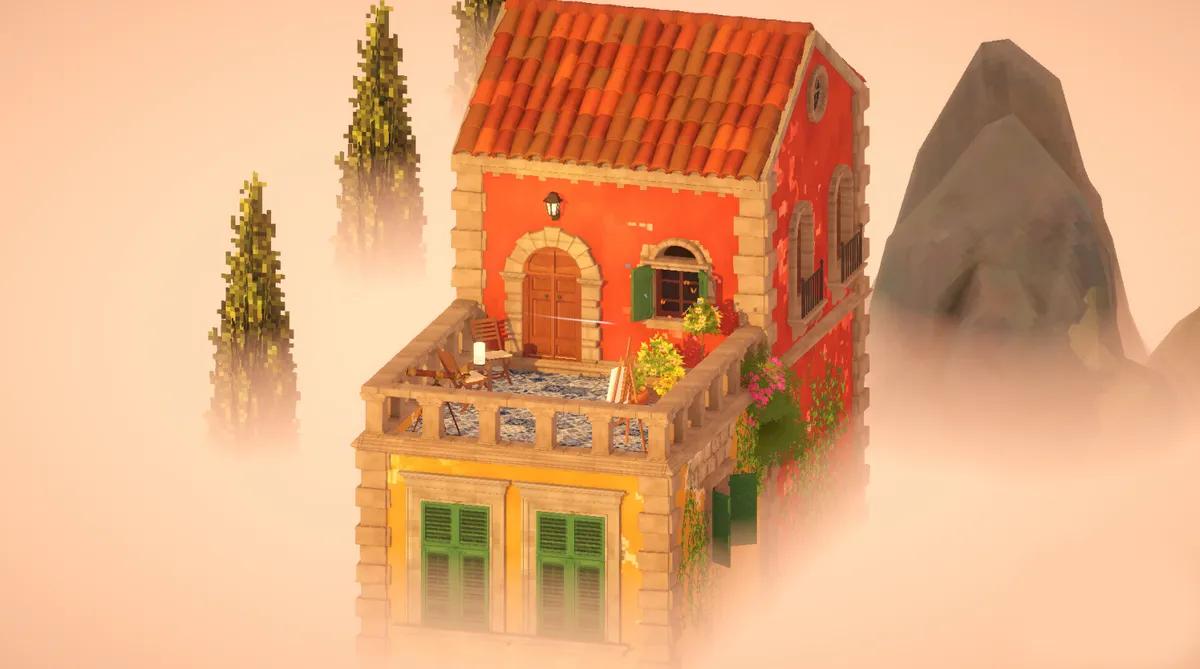
The core of High Above is placement. Players pick a setting — Europe, Japan, Modern, or Futuristic — and start stacking foundations, walls, and platforms to form the skeleton of a rooftop. From there, the game opens into decoration. Furniture, string lights, lanterns, pergolas, potted plants, greenhouses, swimming pools, laundry lines, and dozens of other objects fill out the catalog. Each one can be positioned, adjusted, and layered to create scenes that range from a sunrise yoga studio to a grungy loading dock.
There is no objective in free play. The game provides tools and space, and the player decides what to do with both. Structures can be stacked to create multiple levels. Surrounding buildings, overpasses, and even clouds can be placed to frame the scene. Once the architecture is set, smaller details — books, food, accessories, ivy around doorways — push the build from functional to lived-in. Characters can be added last, sitting on furniture or gazing over the edge of the rooftop.
The absence of pressure is deliberate. High Above never nudges the player toward a deadline or a score. Time passes only through the sky, which cycles from warm pinks and oranges into deep blues and blacks. Rain can be summoned at the click of a button. Birds can be toggled on or off. Wind carries its own sound layer. The entire atmosphere bends to whatever the player wants, and the result is a sandbox that rewards patience over speed. Stopping the time wheel at night and watching placed string lights flare to life across a finished build turns a decorating session into something closer to a diorama reveal.
Challenge Mode Adds a Frame

For players who want direction, each of the four settings includes its own set of challenge prompts. These provide a theme, a budget, and a list of requests from characters who want specific things built into their rooftop space. Sometimes multiple characters share the same build, and their preferences conflict. A character might want greenery while another wants open floor space, and the budget forces compromise.
Completing a prompt unlocks the next one along with new objects for use in other builds. There is no timer attached to any challenge. Players work at whatever pace they choose, and each prompt can be replayed with a different approach. The budget mechanic adds real constraint — overspending on one character's requests means cutting corners elsewhere, and the math forces genuine trade-offs rather than letting players simply place everything they want. The structure is light — more of a suggestion than a campaign — but it gives a foothold to anyone who finds a blank canvas overwhelming.
One restriction stands out during challenges: the environment becomes locked. Time of day freezes at a fixed point, rain cannot be triggered, and birds cannot be added. The rest of the game treats environmental controls as a core creative tool, so removing them during the one mode that introduces structure feels like an odd design choice. No in-game explanation accompanies the limitation.
Controls and the Learning Curve

High Above is a mouse-and-keyboard-only game, and the control scheme takes time to absorb. A shortcut guide is available through a scroll icon in the bottom-right corner of the screen, and returning to it repeatedly is normal even after several hours of play. Placing objects inside greenhouses, for example, requires pressing the scroll wheel — a function that is not immediately obvious and not surfaced through any tooltip during early play.
Camera controls allow for isometric and perspective views, and a pixelation filter is available for in-game screenshots. The photo mode does not include selectable filters beyond these options, but the combination of camera angle and time-of-day adjustments provides enough flexibility to frame compelling shots. Physics occasionally interfere with object placement, requiring camera adjustments or temporary removal of nearby items to get pieces where they need to go. These friction points are minor individually but accumulate over long building sessions.
Customization extends beyond object placement. Depending on the selected theme, players can alter paint colors, brick aging, roof styles, and molding details. The Europe and Japan settings lean into traditional architectural elements, while Modern and Futuristic open up sleeker surfaces and sharper lines. Environmental controls sit in the bottom corners of the screen: a time wheel on the left governs the hour of day and its cycle speed, while a music note icon on the right opens toggles for music, wind sounds, environmental audio, and evening ambience. The layering of these options gives players a surprising degree of control over the mood of each build without ever cluttering the interface.
Sound Design That Disappears Into the Build

The soundtrack is soft, melodic, and unobtrusive. Piano-led tracks loop without hard transitions, and after enough time, the repetition stops registering entirely. The music blends into the act of building rather than sitting on top of it. In the Futuristic setting, the soundtrack shifts to incorporate synthesized textures that match the sci-fi aesthetic, giving that theme its own distinct audio identity separate from the other three.
Rain and wind sounds layer on top of the music when activated, and all audio elements can be individually toggled. The freedom to strip the soundscape down to silence or build it up with overlapping environmental tracks means the player controls the auditory space as precisely as the visual one. I think the audio design is the most polished element of the entire game, functioning less as background music and more as a tool the player shapes alongside the rooftop itself. Earlier builds of the game had the music cutting out after roughly ten minutes; that limitation is gone, and tracks now run uninterrupted across sessions lasting hours.
A Sky That Never Quite Opens

Visually, High Above operates in a narrow but effective range. The lighting is perpetually warm, cycling through dawn and dusk tones that cast soft gradients across every surface. Builds glow differently depending on the time of day, and watching string lights activate as the sky darkens adds a layer of atmosphere that screenshots cannot fully capture. The Futuristic setting introduces overlay colors that break away from the shared palette of the other three themes, offering a visual identity distinct enough to feel like a separate mode. Everything carries a dreamlike softness — edges blur gently, colors stay muted, and the overall effect sits somewhere between a painting and a lo-fi album cover.
The limitation is the sky itself. High Above never reaches a clear, bright blue. The palette stays locked in sunrise and sunset hues regardless of the time setting, and while the result is consistently attractive, the absence of a full daytime sky removes an entire register from the game's visual range. Clouds drifting through open blue carry a different feeling than perpetual golden hour, and the game has no way to access that contrast. The omission becomes more noticeable the longer a session lasts.
Character models present a similar constraint. The available pool is small, and representation is limited. Mobility aids, hijabs, and broader cultural diversity are absent from the roster. Character models also cannot be rotated, which clashes with the flexibility afforded to every other placeable object. In a builder that otherwise prioritizes player expression, these gaps register clearly.
What Could Grow

High Above's building catalog covers a wide range of decorative objects, but the structural options feel thin. Players work with one or two base shapes for most builds, and the absence of individual wall panels, floor tiles, or modular pieces restricts architectural ambition. I find myself wanting more raw building blocks — shapes and surfaces that could bridge gaps or cover seams without relying on preset structures. The game provides enough pieces to build attractive scenes, but it signals a ceiling that more adventurous builders will hit within their first few sessions.
Color options for objects are similarly constrained. String lights come in one style. Plants repeat across settings without enough variation to distinguish one build from another. Additions like colored lighting, fireflies alongside the existing bird toggle, or expanded foliage varieties would extend the creative range without altering the game's core design. The developer has published a post-release roadmap, and community feedback appears to inform the update direction. The foundation is strong enough that targeted expansions — more structural variety, broader character representation, a true daytime sky — could shift the game's creative ceiling considerably.
The solo development context matters. High Above is the work of one person, and the scope of what already exists is substantial for that scale. Four themed settings, a full challenge mode, deep environmental controls, and a large decorative catalog represent a significant output for a solo project. The rough edges are real, but they sit inside a framework that has clear room to expand. Games like Tiny Glade and Spirit City: Lofi Sessions occupy nearby territory in the cozy builder space, but High Above carves out its own position by anchoring the entire creative loop to a single rooftop and the sky above it. The lo-fi aesthetic and pastel color palette give the game an identity that is immediately recognizable and distinct from its closest competitors.
Verdict

High Above delivers a building sandbox that earns its calm without sacrificing creative depth. The loop of placing, adjusting, and refining rooftop scenes holds across long sessions, and the environmental controls give players authorship over mood as much as architecture. High Above is an 8/10 builder game.
Pros:
- Audio design integrates seamlessly into the creative loop.
- Environmental controls offer precise atmosphere customization.
- Challenge mode provides light structure without undermining the sandbox.
Cons:
- Building variety hits a ceiling with limited structural shapes.
- Character models lack diversity and cannot be rotated.
High Above is a focused sandbox that knows exactly what it wants to be and does not reach beyond that scope. The gaps in building variety and character representation are real, but the core loop of constructing and decorating rooftop spaces holds up well beyond the first few hours and rewards players who return to earlier builds with fresh ideas. For players drawn to creative builders that prioritize mood over mechanics, this rooftop is worth the climb at £8.50.


 Successfully copied... Thank you for sharing our content!:



5% deposit bonus up to 100 gems

a free Gift Case





EGAMERSW - get 11% Deposit Bonus + Bonus Wheel free spin


EXTRA 10% DEPOSIT BONUS + free 2 spins

3 Free Cases + 100% up to 100 Coins on First Deposit


5 Free Cases, Daily FREE & Welcome Bonuses up to 35%

3 free cases and a 5% bonus added to all cash deposits.

+5% to deposit




Comments