




A Storied Life: Tabitha Review
 Steam
Steam Review
Lab42's A Storied Life: Tabitha opens with a letter from a dead woman named Tabitha, who asks an unnamed relative to sort through her cottage and sell off what they can. The game was released on April 14, 2026, on Steam for $13, published by Secret Mode. It combines a grid-based packing puzzle with a memoir-rewriting system that turns household objects into narrative fragments. The result is a game caught between two ambitions — one it fulfills with quiet confidence, and one it sometimes fumbles.
Packing Up a Life, One Room at a Time

The setup borrows from Unpacking but reverses the direction. Instead of placing items into a new home, players move room by room through Tabitha's British cottage, deciding what to keep, recycle, or send to auction. Each room offers a single cardboard box with a small grid layout, and every object must be rotated and arranged to fit inside it. Only the items packed into the box carry over to the next phase of the game.
Rooms contain far more objects than the box can hold. A kitchen counter might have ceramic dishes, framed photos, a set of old medals, and a suspicious hammer with dried red matter on the head. Players click through drawers and cupboards to find hidden items, and some require moving furniture or locating keys. The search phase works well — it rewards curiosity and gives each room a sense of lived-in clutter rather than a sterile arrangement of collectibles.
Objects range from the mundane to the bizarre. There are knitting supplies, debt collection letters, occult wall hangings, photos with scratched-out faces, and at least one haunted doll. The variety feeds directly into the game's second mechanic: every item a player keeps contributes four words to a pool used to reconstruct Tabitha's damaged memoir.
The Memoir Mechanic: Mad Libs With Consequences

Before she died, Tabitha had a memoir in progress with a publisher. Water damage has rendered most of it illegible, and the player fills in the blanks using words generated by the objects they packed. The format resembles Mad Libs — each gap in a chapter accepts specific word types, and the player drags options from their collected pool into the open slots.
This system is the game's central hook and its biggest source of friction. Each item generates words tied to a particular story strand. Gardening tools produce language about horticulture. Heart-marked keepsakes yield romantic vocabulary. Witchcraft paraphernalia unlocks occult terminology. If a player packs items from a single thematic group, the resulting chapter reads coherently. If they mix freely, the memoir devolves into grammatical nonsense — sentences that contradict themselves or collapse into absurdity.
The game does offer guidance. Dot patterns printed on the box correspond to patterns on individual items, signaling which objects belong to the same narrative thread. Matching these patterns produces a usable selection of nouns and adverbs for the memoir screen. Finding multiple items with a shared theme — a husband's belongings, or tools from a garden shed — generates word combinations that form legible paragraphs. The system works, but it requires players to treat the packing phase as a sorting exercise rather than an open-ended exploration.
Multiple Tabithas, None of Them Fixed

Tabitha is not a single character. She is a set of overlapping possibilities defined by which objects the player decides to keep. One playthrough might paint her as a loving wife and grandmother. Another might reveal a career-driven horticultural expert. A third might cast her as an aspiring witch. A fourth might suggest she committed fraud and possibly assault — the hammer, after all, could tell more than one story.
The game contains several distinct story strands, each tied to a themed set of objects spread across the cottage. Completing a strand requires packing the right items across multiple rooms, which means replaying chapters with different selections. The full spread of endings takes roughly 10 to 15 hours to uncover, and some of the revelations land with genuine emotional weight. The stories move between warmth and grief without forcing either tone.
This open-endedness also means the game never confirms anything. The dried substance on the hammer might be rust. The scratched-out face in the photo might have an innocent explanation. Tabitha's life remains ambiguous by design, and the player's choices define her posthumously. That ambiguity fits the premise — reconstructing someone's life from objects is inherently speculative — but it also means the emotional payoff depends on the player's willingness to commit to a single version of events across multiple rooms.
The Box Problem

The packing puzzle is where the game's design starts to strain. Each room provides one box, and the grid inside it is small. Large items — a serving dish, a framed painting — consume most of the available space. An A4 piece of paper occupies the same footprint as a thick book and adds to the box's weight in equal measure. Weight limits further restrict what fits, and fragile items require bubble wrap, which eats into both space and supply.
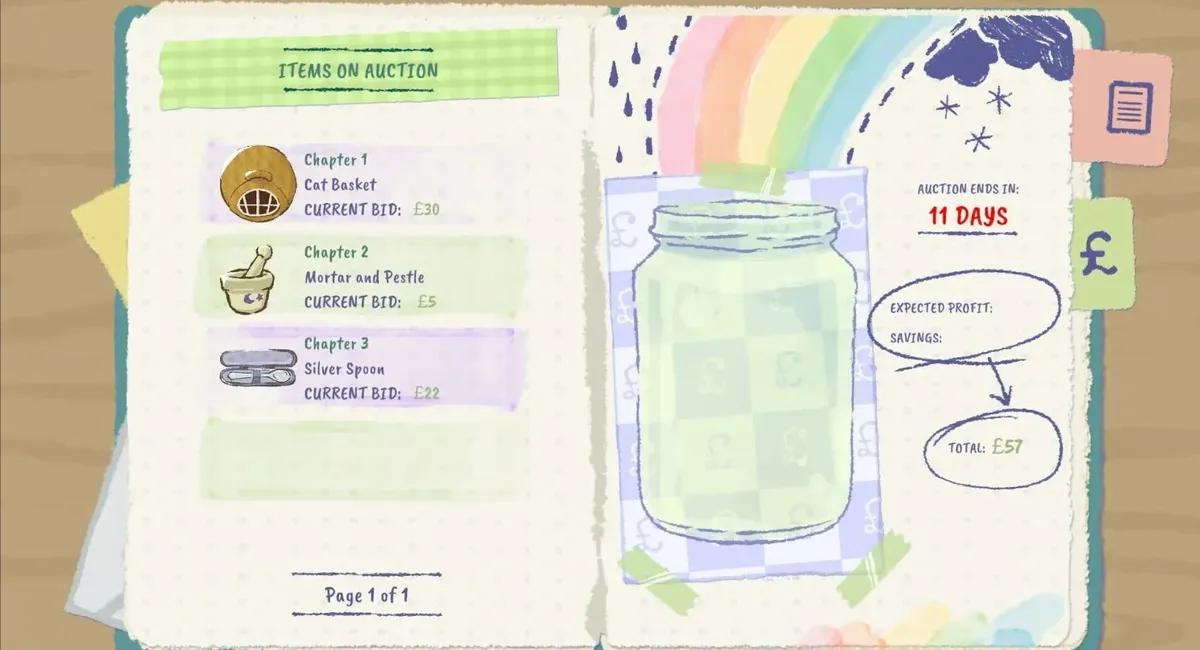
Players find tape, bubble wrap, and vacuum-seal packing bags scattered through Tabitha's cupboards. Tape reinforces the box to handle more weight. Packing bags shrink soft items. Bubble wrap protects breakables from shattering — and shattered items fill the memoir screen with unusable words. These supplies replenish across rooms, and a small budget earned from auctioned items can cover shortfalls. Running out of materials rarely becomes a serious threat.
The constraint that does cause problems is the single-box limit. Ninety percent of the objects in a given room cannot fit together, and packing one or two large items often leaves no space for anything else. Players who want to follow a specific story strand can usually fit the required objects, but anyone hoping to mix and match across themes hits a wall fast. There is no option to buy a second box with auction earnings, and no upgrade path that expands capacity in later chapters. The restriction keeps the puzzle tight but makes the packing feel punitive rather than satisfying when a player wants to explore more than one narrative thread per room.
Difficulty Options and Daily Puzzles

Lab42 built in two modes to address the box frustration. Cosy mode applies full weight and fragility rules. Relaxed mode strips some of these requirements away, letting players focus on the memoir without worrying about shattered porcelain or overloaded cardboard. The option sits in the menu from the start and can be toggled freely.
I think the difficulty toggle is a smart concession, though it treats the symptom rather than the cause — the real limitation is the single box, and loosening the physics rules does not change how few items a player can take from each room. Later chapters introduce reinforcing tape as an additional tool, but nothing else arrives to expand the core packing capacity.
Outside the main campaign, the game offers daily puzzles. These strip out the narrative layer entirely and task players with fitting a pile of items into a box as efficiently as possible. The mode provides a reason to return after finishing the story, though its appeal depends entirely on how much a player enjoyed the spatial puzzle in isolation. Without the memoir hook, the packing mechanic is pleasant but thin.
Presentation and Atmosphere

The cottage is hand-drawn and detailed. Cupboard doors creak. Unfolding jumpers produces a soft rustle. Each room feels domestic and specific — the cramped kitchen, the cluttered garage with Tabitha's ancient car, the living room with its discolored wallpaper where frames once hung. The sound design and art direction sell the setting as a real place rather than a game board, and emptied rooms carry a visible absence that reinforces the premise without overplaying it.
I find the visual presentation to be A Storied Life: Tabitha's strongest asset, grounding even the game's weaker mechanical moments in a space that feels worth exploring. The British domestic setting avoids spectacle and leans into the kind of quiet, recognizable detail that makes rummaging through someone's belongings feel appropriately intimate. Objects tell micro-stories through their placement and condition — a photo tucked behind a shelf, a letter shoved into the back of a drawer — and the environment rewards attention even when the memoir mechanic does not.
The game does not use voice acting. Story delivery happens entirely through the memoir pages and the objects themselves, which keeps the tone restrained. Music stays low and ambient, never competing with the environmental sounds that do most of the atmospheric work.
Verdict

A Storied Life: Tabitha builds a genuinely affecting premise around packing up a dead woman's house and reconstructing her life from whatever fits in a box, but the single-box constraint and the unpredictable memoir system hold it back from reaching the emotional clarity its best story strands deserve. A Storied Life: Tabitha is a 7/10 game.
Pros:
- Hand-drawn art and sound design create one of the most convincing domestic spaces in the cosy genre.
- Multiple story strands offer meaningfully different versions of Tabitha's life, some of which land with real emotional force.
- Hidden objects and interactive furniture make the search phase of each room consistently engaging.
Cons:
- The single-box limit restricts experimentation and makes most items feel disposable rather than meaningful.
- The memoir system produces incoherent results too often when players deviate from a single narrative thread.
A Storied Life: Tabitha works best when a player commits to one story strand per playthrough and treats the packing puzzle as a means to that end rather than a freeform sandbox. The cottage itself is worth the visit — Lab42 built a space that earns the quiet sadness of its premise through specificity rather than sentiment. Whether the memoir mechanic justifies the return trips needed to see every ending depends on each player's tolerance for trial, error, and the occasional grammatical crime.


 Successfully copied... Thank you for sharing our content!:



5% deposit bonus up to 100 gems

a free Gift Case





EGAMERSW - get 11% Deposit Bonus + Bonus Wheel free spin


EXTRA 10% DEPOSIT BONUS + free 2 spins

3 Free Cases + 100% up to 100 Coins on First Deposit


5 Free Cases, Daily FREE & Welcome Bonuses up to 35%

3 free cases and a 5% bonus added to all cash deposits.

+5% to deposit




Comments