




Beyond Words Review
 Review
 Xbox
Xbox PlayStation
 Steam
SteamBeyond Words comes from MindFuel Games, a studio founded by Steve Ellis and David Doak, the designers behind GoldenEye 007, Perfect Dark, and TimeSplitters. Published by PQube and released April 9, 2026, on Xbox Series X|S, PS5, PC, and Switch, the game grafts Scrabble-style tile placement onto a roguelike card economy modeled after Balatro. Players draw seven letter tiles per turn, place them on a board to form words, and chase escalating score targets across 45 levels. The pitch is direct: take a century-old word game, inject it with modifier cards and stacking multipliers, and see what breaks.
From Shooters to Scrabble

Ellis and Doak carry a specific kind of pedigree. The two built their reputations at Rare during the Nintendo 64 era, then co-founded Free Radical Design and shipped the TimeSplitters trilogy. In 2021 they reformed Free Radical under Deep Silver's umbrella, but by 2023, the studio was shuttered again and the TimeSplitters revival was scrapped. Beyond Words represents a total pivot — a small-budget puzzler backed by PQube instead of a Triple-A publisher. The scale is incomparably smaller, the scope tighter, the risk lower. That trajectory explains the game's modest ambitions and also its careful, systems-first design. The budget, by all appearances, is a fraction of what a TimeSplitters sequel would have cost. There are no cutscenes, no voice acting, no narrative wrapper. The game opens on a branching level roadmap and gets out of the way.
Core Mechanics

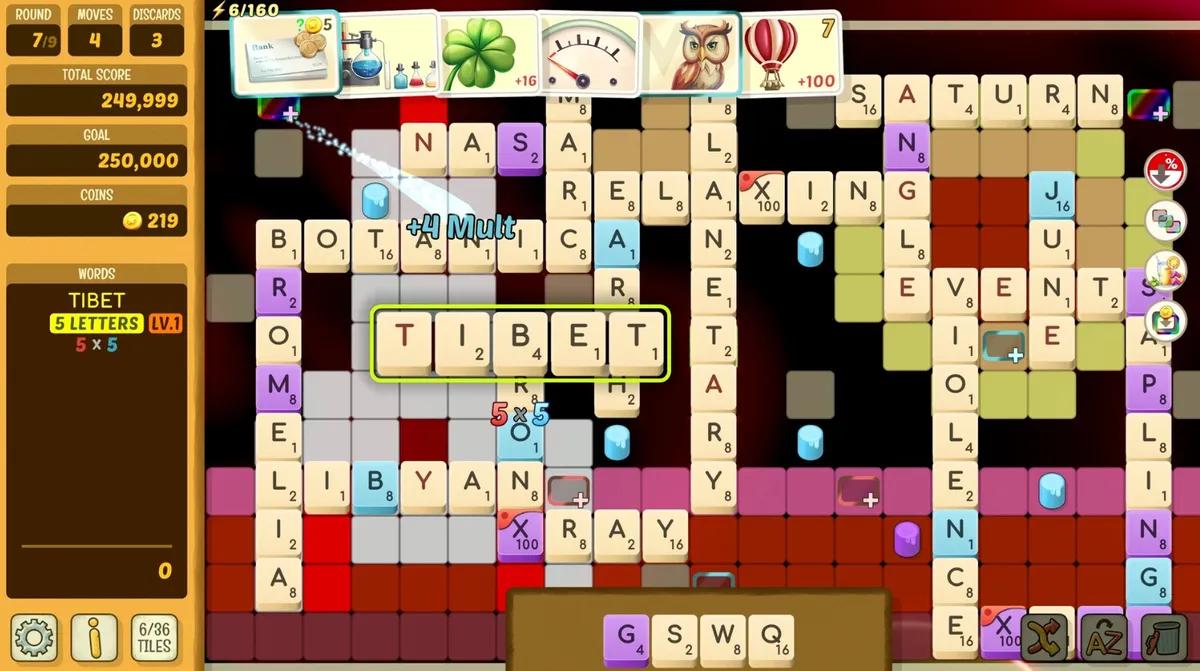
Each level opens on a mostly empty board, dotted with bonus squares that echo Scrabble's double-word and triple-letter tiles. A player has five moves to reach a target score. The first targets hover around 500 points. By the middle stages, they climb to 10,000 and beyond, eventually demanding 250,000 or more from the same five moves. Scoring follows a modified Scrabble logic — each letter carries a base value, and word length applies a multiplier — but the real math comes from stacking external modifiers. Between rounds, coins earned during play open a shop stocked with Power Cards, Booster Cards, Perks, and special tile types. These cards transform the arithmetic. Keep It Short, for example, adds 10 to a word's multiplier if the word is four letters or fewer. Loquacious gains a cumulative +5 multiplier every time a player scores two or more words in a single move, but resets to zero if a turn produces only one word. Like A Robot grants a multiplier whenever the letters R, B, O, or T appear. Tile Mania spawns three random tiles on the board after each move. There are over 300 unique modifiers at launch, split across Power Cards, Booster Cards, Perks, and special tiles including Bomb tiles that clear the board and Virus tiles that spread and grow in value each turn.
The Balatro Blueprint

The comparison to Balatro is unavoidable and intentional. Both games take a familiar tabletop format — poker in Balatro's case, Scrabble here — and warp it through roguelike modifier cards that force players to rethink foundational strategy. In Balatro, the central tension is between the hand you're dealt and the Jokers you've assembled. In Beyond Words, the tension sits between the letters in your rack and the Power Cards shaping your scoring conditions. The difference is where luck falls. Balatro locks a large share of progress behind the randomness of a card draw. Beyond Words shifts weight toward vocabulary. A player who can pull an obscure seven-letter word from memory — "bricolage," "iconolatry" — will score higher than one placing safe four-letter standbys, regardless of modifier luck. The skill floor is higher, and the ceiling stretches with the player's lexicon. Crosshatching words against existing columns and rows to generate multiple scoring words per move adds a spatial puzzle layer that poker lacks entirely. The pace is slower, more deliberate. Beyond Words does not produce the compulsive, slot-machine pull that made Balatro consume entire evenings. Each move demands time, and the reward is intellectual rather than dopaminergic.
Difficulty and Pacing

The scoring curve is where Beyond Words falters. Target scores escalate fast, and the jump from early rounds to mid-game demands can feel abrupt. The game offers 45 levels along a branching roadmap, each containing nine segments, plus an Endless mode. Forty boss challenges layer on additional constraints — tile restrictions, forced word lengths, other rule distortions — and some of these arrive without enough warning or counterplay. The result is a pacing problem. The early hours can feel like setup without payoff. One account of the game describes playing for nearly three hours before hitting a run where the Power Card synergies genuinely clicked and the scoring systems came alive. That wait is too long. Balatro delivers its first eureka moment within minutes. Beyond Words asks for patience it does not always reward. When the cards do align — when a Loquacious pairs with a Power Of Five and a Must Fit Somewhere, and the player builds a chain of two-word moves while extending a base word across multiple turns — the game reaches a satisfying peak. Those peaks are real, but they appear too infrequently in the current balance. I think the core loop deserves a gentler curve in its first few hours, because the system has enough depth to sustain long runs once a player grasps the synergies. The 130 trophies across bronze, silver, and gold tiers provide a long-term chase, and seeded runs allow players to share and compare specific boards. The replayability infrastructure exists. A time-attack mode offers a faster, more frantic alternative to the standard run structure, and a detailed stats screen and collection tracker give completionists a reason to catalog every unlock. The onboarding does not match it.
Presentation

The visuals are functional and flat. Tiles are readable. The UI communicates card effects and scoring math without confusion. But the art direction stops there. Backgrounds cycle through aimless pastel swirls. Themed biomes arrive in later stages and provide some variety, and the board layouts themselves shift away from standard grids into more complex shapes as the game progresses. But the default look carries a plasticky sheen that does nothing to create atmosphere or identity. A word game does not need photorealism, but it benefits from texture and warmth — the tavern-lit grain of Gwent's card table in The Witcher 3 is a useful reference point for what even a simple board game interface can evoke. Beyond Words does not attempt that kind of environmental storytelling. Audio follows the same trajectory: present, functional, forgettable. Nothing grates, but nothing sticks. On the performance side, occasional frame-rate dips appear on console, and navigating dense boards with a controller can be clunky. Neither issue is severe, but both reinforce the sense of a game that shipped at a competent baseline without the final layer of polish.
Systems and Strategy

The strategic depth, when it reveals itself, is the game's strongest argument. Tile bag management — duplicating valuable letters, destroying dead weight — feeds directly into run planning. Stickers and enhancements modify individual tiles, adding another axis of customization. The Plus and Multiply modifier types create distinct mathematical paths: additive stacking for steady climbs, multiplicative stacking for explosive turns. Bomb tiles force a risk-reward decision between clearing a path to a high-value board square and holding them to purge low-value tiles from a cluttered hand. Virus tiles create a ticking clock that rewards timing. I find the interplay between vocabulary skill and card strategy to be the game's defining strength, and when a run lines up correctly, the board becomes a dense, satisfying puzzle where every tile placement matters three moves ahead. Planning for future turns — setting up a word that can be extended in two directions on subsequent moves — adds a layer of foresight that separates Beyond Words from both standard Scrabble and from Balatro's more reactive hand management. The problem is that this depth takes too long to surface for new players and remains too dependent on shop offerings in any given run.
Verdict

Beyond Words has a sharp mechanical core buried under pacing issues, flat presentation, and an unforgiving early difficulty curve that will turn away players before the systems reveal their potential. Beyond Words is a 7/10 game.
Pros:
- Deep modifier system with over 300 unique cards, perks, and tile types
- Vocabulary-driven skill ceiling that rewards knowledge over luck
- Strong replayability through 45 levels, 130 trophies, and seeded runs
Cons:
- Scoring curve escalates too steeply, delaying the first satisfying synergy payoff
- Flat visual and audio presentation lacks atmosphere and identity
Beyond Words contains a genuinely clever word-puzzler that rewards strategic thinking, board planning, and a deep vocabulary. The card economy and modifier stacking create runs that feel distinct and encourage repeated attempts. But the game needs a smoother difficulty ramp and a stronger visual identity to stand alongside the roguelike deckbuilders it clearly admires.


 Successfully copied... Thank you for sharing our content!:



5% deposit bonus up to 100 gems

a free Gift Case




EGAMERSW - get 11% Deposit Bonus + Bonus Wheel free spin


EXTRA 10% DEPOSIT BONUS + free 2 spins

3 Free Cases + 100% up to 100 Coins on First Deposit


5 Free Cases, Daily FREE & Welcome Bonuses up to 35%

3 free cases and a 5% bonus added to all cash deposits.

+5% to deposit




Comments