




Mouse: P.I. For Hire Review
 PlayStation
 Steam
Steam Review
Fumi Games first showed Mouse: P.I. For Hire in a 2023 trailer, when the game was still just called "Mouse." Three years later, the full release arrives on April 16 for PC, PS5, Xbox Series X/S, and Nintendo Switch 2, published by PlaySide Studios. The pitch is a first-person shooter set in a monochrome 1930s cartoon world, starring anthropomorphic mice caught up in a film noir detective story. The result is a roughly 12-to-13-hour campaign that prioritizes style, gunplay, and mystery-solving in nearly equal measure.
Critics have already given Mouse: P.I. For Hire positive reviews — see more in our post. For now, I’ll share my own take on the game.
A Cartoon World Built on Rubber Hose Animation

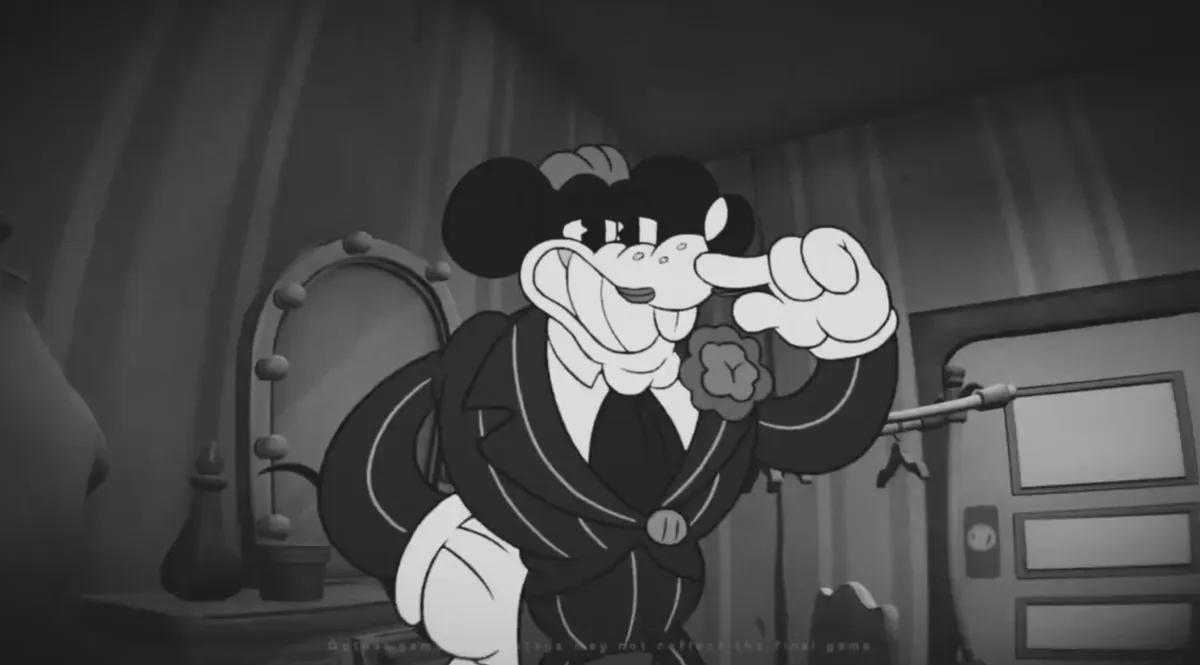
The entire game runs in greyscale. Every character, weapon, and interactable object is rendered in 2D, mimicking the rubber hose animation style of early Disney and Fleischer cartoons — Steamboat Willie and Silly Symphonies territory. Pre-release concerns about enemy visibility in such a limited palette turn out to be unfounded. The hand-drawn environments and character animations carry enough distinction to keep the action readable at all times.
Levels pull from old-school movie and cartoon tropes of the 1920s and 1930s. There is an opulent opera house, a steamboat overrun with gangsters, a spooky laboratory, a swampy cheeselegging hideout, a western movie set on Tinsel Avenue, and seaside docks. Plants have faces. Spiders wear shoes. Slugs dance. Developer Fumi Games built the game in Unity, and the animation work carries a handmade quality throughout — characters squash and stretch, shotgun shells get stuffed into guns with reckless speed, and enemies burst apart in fountains of inky-black blood. Visual filter settings let players adjust the amount of noir-style film flickering on screen. The rare technical hiccup exists: occasional frame drops, minor clipping, and some texture flickering. These are small blemishes on an otherwise polished presentation.
Jack Pepper and the Mystery of Mouseburg

The player controls Jack Pepper, a war veteran and former cop turned private investigator, voiced by Troy Baker. Pepper lives and operates in Mouseburg, a crime-ridden city populated by talking mice and shrews. The case begins with the disappearance of one of Pepper's old war buddies, now a famous magician, and quickly spirals into a conspiracy involving corrupt cops, shrew trafficking, illicit cheeselegging, a murdered Tinseltown star, and a political party directly modeled on the Nazis attempting to round up shrews who are already treated as second-class citizens.

Baker delivers every line with gravel-voiced authenticity. The writing is loaded with cheese puns — brie, blue, cheddar, gouda, fondue, Stilton — and pop culture references, including a nod to the 2012 "potion seller" video. The noir pastiche lands more often than it misses, though the story can tip into heavy-handedness, particularly around the Nazi-mouse political allegory. Some dialogue runs long. The developers clearly wanted to make the most of Baker's presence, and certain scenes feel overwritten as a result. Levels occasionally halt the action to have Pepper question multiple characters in sequence, which can frustrate players eager to get back to the shooting.
Between missions, Pepper returns to a hub area around his office. A top-down overworld map lets players drive a small car between locations, replacing loading screens with a charming animated transition. The office itself serves as a base where clues from each mission get pinned to a corkboard, gradually mapping out each case and how they connect. Nearby, the Little Big dive bar offers conversations with residents like shrew bartender John Brown and politician Cornelius Stilton. Tammy Tumbler, a friend operating from a basement workshop, upgrades weapons in exchange for schematics found during missions.
Guns, Cheese, and the Art of Shooting Mice

Combat accounts for roughly 80 percent of playtime. The structure is level-based: enter an area, clear out enemies, collect clues and items, move on. Pepper carries up to nine pieces of cheddar for mid-combat healing, and health tonics, armor, and ammunition are scattered generously across every stage. Typewriters serve as manual save points, and regular autosaves keep checkpoints close.
The weapon roster starts conventional — the Micer pistol, the Boomstick shotgun, the James Gun (a Tommy Gun by another name) — and expands to include an acid-spraying Devarnisher, a cannonball launcher, a brain-scrambling ray gun, dynamite, and the fiery double-barrelled Kiss Kiss. The Devarnisher coats enemies in turpentine before they melt away, leaving vacant eyes and scattered bones on the floor. Dynamite triggers comical explosions. Pianos and anvils drop from ceilings when supporting ropes get shot. Graffiti reading "totally normal wall!" marks surfaces that can be destroyed with explosives. Each weapon can be upgraded using hidden blueprints, and upgrades add meaningful changes: the Boomstick gains a charged alternate fire mapped to L2 on the DualSense, bypassing aim-down-sights entirely.
Power-ups inject further variety into fights. An incendiary chilli pepper sets enemies ablaze. A coffee pickup sprouts finger guns with unlimited ammo. A can of spinach inflates Pepper's arms to Popeye proportions for devastating punches. The weapon wheel allows free switching in combat, and kicking remains a viable option throughout the campaign.
Movement, Exploration, and Where Levels Break

Pepper's traversal kit expands over the campaign. The starting moveset is a simple jump and dash. Double-jumping arrives via spring-loaded soles. Wall-running opens vertical routes. A tail-spin ability enables gliding and riding updrafts. A grappling mechanic uses the tail like Indiana Jones's whip to swing from hooks. Stamina limits consecutive dashes and extended tail spins but never becomes a serious constraint in practice.
These abilities serve exploration more than combat. Levels are linear but full of branching paths and hidden areas. Newspapers, comic strips, baseball cards, and ultra-secret Jack Pepper figurines are tucked into corners reachable only with the full movement kit. A press of the d-pad summons a fingerprint-dusting brush that sweeps a chalky trail to the next objective, a practical solution for navigation in the game's twisting corridors.
The freedom of movement can break scripted sequences. One level set in a film studio allows players to reach a rooftop early, triggering a floor-collapse set piece out of order and approaching a key NPC from behind, rendering him non-interactive. An invisible wall meant for a later train crash sequence can be jumped over entirely. These moments do not block progress but reveal how the compact environments buckle under determined exploration. Levels also cannot be revisited after completion, and doors frequently lock behind the player, punishing anyone who wants to backtrack for missed collectibles.
Difficulty and the Resource Problem

Mouse: P.I. For Hire is not a punishing game. Health pickups, ammo caches, and armor are abundant enough that resource scarcity almost never factors into combat. The Supersleuth difficulty — the hardest available — still allows a near-deathless run for experienced FPS players. Boss arenas pose the most threat, and even those tend to challenge through environmental hazards rather than raw enemy damage or numbers.
The generous resource economy undermines weapon variety. With ammo plentiful for every gun, there is little incentive to switch weapons tactically the way other boomer shooters demand. The James Gun alone can carry a player through most of the campaign without issue. Some later weapons feel underpowered or redundant, though upgrades salvage a few of them. A handful of late-game combat encounters spike in difficulty without warning, creating an uneven curve after hours of relatively smooth sailing. I think this design choice — flooding levels with resources to keep the pace fast — makes Mouse broadly approachable but leaves a real gap for players who want the combat to push back harder.
Sound, Music, and the Details Between Shootouts

Composer Patryk Scelina delivers a jazzy, brass-heavy soundtrack that matches the 1930s setting beat for beat. Every level carries its own track, each sounding like a brass band running on caffeine. The hub world transition music sets the noir tone without overplaying it. Sound design extends to enemy death noises — one enemy screams "GABAGOOL" upon dying — and the overall audio package contributes as much personality as the visuals do.
The voice cast inhabits their roles fully. Baker anchors the game as Pepper, but the supporting characters — bartenders, politicians, villains, allies — each carry distinct vocal performances that bring Mouseburg to life. Minor audio bugs persist: sound effects shift abruptly depending on player position within a room, dynamite occasionally vanishes after being thrown, and the baseball card minigame tutorial repeats every round. None of these issues block progress.
I find that baseball card minigame — a Top Trumps-style system using collectible cards gathered across levels, played against NPCs at the Little Big bar — to be a surprisingly solid distraction that rewards hunting down every card in the campaign.
Verdict

Mouse: P.I. For Hire pulls together rubber hose animation, noir detective fiction, and boomer-shooter gunplay into a package that works far better than its elevator pitch might suggest. The art direction, voice acting, and level variety carry the experience even when the combat lacks teeth. Mouse: P.I. For Hire is an 8.5/10 game that you can play now or even in 5 years.
Pros:
- Rubber hose art style and hand-drawn animation give every level a distinct, handcrafted identity
- Troy Baker's vocal performance as Jack Pepper anchors a knotty, pun-filled noir narrative
- Level variety spans opera houses, swamps, film sets, laboratories, and steamboats with consistent visual invention
- Jazzy soundtrack by Patryk Scelina matches the 1930s setting and elevates every shootout and hub transition
- Weapon upgrades, power-ups, and expanding traversal abilities keep the 12-hour campaign from going stale
Cons:
- Generous health and ammo distribution removes meaningful challenge even on Supersleuth difficulty
- Several late-game weapons feel underpowered or redundant compared to early unlocks
- Levels lock behind the player and cannot be revisited, punishing thorough exploration
- Heavy-handed political allegory and occasionally overwritten dialogue slow the pacing between fights
- Minor bugs including repeating tutorials, vanishing dynamite, and inconsistent audio positioning
Fumi Games set out to build a playable 1930s cartoon and delivered exactly that, complete with slapstick violence, cheese puns, and a detective story that holds together across 20-plus chapters. The low difficulty ceiling and a few rough edges keep it short of the top tier of the genre. For anyone drawn to the art style or looking for an FPS that trades military grit for cartoon charm, Mouseburg is worth the visit.


 Successfully copied... Thank you for sharing our content!:



5% deposit bonus up to 100 gems

a free Gift Case





EGAMERSW - get 11% Deposit Bonus + Bonus Wheel free spin


EXTRA 10% DEPOSIT BONUS + free 2 spins

3 Free Cases + 100% up to 100 Coins on First Deposit


5 Free Cases, Daily FREE & Welcome Bonuses up to 35%

3 free cases and a 5% bonus added to all cash deposits.

+5% to deposit




Comments