




Dosa Divas Review
 Steam
Steam PlayStation
 Review
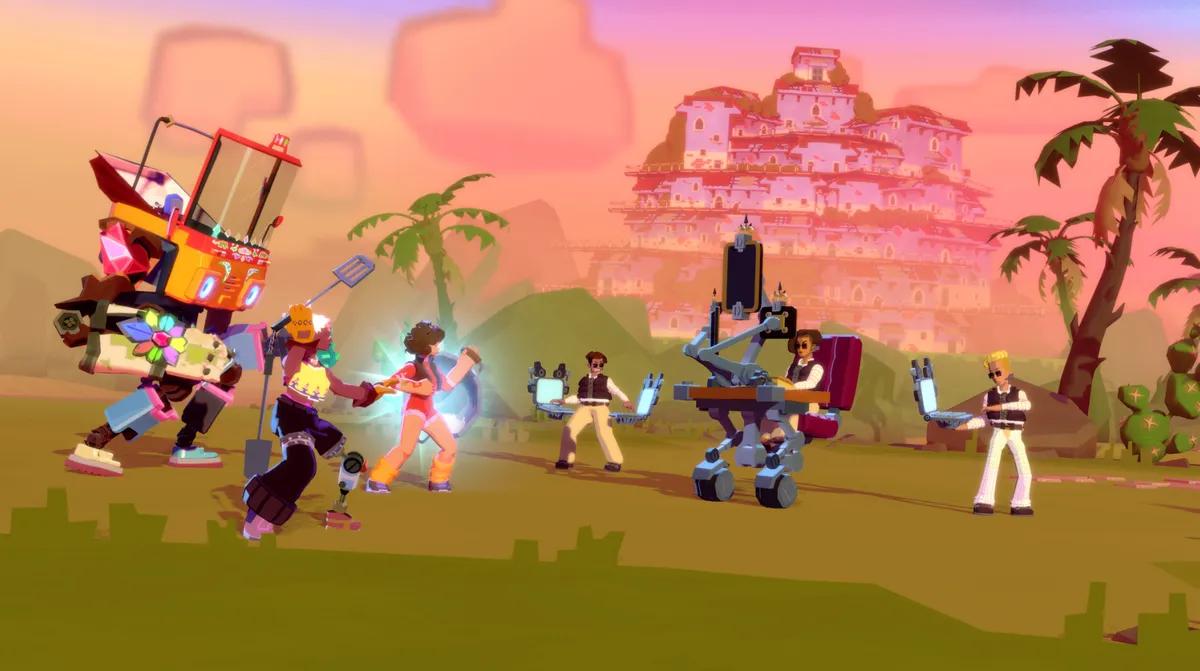
Outerloop Games releases Dosa Divas on April 14, 2026, the studio's follow-up to Thirsty Suitors, and it arrives with the same appetite for emotionally dense storytelling that distinguished that earlier work. Two sisters, Amani and Samara, travel across a fractured world inside a food-themed mech called Goddess, cooking for communities their estranged sister Lina has stripped of culinary tradition by replacing home-cooked meals with a corporate food paste called LinaMeals. The premise treats food not as décor but as the connective tissue between characters, between memory and identity, and between a family trying to locate what it broke. What Outerloop delivers is a game that hits harder in individual scenes than it does as a whole.
A Story Built Around the Act of Feeding People

The central conflict in Dosa Divas positions home cooking as resistance. Lina's corporation, Linaworks, has taken control of nearly every remaining village in Meyndish, enforcing LinaMeals as a replacement for traditional food. Her motivation is not simply corporate expansion — the backstory traces her resentment directly to the restaurant the three sisters once ran together, destroyed by their collective ego and poor decisions when they were younger. That grounding gives the antagonist more texture than most of her archetype receive.
Amani carries the emotional weight of the narrative. As a former restaurant chef, she approaches cooking as the primary way she communicates care — not a hobby, but a language. The game is at its sharpest when it interrogates that impulse honestly, tracing the limits of using food as a substitute for direct emotional engagement. These moments arrive with clarity and land with real effect. The problem is that they do not arrive often enough, and when they do, the script frequently interrupts them with a joke, a new objective, or a plot detour before allowing the weight to settle.
The game also weaves in child neglect, the ease with which capitalism dismantles tradition, and a parallel storyline about the history of the Divas — the mechs — and how their past aligns with the sisters'. When the script focuses on two or three of these threads at once, the results are sharp. When it attempts to service all of them simultaneously while keeping the runtime near ten hours, the threads collide without resolution.
The RPG Mechanics: Flavor Theory in Battle

Combat in Dosa Divas borrows structurally from Octopath Traveler and Super Mario RPG. Enemies carry a shield number beside their HP gauge and a weakness tied to one of five flavor elements: sour, sweet, spicy, savory, and salty. Targeting that weakness chips away at the shield. Once it reaches zero, the enemy enters a Stuffed state, opening a window of significantly increased damage. Some weaknesses are concealed at the start of battle, which introduces trial-and-error into resource allocation.
The boost system adds useful complexity. Players spend boost points to extend basic attack combos or amplify skill damage, with timed button prompts attached to each action. A precise input extends a combo; a missed prompt cuts it short. This creates genuine decision-making around whether to burn SP on a skill with a confirmed flavor type or conserve it and risk a failed combo window. Standard enemy encounters apply more consistent pressure than the bosses, which introduce gimmicks but rarely escalate the underlying mechanical challenge.
Blocking operates on the same timed-input principle. Multi-hit attacks and unclear visual cues make certain prompts difficult to read consistently. On standard difficulty, a missed block carries steep consequences, and healing items obtained outside of cooking are sparse. The frustration here comes less from a high skill ceiling than from ambiguous feedback on when input windows open and close — a problem that easier modes soften without solving.
The Cooking System: Ritual Without Resonance

Cooking sits at the center of Dosa Divas in both theme and structure, but the implementation does not match the concept's weight. Ingredient collection happens automatically as Goddess moves through hub zones — produce like tomatoes, onions, and coconuts gathers on contact. Rarer materials such as oils require trading with Kabi, the recurring merchant who communicates almost exclusively through sexual innuendo directed at the sisters.
Preparation takes place in a separate dimension accessible from inside Goddess. Players select a dish and complete a sequence of minigames — rotating a thumbstick at a set speed to spread oil, pressing a button repeatedly to finish a dosa, memorizing timing when the interface fades on more difficult ingredients. Performance rating determines quantity of output, which feeds into both battle item supply and NPC quest delivery. The system enforces the idea that food requires labor and knowledge rather than appearing from nothing, and the actual recipes, centered mostly on dosas, stay reasonably close to real culinary practice.
I think the minigames work adequately in isolation; what breaks them is the volume of repetition the quest structure demands. Cooking the same dish multiple times across a single village arc, for NPCs the game never develops past their function as order tickets, reduces the act to rote task management. Orders are collected by honking Goddess's horn while driving past people. Meals are delivered by flinging them from the cockpit. For a game whose writing argues that cooking is an act of care and community, the mechanics strip that argument down to inventory logistics.
World Design and Traversal

Dosa Divas covers a compact set of environments: a cliffside village, an underground settlement built into tree roots, and a lakeside resort area. Goddess gains traversal tools as the game progresses — a hookshot and a drill — that open paths through previously inaccessible sections. These abilities extend access but route players back through familiar locations rather than opening new ones, and the absence of wider wilderness spaces makes the world feel contained throughout its runtime.
The art direction is the game's most consistent achievement. Characters carry exaggerated proportions, and the dense, angular color palette references the visual register of Jet Set Radio. Animation quality holds across both cutscenes and combat, and the game relies on it heavily during emotional beats — sometimes to compensate for dialogue that underprepares those moments. NPCs share visual templates closely enough that distinguishing one from another in a crowd proves difficult. The soundtrack operates mostly in light, bouncy registers, with plucked guitar and rhythm sections that rarely adjust to match the dramatic weight of key scenes.
Narrative Ambition vs. Runtime Compression

Within its ten-hour runtime, the script attempts to carry a family tragedy, a critique of capitalism erasing cultural identity, a parallel storyline about the Divas and their hidden history, and a village-by-village relationship repair arc for Amani and Samara. Each thread has merit. None receives enough room.
The Diva storyline adds mythology without connecting it cleanly to the human drama. The parallel between the mechs' history and the sisters' is positioned as a structural echo, but the Diva narrative never develops far enough for that echo to register with emotional force. By the final act, several threads attempt to resolve within compressed scene time, and the conclusions feel rushed rather than earned. The game's short runtime functions as a genuine advantage in a genre prone to bloat, but Dosa Divas needed either more time to develop what it started or the discipline to cut what it could not finish.
The writing recovers at specific points. The game's handling of the long-term consequences of past decisions, of what a family does with the damage it caused each other, lands with precision when the script commits to it. A plot beat about child neglect and absence carries more than most of what surrounds it. These are the moments where Outerloop's capability as a storytelling studio is most visible — and where the gap between what Dosa Divas reaches for and what it delivers is most apparent.
Voice, Presentation, and the Merchant Problem

Voice acting covers key dialogue but not all of it. Where it appears, delivery is uneven — partly because the script shifts register abruptly, asking performers to carry comedy and grief within the same short exchange. The tonal instability is a writing problem that voice direction cannot fully absorb.
Kabi concentrates much of the game's tonal inconsistency. His role is comic relief, and the script builds him almost entirely from sexual innuendo aimed at the sisters and at the player. I see a character whose function as comic relief competes directly with the emotional register the game requires in the scenes surrounding him. Two of the three existing critical assessments of the game reach different conclusions about whether he works — one finds him charming, one finds the framing more troubling — which may be the most accurate indication of where the writing lands.
The cosmetic system for Goddess allows players to swap individual mech parts using skins collected during exploration. It operates as a minor reward loop with no effect on combat or cooking performance. Character skill progression is entirely fixed — abilities unlock at predetermined story points and cannot be rearranged or substituted, leaving players with minimal agency over how their party functions in battle.
Verdict

Dosa Divas is a 7/10 game. It carries the structural fingerprints of a stronger title — precise character writing in its best scenes, a thematic premise that uses food to argue something specific about memory and care, and visual and animation work that holds up from first hour to last — but the cooking and quest systems that fill most of its ten hours do not rise to the level of the story they are meant to support.
Pros:
- Turn-based combat applies a flavor-element weakness and shield-break system borrowed from Octopath Traveler and Super Mario RPG with mechanical logic that rewards precise resource allocation
- Character writing around family damage and the consequences of past decisions delivers with precision when the script narrows its focus
- Art direction and animation quality remain consistently high across both exploration and combat, giving the game a distinct and recognizable visual identity
Cons:
- Cooking and delivery mechanics reduce the act of feeding people to a repetitive collect-and-fling loop that directly undercuts the story's central argument about food as care
- The compressed runtime forces several narrative threads — including the Diva mythology and the village restoration arc — toward conclusions that lack the development to earn them
Dosa Divas sets out to make food mean something: not as a mechanic but as an argument about what gets lost when tradition is treated as inefficiency. When the script pursues that argument directly, the game earns it. The gap between what Dosa Divas wants to say and what its systems actually communicate is the central problem Outerloop has not solved here. The best version of this game exists in the material — the studio demonstrated with Thirsty Suitors that it can sustain this level of character work across a full cast and runtime — but Dosa Divas does not consistently reach it.


 Successfully copied... Thank you for sharing our content!:



5% deposit bonus up to 100 gems

a free Gift Case





EGAMERSW - get 11% Deposit Bonus + Bonus Wheel free spin


EXTRA 10% DEPOSIT BONUS + free 2 spins

3 Free Cases + 100% up to 100 Coins on First Deposit


5 Free Cases, Daily FREE & Welcome Bonuses up to 35%

3 free cases and a 5% bonus added to all cash deposits.

+5% to deposit




Comments