




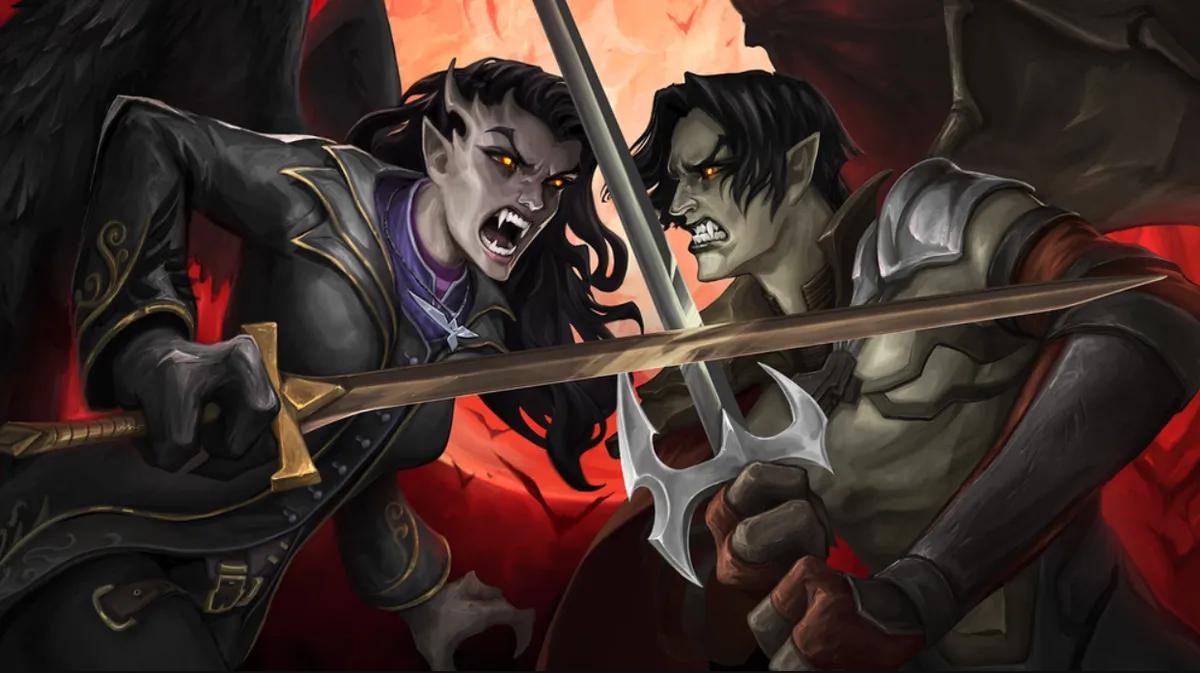
Legacy of Kain: Ascendance Review
 Steam
Steam Review
 PlayStation
Twenty-three years passed between Legacy of Kain: Defiance in 2003 and the franchise's first original release, a 2D pixel-art side-scroller developed by Bit Bot Media and published by Crystal Dynamics for $20. Crystal Dynamics has confirmed Ascendance is canon, positioning it as a prequel to Soul Reaver and the first entry to formally expand the series' lore since Defiance. The studio preceded this launch with remasters of Soul Reaver 1 & 2 in 2024 and Legacy of Kain: Defiance Remastered earlier this year, building toward Ascendance as the commercial test case for whether a full-scale sequel warrants production. That test does not return encouraging results.
A New Character In Old Events
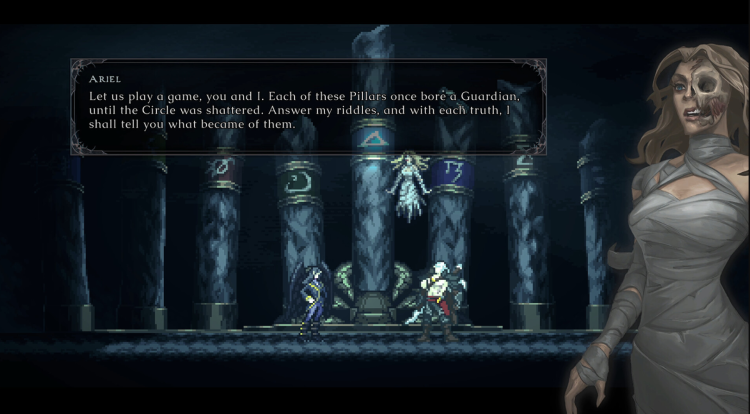
Ascendance introduces Elaleth, Raziel's sister, who first appeared in the tie-in graphic novel The Dead Shall Rise. She accounts for the majority of playtime across the game's four-hour runtime. Crystal Dynamics declares the story canon, which means Elaleth's role carries direct lore consequences: she is positioned as the figure who encouraged Kain to raise the Sarafan inquisitors as his lieutenants, who catalyzed Raziel's wing development, and who deliberately engineered his execution by Kain — all to extract the location of the Heart of Darkness and settle a revenge arc built around a dead boyfriend named Mathias. A guide named Ky'set'syk leads her through time as she tears through the Sarafan army, of which Raziel serves as a high-ranking inquisitor before his conversion.
The retcon strips agency from both protagonists the franchise was built on. Every consequential decision Kain and Raziel made across five games is now reframed as Elaleth's manipulation. The game does not resolve her arc — its final sequence teases a sequel — leaving the damage to established lore without a meaningful payoff. Bit Bot compensates mechanically: Elaleth's sections feature generous checkpoints, frequent feeding opportunities, an air dash, wing flaps for elevation, and a downward dive attack. She has no functional weaknesses. That design choice makes her levels easy to pass through without making the character easier to accept.
Three Protagonists, Three Different Games
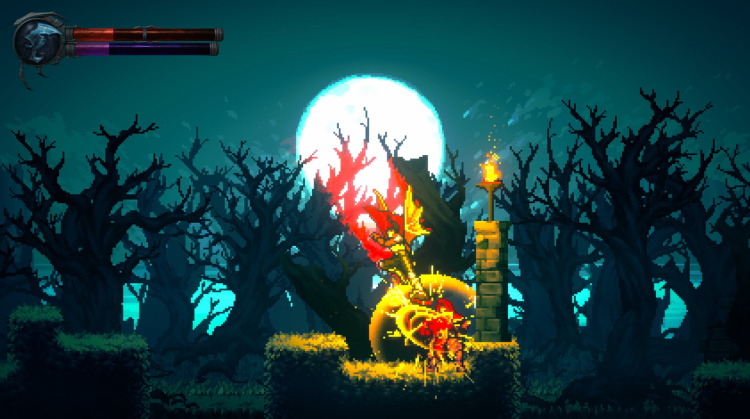
Ascendance rotates control between Elaleth, Raziel in human and vampire forms, and Kain. Each character operates under different rules. Elaleth's levels, comprising the bulk of the runtime, place few obstacles in the player's way. Her blood-drain health mechanic is so thoroughly offset by healing availability that it barely registers as a constraint.
Raziel's sections run on different terms. Checkpoints are spaced further apart. Enemies spawn off-screen behind the player with inconsistency, hit harder, and provide fewer opportunities to recover health. His winged vampire form, which should function as a high point for series fans, handles with a sluggishness that requires repeated button mashing to gain elevation across platforming sections. The difficulty gap between Elaleth's levels and Raziel's is not a deliberate design escalation — it reads as two separate games operating in the same executable.
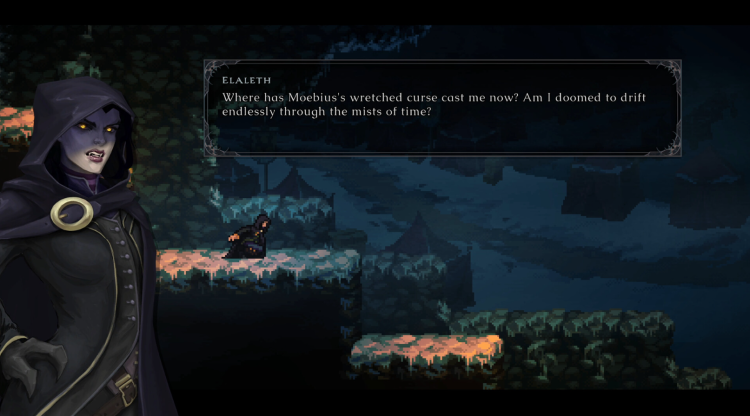
Kain appears for approximately thirty minutes across a single level and one boss fight. He functions as a melee power fantasy: enemies die in a single hit, he can dissolve into mist or a swarm of bats for traversal purposes, and he has a blood telekinesis feeding animation rendered in SNES-era pixels that is the game's best individual asset. I find his section the most mechanically satisfying of the three, despite receiving the least development time of any playable character.
Combat, Platforming, and Where Both Fail
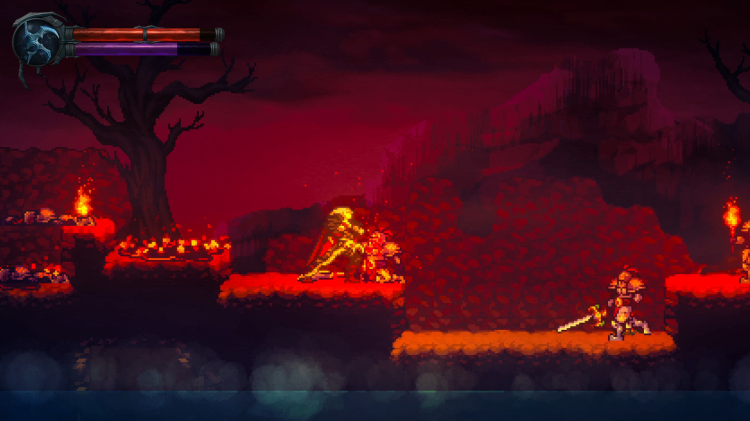
The combat loop runs on a light attack, a resource-governed power set specific to each character, and a parry. The parry functions correctly. When timed well, it connects with clean audio feedback and opens a damage window on the attacker. That is the most reliable positive in the moment-to-moment gameplay.
Enemy variety runs thin. Melee fighters telegraph attacks inconsistently. Bat creatures reappear across nearly every map distinguished only by palette swaps. Archers frustrate without providing genuine difficulty. A handful of chunky demon types carry flame attacks and deliver weak voice lines. None of these enemy types evolve across the game's runtime, and the levels do nothing to introduce new configurations that would change how the player engages them.
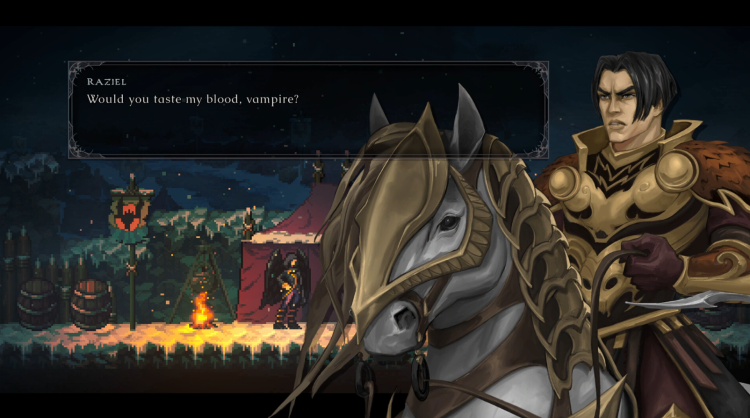
Platforming wears out faster than the combat. Jumping reads as slow across all three characters. Wing flap mechanics for Elaleth and Raziel behave inconsistently in the game's higher-demand sections. Extended puzzle sequences built around flap-based elevation go on past any reasonable endpoint. There are moments with ambition: a parallax horse-riding sequence modeled on Shinobi III, a couple of boss designs that borrow from the DS-era Castlevania games. They appear too briefly to shift the experience, and they highlight how much more interesting the game could have been with a more focused mechanical identity.
Writing, Dialogue, and the Voice Cast
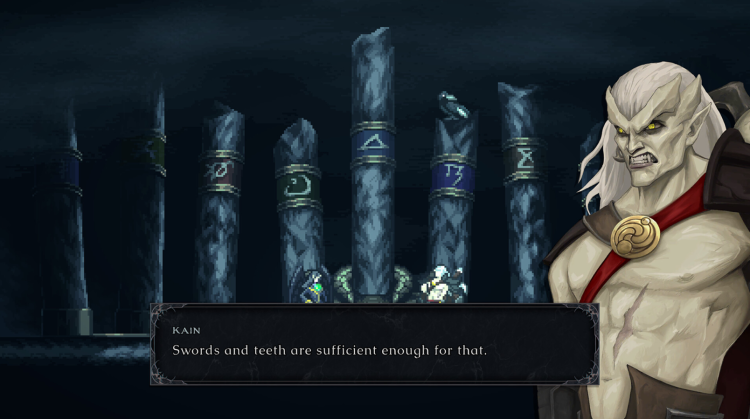
I think the writing team genuinely understood the franchise's mythology and wanted to honor it. References to established lore are specific — the timeline-hopping structure visits locations familiar from Soul Reaver onward, and lore fragments scattered through individual levels carry titles like "On the Unruliness of Time" and "On Endings That Fail to End." When Ascendance locks into those established details, the developers' investment is visible.
The dialogue does not reach the register the franchise set in its prime. The Shakespearean cadence that defined Blood Omen and Soul Reaver required writers and voice directors working at full capacity together. Ascendance produces something approximating that tone — Kain describes his feeding as "a flow of rubies in a bejeweled cup" at one point — without achieving it. It sounds like an attempt at that harder, more formal meter rather than an expression of it.
The voice cast is the game's strongest production element. Simon Templeman reprises Kain and delivers his lines with authority. Michael Bell, who first played Raziel in 1999 and is now 87, returns to the role after 23 years. The age in his voice is audible — noticeably different from the recordings that remain the franchise reference point — but his presence in the game is still significant. Richard Doyle and Anna Gunn return as Moebius and Ariel respectively. Tony Jay, who voiced the Elder God in the original Soul Reaver titles and died in 2006, appears in an archival recording during a cameo at the game's close.
Art Direction and Audio
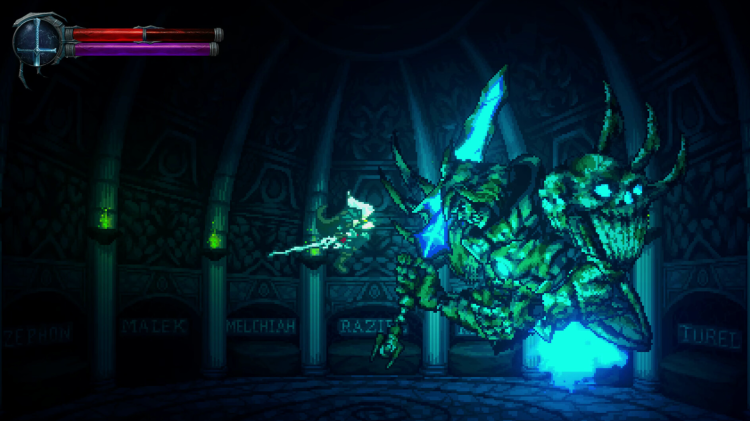
Ascendance moves through five distinct visual styles without committing to any of them. The primary presentation is pixel art loosely modeled on Super Castlevania IV — functional lighting, middling character sprites. Dialogue scenes use anime-style portrait art with characters in constant low-amplitude bounce animations. Brief sequences shift to PS1-era polygonal 3D, most notably during Kain's crypt sequence. One flashback uses static images with the production quality of a children's illustrated book. A handful of animated cutscenes appear near the end with noticeably higher production value than anything that precedes them.
The PS1 demake segments are the strongest visual material in the game. Several critics noted after completing it that Bit Bot should have committed to that style for the full runtime. Cycling between approaches every few levels prevents any coherent identity from forming and repeatedly interrupts engagement with the story by foregrounding how inconsistent the production is.
The audio compounds that inconsistency. The voice performances represent the ceiling of the game's craft. The music occupies the floor. A single theme loops at high volume without meaningful variation across levels, contributing nothing to tension, pacing, or atmosphere — the three areas where Legacy of Kain's original soundtracks did their most important work.
Franchise Context and What Ascendance Was Asked to Do
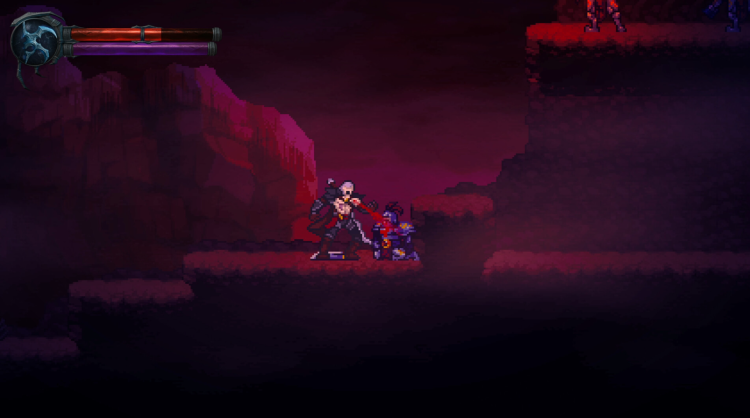
Crystal Dynamics has signaled publicly that Ascendance functions as a market test. Strong performance is implied to build the case for a full-scale follow-up — the kind of game series devotees have wanted since Defiance. That context shapes what Bit Bot was handed: a $20, four-hour side-scroller expected to generate enthusiasm for a franchise whose defining qualities — complex environmental puzzle design, cinematic long-form storytelling, dense mythology delivered through extended cutscenes — cannot survive the translation to this format.
Blood Omen used CD-ROM capacity for FMV and dynamic music scoring. Soul Reaver built its environmental puzzles around vertex-warping spatial mechanics that allowed entire buildings to reconfigure under the player's interaction. Those were brain-first games with combat and traversal built in service of the puzzles. Ascendance replaces that architecture with a combat loop that borrows structural ideas from Castlevania without the mechanical depth those games earned. The canonical retcon turns what was a franchise defined by consequence and character into a story in which the two protagonists were background figures in someone else's scheme all along.
Verdict
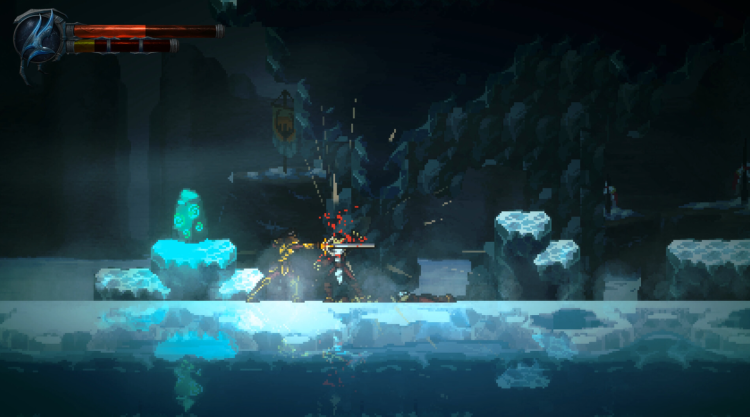
Legacy of Kain: Ascendance is a 5/10 game. The original voice cast returns, the parry mechanic works, and Kain's single level delivers on the power fantasy the character was always built around — but the Elaleth retcon does lasting damage to the franchise's two central characters, the gameplay frustrates more than it satisfies, and the five-style visual presentation prevents coherent identity from forming across even a four-hour runtime.
Pros:
- Michael Bell, Simon Templeman, Richard Doyle, and Anna Gunn all return to their original roles
- The parry lands cleanly and carries strong audio feedback on a successful timing
- Kain's melee-focused level and blood telekinesis animation are the game's highest single-character moments
Cons:
- The Elaleth retcon repositions her as the architect of Kain and Raziel's defining choices, removing their agency from the entire prior series
- Raziel's sections spike in difficulty disproportionately, with off-screen enemy spawns and scarce healing compared to Elaleth's generously checkpointed levels
- Platforming physics are slow and inconsistent across all three characters, with wing flap elevation mechanics that malfunction under sustained pressure
- Five incompatible visual styles rotate through the runtime without producing a coherent aesthetic identity
- The music loops a single undifferentiated theme at high volume, contributing no pacing or atmosphere across the full game
Ascendance arrives with its canonical status already declared and its damage to established lore already locked in, offering a four-hour experience whose format was never capable of delivering what the franchise's audience actually wants. The voice cast does what a significantly better game would have given them proper material to accomplish. Whether Crystal Dynamics reads commercial underperformance as a reason to invest more — or less — in the series will determine whether Ascendance becomes a minor footnote or the last entry for another two decades.
Exploring the Best Singleplayer Games 2026 is a reminder that solo gaming still offers some of the most immersive stories, memorable characters, and emotionally rich experiences you can enjoy at your own pace.


 Successfully copied... Thank you for sharing our content!:



5% deposit bonus up to 100 gems

a free Gift Case





EGAMERSW - get 11% Deposit Bonus + Bonus Wheel free spin


EXTRA 10% DEPOSIT BONUS + free 2 spins

3 Free Cases + 100% up to 100 Coins on First Deposit


5 Free Cases, Daily FREE & Welcome Bonuses up to 35%

3 free cases and a 5% bonus added to all cash deposits.

+5% to deposit




Comments