




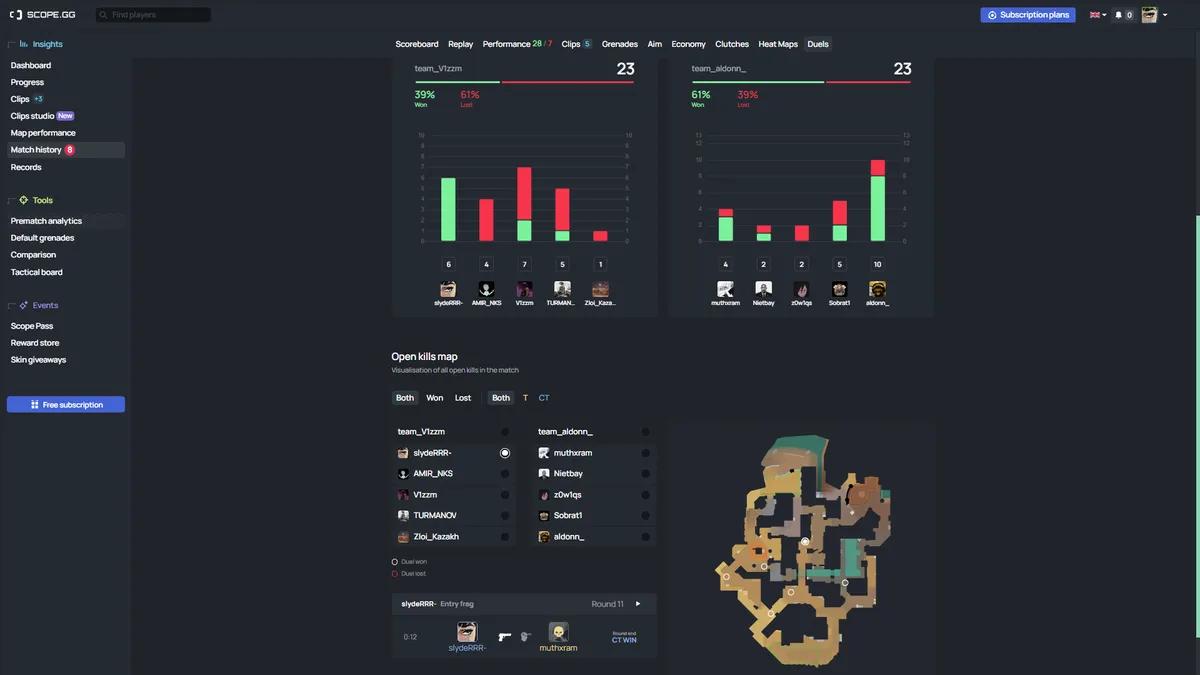
Why Watching CS2 Matches With Live Stats Changes How You Understand the Game
Most viewers perceive CS2 through highlights and the scoreboard. Frags, clutches, and flashy moments shape the feeling of the game, but often overlook the most important part — the reasons behind wins and losses. On the surface, a match may look “close” or “random,” even though its outcome is actually determined by systemic factors: economy, timing, and map control.
This is where live analytics comes in. By using live CS2 stats and tools like scope.gg, viewers shift from watching duels to understanding decisions. Team stats and match flow indicators reveal how teams construct rounds, where pressure builds, and why similar situations end differently. The focus moves away from kills and toward tactical decisions — when a team accelerates, slows down, and how it reacts to economic changes.
In this article, you will learn how to read a match in real time: spot turning points before they happen, recognize gameplay patterns, and correctly interpret analytics data. At the same time, we’ll break down the key limitations of live statistics — where numbers help, and where they can mislead without deeper context.
Patterns That Let You See the Turning Point Earlier (Before the Score Shows It)
The score in CS2 is almost always delayed. A team may still be leading 6:4 but already losing control of the game — and this is clearly visible through live stats. When you look at match flow and team stats, certain patterns start repeating before the score changes. These patterns signal an upcoming shift.
One of the most obvious signals is repeated opening kills by one side. If a team consistently wins the opening duel, it reflects not just better aim, but superior timing and round preparation. When this trend continues for 3–4 rounds in a row, it is almost always a precursor to a streak of won rounds.
The second key factor is the economic spiral. Broken buys, force rounds without proper utility, constant ecos — all gradually reduce a team’s chances even in “close” rounds. In live analytics, this is visible through reduced utility usage and frequent losses without retake potential.
Another important pattern is repeated CT defense breakdowns at the same timing. If the attacking side consistently exploits a weakness (for example, executing at 1:00–0:50), it means the defense is not adapting. These rounds are rarely decided by individual mistakes — they point to systemic issues in protocols.
On the attacking side, pay attention to post-plant conversion quality. If a team starts winning more post-plants, it indicates improved positioning and communication — another sign of shifting momentum.
Clutches are also a key indicator. A series of successful 1vX situations can artificially “keep” a team in the game. But once clutches stop going their way, the score quickly collapses. Live stats help distinguish stable performance from reliance on heroic moments.
Another signal is side dominance. A large gap between CT and T halves suggests deeper issues — either in defense or offense. This may not be obvious from the overall score but becomes clear through side-split statistics.
Finally, the classic case — a “close score, but not a close game.” If one team wins rounds narrowly (clutches, 2v4 retakes) while the other wins convincingly (5v3 advantages, map control), the real gap is much larger than the scoreboard suggests. Round quality and context reveal the true balance.
Why Viewers With Analytics Understand Team Mistakes Better
Without analytics, most decisions in a match look like simple mistakes: “too rushed,” “didn’t check the angle,” “late rotation.” But live CS2 stats and deeper team data allow you to distinguish random moments from systemic problems. This fundamentally changes how you read the game.
The first example is timing versus information. At first glance, it may seem like a player mistimed their move. But if similar situations repeat, it often means the team lacks information: no map control, missing late calls, or ineffective utility usage. Analytics helps determine whether it’s a one-off mis-timing or a recurring information problem.
The second distinction is isolated deaths versus untradeable spacing. A single frag may look like an individual mistake, but if players consistently die without trade potential, it becomes a structural issue. Match flow and positional patterns reveal whether a team maintains proper spacing and synchronization or constantly gets split across the map.

The third factor is utility. Often, grenades are “used” but create no value — they don’t force positions, provide information, or open space. In live analytics, this shows up as weak site executions or lack of control after contact. Visually, everything may look “correct,” but in reality, the round is played without effective tools.
Another telling case is rotations. What looks like an over-rotation can sometimes be a correct gamble based on economy or reads. Conversely, “logical” rotations may be late or predictable. Only by analyzing context — losses, economy, previous rounds — can you judge whether a decision was justified.
This is where analytical platforms like scope.gg become essential. They allow you to track repetition: whether something is a one-time event or a pattern lasting multiple rounds. If the same issue appears again and again, it’s no longer a “player mistake,” but a systemic flaw in tactical decisions.
Ultimately, analytics doesn’t just explain what happened in a round — it answers the key question: why it happened and whether it will happen again.
Metrics That Best Explain ‘Even’ vs Dominant Games
The scoreboard in CS2 doesn’t always reflect the true state of the game. A match may look even, but team stats and match flow quickly reveal who is actually in control. The difference between a “close” game and domination often lies in details that are invisible without analytics. That’s why it’s important to focus on consistent patterns rather than just the score.
The first key indicator is opening duel success. If a team consistently secures opening kills, it dictates the pace and plays with a numerical advantage. Even with a tied score, this creates constant pressure on the opponent. Over time, such rounds accumulate into streaks.
The second important block is conversions. Winning advantages, post-plants, and anti-eco rounds shows how consistent a team is in “winning” situations. Dominant teams rarely lose these rounds, while in even matches you often see advantages slipping away. This is one of the clearest indicators of difference in quality.
Economy is equally important. Frequent full buys provide access to complete utility and strategic options, while broken buys limit possibilities. If one team consistently has better resources, it signals a long-term advantage. Even with a close score, this points to a likely turning point.
You should also consider impact distribution. When success depends on one player, it’s an unstable model that rarely lasts. In contrast, balanced contribution across the team indicates structure and control. This often separates top teams from those relying on individual performances.
Finally — round structure. Confident wins (5v3 advantages, map control, clean executions) signal dominance even when the score is close. If rounds are won through clutches or chaotic situations, the game may look even, but lacks stability. These details best reveal the true balance of power.
The Limitations of Live Stats in Complex Tactical Rounds

Despite the fact that live CS2 stats and platforms like scope.gg significantly improve game understanding, they do not provide a complete picture of complex tactical rounds. Analytics does a great job of showing outcomes — who won a duel, how the match flow changed, what resources were available — but it does not explain intent. It cannot reliably distinguish between fake pressure and a real execute, nor can it show what calls were made during the round. The asymmetry of information also remains hidden: players act on limited information, while the viewer sees everything.
Another limitation is evaluating execution quality. Setups, utility layering, and spacing between players can determine the outcome of a round, but these factors are barely visible in raw numbers. A similar issue exists with deaths: “good” deaths (that create space or provide information) and “bad” ones look identical in statistics. Additionally, the early phase of a half suffers from small sample size — a few rounds can lead to misleading conclusions about a team’s form or decision-making efficiency.
Ultimately, even with tools like scope.gg, live statistics work best for identifying patterns and trends. But to understand the most complex situations, deeper context is still required — demo review, communication analysis, and detailed breakdowns of decisions.
A Simple Live-Stats Viewing Workflow
To get the most out of live CS2 stats, it’s important not just to look at numbers, but to do so systematically. A simple step-by-step approach helps you quickly understand match flow and avoid getting lost in the information stream. Tools like scope.gg, with their dashboards and visualizations, make it easy to track these signals in real time.
Before the match, it’s useful to establish baseline expectations: how teams play on a specific map, and what their strengths are on CT and T sides. If such data is available, it provides context for further analysis. Even at this stage, scope.gg helps quickly assess overall tendencies through team stats.
In the first 6 rounds, the focus should be on economy and opening duels. Who consistently gets the opening kill? Is there early pressure on the opponent’s economy? These early patterns often set the tone for the entire half and are easy to track through live dashboards.
In the middle of the half, it’s important to identify the first “turning point round.” This could be a won force-buy, a broken buy, or a key clutch. After that, track conversions: does the team capitalize on its advantage, or does it lose rounds in favorable situations?
Toward the end of the half, it becomes clear whether the game is truly close or if one side is in control. This is best seen through economic stability and conversion consistency. Scope.gg visualizations help quickly determine whether there are strings of confident rounds or if the game relies on clutches.
After the match, it’s useful to select 2–3 key rounds for deeper analysis. This is where you can verify whether the conclusions drawn from live stats hold up. If needed, reviewing demos helps add context to the numbers and better understand decision-making.
Conclusion
Live statistics fundamentally change how CS2 is watched. Instead of focusing on frags, viewers begin to see match flow, understand tactical decisions, and recognize why rounds are won or lost. This makes it easier to spot turning points early and distinguish random success from systemic advantage.
The best approach is to use live patterns as a foundation for hypotheses. If the data shows a trend, it should be noted and then verified through deeper analysis, such as demo review. This helps avoid superficial conclusions and leads to a better understanding of complex in-game situations.
Scope.gg helps viewers and players navigate matches more effectively by combining contextual statistics with intuitive visualization — while keeping analysis grounded, rather than reducing it to “who got more kills.”


 Successfully copied... Thank you for sharing our content!:

Comments