




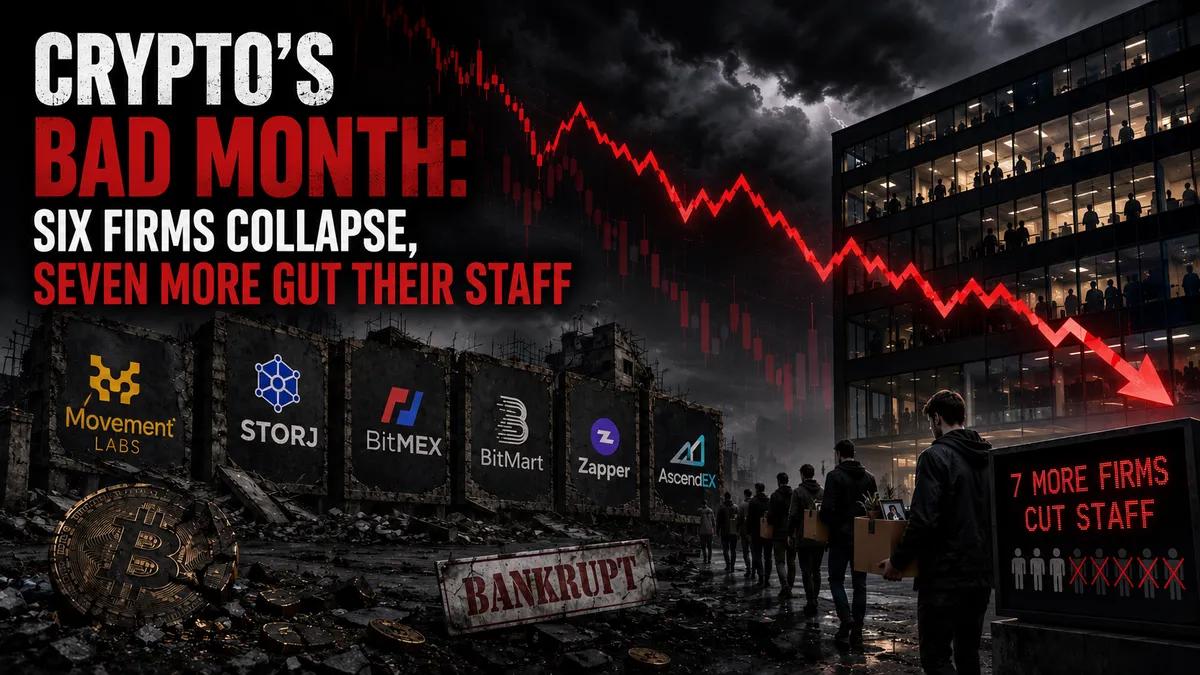
Crypto's Bad Month: Six Firms Collapse, Seven More Gut Their Staff
 DeFi
DeFiSomething broke loose in crypto this July, and it wasn't one company — it was almost all of them at once. Within roughly three weeks, six platforms either filed for bankruptcy or announced they're shutting down entirely. Meanwhile, at least seven more companies took an axe to headcount, some for the second or third time this cycle. Put those two lists side by side and you get a fairly blunt picture of where the industry actually stands right now, regardless of what the price charts say.
The Shutdowns
None of these six companies planned to close in the same month, but that's exactly what happened. Some had months of warning signs behind them, frozen wallets, delayed withdrawals, executives quietly heading for the door. Others gave almost no notice at all. Here's what happened, one by one.
Movement Labs
Went first, at least in terms of formal paperwork. The company behind the Movement blockchain filed for Chapter 11 on July 15 in Delaware, listing under $500,000 in assets against liabilities as high as $10 million — a startling gap for a project that raised over $141 million and was reportedly closing in on a $3 billion valuation in early 2025. The unraveling traces back to a market-making scandal: roughly 66 million MOVE tokens, about 5% of supply, hit the market a single day after launch through an arrangement involving Web3Port, and the resulting sell-off never really let go of the token. Move Industries, the separate entity that now runs the ecosystem day to day, was quick to say the bankruptcy doesn't touch its operations. Its CEO, Torab Torabi, addressed the confusion directly on X, stressing that MVMT Labs, Inc. is a distinct legal entity and that Move Industries "is operating normally."
Storj Labs
Followed less than two weeks later, filing Chapter 11 on July 26 in West Virginia. Unlike Movement, this one reads less like a collapse and more like a cleanup — the decentralized storage firm says customer services will keep running throughout, and it's proposing something unusual: giving STORJ token holders a stake in the reorganized business alongside management and investors. That didn't stop the token from dropping as much as 20% in the hours after the filing. Storj had raised about $35 million total and was already in the middle of being acquired by Inveniam Capital Partners, a deal that now runs through the bankruptcy court instead of around it.
BitMEX
One of the industry's oldest names, announced on July 23 that it's closing for good. New registrations stopped immediately; trading winds down in stages through August, with full shutdown set for September 23, eleven years to the month after Arthur Hayes, Ben Delo and Samuel Reed founded it. In a message to users on X, the exchange called the decision "difficult" and noted it had gone its entire operating history without losing a single dollar to hackers, which is more than most of its peers can say. Its native BMEX token still lost over 90% of its value within hours.
BitMart
Announced its own wind-down just three days later, on July 26, making it the second exchange to close in under a week. Trading stops August 26; the platform fully shuts on January 31, 2027. What made the BitMart story stranger than most is that the exchange's own global CEO, Nathan "Nenter" Chow, said he found out about the closure the same way everyone else did — by reading the announcement. He posted on X that he'd been informed of his own termination two days earlier and had "no role in the management or decision-making of the company" by the time the shutdown went public. BMX cratered by more than half within a day.
Zapper
The DeFi portfolio tracker that once processed $13 billion in transaction volume for over 2 million monthly users, is winding down on August 3 after nearly seven years. CEO Seb Audet framed it plainly in his announcement: the team "evaluated a number of different options" and concluded an orderly shutdown was the right call. Asked later what tipped the decision, he didn't dress it up, "at the end of the day, the market decides." Zapper had backing from Mark Cuban and Framework Ventures and helped define what a DeFi dashboard even looked like back in 2020. None of that was enough this time.
AscendEX
Formerly BitMax, rounds out the list, and arguably has the ugliest ending of the six. The exchange ceased operations on July 1, officially citing its failure to secure a MiCA license before the EU deadline plus a liquidity deal whose counterparty never delivered. On-chain investigator ZachXBT had flagged the trouble less than a week earlier, warning that AscendEX's hot wallets looked nearly empty of major assets like ETH, USDT and SOL. Withdrawals are still technically open, but every request now goes through manual review with no guaranteed timeline — and no promise the money comes back at all.
Taken together, that's Movement Labs, Storj, BitMEX, BitMart, Zapper, and AscendEX gone or going within about a month. Analyst 0xvietnguyen has been tracking the broader trend and puts the number of crypto projects that have shut down in 2026 above 30, spanning Layer 1s, Layer 2s, and DeFi protocols alike.
The Layoffs
The job cuts tell a related but slightly different story — this isn't just failing companies going under, it's profitable ones getting leaner, often citing AI as the reason.
Coinbase
Cut about 700 people, 14% of its workforce, on May 5. CEO Brian Armstrong didn't frame it as belt-tightening so much as a rebuild: he wants the company "lean, fast and AI-native," pointing to engineers who could reportedly "ship in days what used to take a team weeks" with AI tools. The company's Chief People Officer, who oversaw the cuts, resigned himself less than three months later.
Gemini
Has now trimmed roughly 30% of its staff since the start of the year, bringing headcount down to around 445. The Winklevoss twins tied part of the move to AI adoption, but it's landing alongside a $585 million net loss for 2025 and a full retreat from the UK, EU, and Australian markets. Three C-suite executives, the COO, CFO and CLO — left on the same day.
BitGo
Announced a roughly 15% cut, affecting close to 90 people, with CEO Mike Belshe saying the move sharpens the company's focus on stablecoins, trading, and AI-backed infrastructure. He called it "a one-time action" and said no further cuts are planned — though it's worth noting BitGo's stock has fallen nearly 73% since its January IPO.
Uphold
Let go of about 85 people, permanent staff and contractors combined, roughly 17% of its global workforce. The company insists this isn't a retreat — it says it's shifting investment toward its enterprise business serving banks and fintechs, while keeping its consumer roadmap, including plans for stock trading and tokenized securities, intact through the rest of 2026.
Matter Labs
The team behind zkSync, cut senior engineers, designers and operators in June as it commits fully to Prividium, its permissioned privacy chain for regulated institutions. CEO Alex Gluchowski took the decision on himself publicly, framing it as a skills mismatch rather than a performance issue. The community's response was less forgiving — plenty of people online pointed out that Matter Labs has raised roughly $450 million and asked, reasonably, where it went.
Polygon Labs
Laid off 60 employees in January following its acquisitions of Coinme and Sequence, worth over $250 million combined. The company pushed back on early reports pegging the cut at 30%, saying the changes were about integrating new teams while keeping overall headcount flat.
One thing worth flagging: reports have also circulated about a fresh round of cuts at Bybit, but unlike the others on this list, nothing recent enough to independently confirm has surfaced — the well-documented 30% reductions at Bybit date back to 2022, not this year. Worth treating with some skepticism until something more solid shows up.
What It Adds Up To
Simon Dedic, founder of Moonrock Capital, put his finger on something specific about the exchange closures: the mid-tier exchange business model has what he called a "fatal flaw", it only works while new users keep flowing in, and right now they're not. That's a decent explanation for BitMEX, BitMart, and AscendEX. It's a worse fit for Storj or Zapper, which weren't exchanges chasing retail volume so much as infrastructure plays that simply ran out of room, or ran out of patience from investors.
The layoffs read differently again. Coinbase, Gemini, and BitGo are not insolvent, they're paring back while pointing at AI as the justification, which is either a genuine efficiency story or, as more than a few people in the space have started to suspect, a convenient label for cuts that would have happened anyway in a quiet market. Probably some of both, depending on the company.
Either way, it's a rough month to be reading your crypto portfolio company's blog for updates.


 Successfully copied... Thank you for sharing our content!:



5% deposit bonus up to 100 gems

a free Gift Case





EGAMERSW - get 11% Deposit Bonus + Bonus Wheel free spin


EXTRA 10% DEPOSIT BONUS + free 2 spins

3 Free Cases + 100% up to 100 Coins on First Deposit


5 Free Cases, Daily FREE & Welcome Bonuses up to 35%

3 free cases and a 5% bonus added to all cash deposits.

+5% to deposit




Comments