



Demon Tides Review
 Review
 Steam
SteamFabraz released Demon Tides on February 19, 2026, a sequel to 2021's Demon Turf that abandons the original's linear stage structure in favor of an open ocean archipelago called Ragnar's Rock, split into three navigable regions filled with distinct platforming islands. Demon queen Beebz returns with an expanded moveset — bat double jump, drill float, snake speed burst — and a talisman system that lets players alter the properties of every transformation before entering a level. The game draws comparisons to Super Mario Odyssey and The Legend of Zelda: The Wind Waker in its structural DNA, but the movement system it builds is specific enough to Fabraz's design that those comparisons only go so far. What Demon Tides delivers is a 3D platformer that trusts its movement design completely and builds everything else around that trust.
Story and Characters
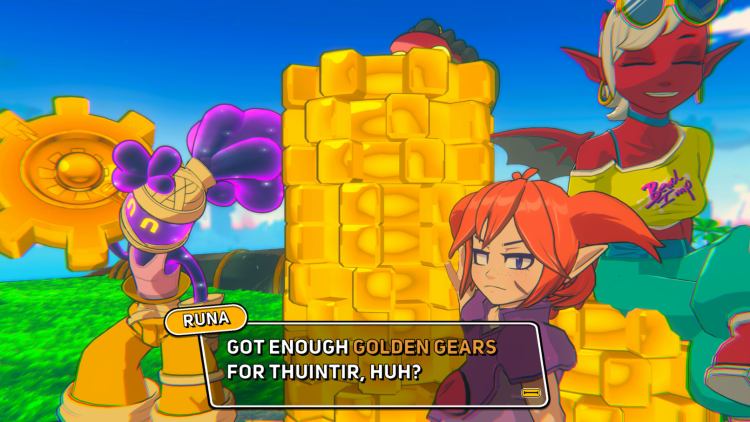
Beebz receives an invitation from Ragnar, her estranged father, and travels from the Underworld she rules to his ocean territory with her crew. The welcome is hostile — Ragnar's Rock operates under authoritarian control, and Beebz quickly becomes entangled in a conflict between its ruling class and the revolutionary commonfolk across the archipelago. The story asks Beebz to confront both her family history and the actions she took to seize the Underworld in the first game. For a 3D platformer, that is a specific and demanding narrative ask, and the writing handles it with more care than the art style and soundtrack initially suggest.
DK, one of Beebz's companions, speaks exclusively in internet slang before a character arc about the cost of performing a persona for social acceptance. Beebz herself runs a punk rock facade that the story methodically dismantles. The game does not treat these threads as background decoration. The plot is darker than the cel-shaded visuals communicate, and the emotional beats land precisely because the characters earn them across the runtime rather than demanding investment upfront. For most games in this genre, story serves as connective tissue between level sequences. In Demon Tides, it becomes a genuine reason to push forward.
Movement and the Schmoovement System
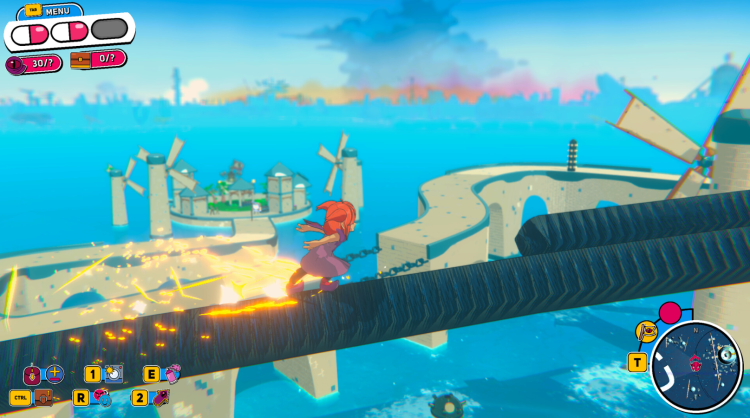
Beebz's core moveset builds from established 3D platformer foundations — chained hops for height, a sharp turn somersault jump, a Wario-style dashing attack — then extends them through three demon transformations that the player sequences together mid-air. Transforming into a bat provides a double jump; a one-eyed drill form floats and repositions; the snake form generates a burst of horizontal speed. The order of transformation changes the outcome: shifting into drill before bat produces a horizontal fling rather than a simple height boost, while reversing the order gives a controlled descent useful for landing on moving platforms. Beebz can only transform or boost once per jump sequence, so players commit to each decision before executing it.
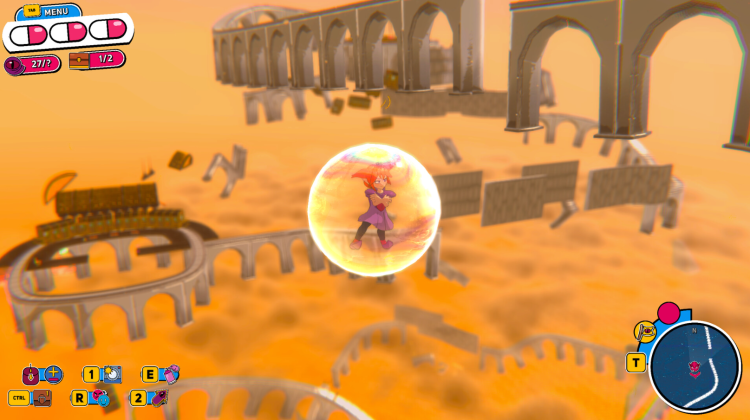
Talismans modify every property within this system. A bat talisman can trade height for distance. A drill talisman can add a small vertical pop at spin initiation. A snake talisman can enable a second jump at speed. Additional talismans introduce whole new movement options: a paraglider, a suspending bubble, or roller skates that increase momentum at the cost of traction. Two full loadouts can be swapped mid-session, each with its own costume set. The number of possible combinations across talisman slots — which expand as the game progresses — is large enough that no two players necessarily navigate the same sequence of jumps in the same way.
I grew up playing Mario, Sonic, and Sly Cooper, so I'm specific about whether a platformer's movement holds up under extended play — and Demon Tides fits like a game built from the best parts of all of them simultaneously, weighted enough to feel substantial but fast enough that movement is the reward rather than the obstacle.
Open World Structure
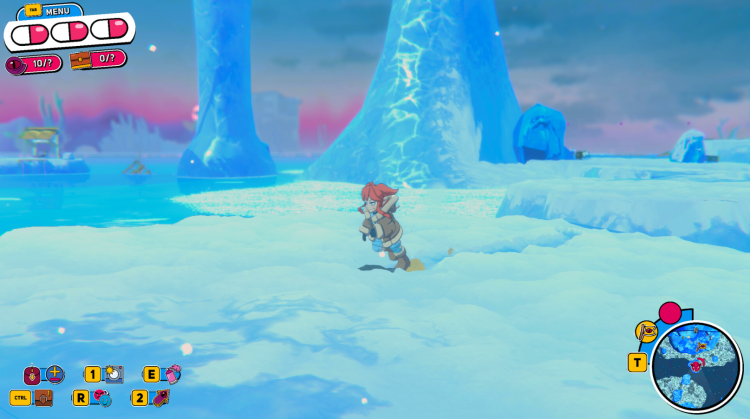
Ragnar's Rock presents islands of varying size and theme, each containing different objective types: gear piece collection, races, enemy arenas, escort missions, and linear platforming gauntlets with a single path to the end. Golden Gears serve as the progression currency, required in specific quantities to unlock access to new ocean regions. Beyond gears, islands yield talismans and costumes. Players choose which islands to tackle and in what order across the three regions.
The open structure produces the game's primary tension. Islands contain more talismans and costume pieces than Golden Gears, which means clearing an island does not guarantee forward progress. Gear Guardian boss battles — repeated encounter types tied to gear rewards — land on the repetitive side. The third ocean region's emphasis on cave environments delivers less variety than the earlier two regions, and a late-stage clean-up run through that section ends the game on a relatively flat note for players who have already processed the campaign's emotional arc.
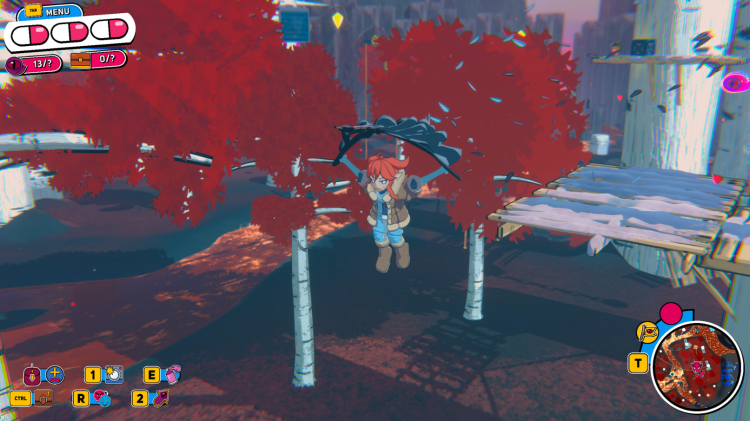
The checkpointing system from Demon Turf — where players manually placed a limited number of checkpoints — carries into Demon Tides without the resource restriction. Players can drop a respawn point almost anywhere, and most longer sequences include shortcut ropes back to sea level if a fall occurs. The checkpoint system is designed to give players control over their own risk tolerance, but removing the resource cap reduces the stakes of the decision. The platforming remains demanding regardless, particularly in Mr. Mint's challenge gauntlets, which represent the hardest sequences in the game.
Combat
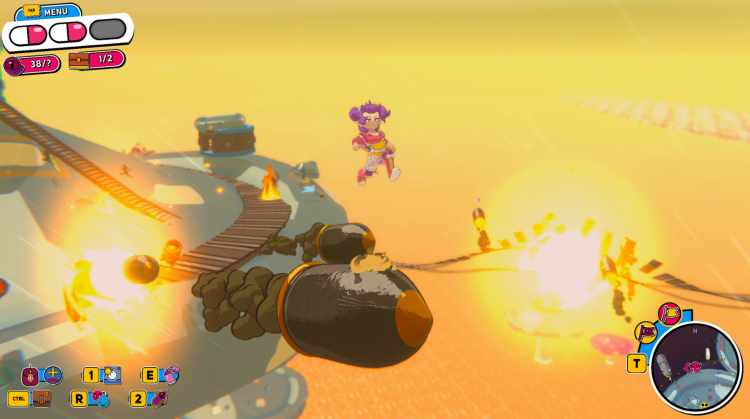
Combat appears less frequently than in Demon Turf and integrates with the movement system rather than interrupting it. Players engage enemies using Beebz's platforming toolkit — transformation dashes, directional attacks — which makes encounters feel like extensions of the traversal rather than separate mechanical modes. Boss fights operate on the same principle. The reduction in combat frequency addresses a specific criticism of the first game, where arenas disrupted pacing unless the player knew how to speedrun past them. Demon Tides does not eliminate combat but restructures it so that the skills built during traversal apply directly.
Platforming Design and Difficulty
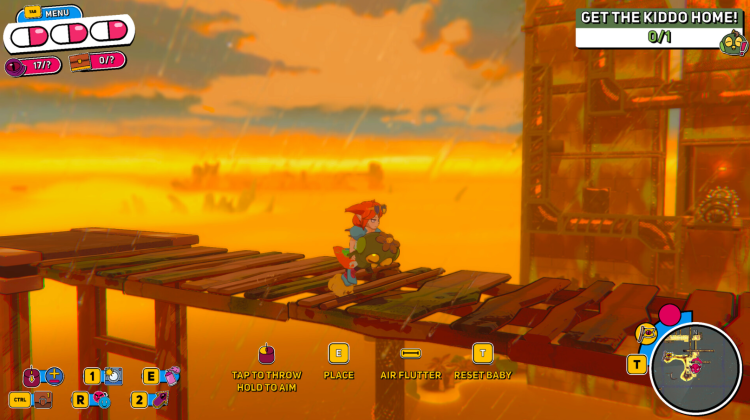
The game is easier than Demon Turf in aggregate, which is partly structural and partly a product of the talisman system. Players who build movement-amplifying loadouts can bypass sections that the level design intends as challenges. The Mr. Candy gauntlet sequences — distinct from Mr. Mint's challenges — represent some of the hardest content in the game, but the broader tone is accessible. Sequences that would register as brutal in a stricter platformer feel approachable within Demon Tides' framework because the tools for solving them are always in the player's hands rather than fixed by level design.
The best islands function like standalone levels from a more traditional 3D platformer but with the added dimension of talisman experimentation. A specific ice level introduces a mechanic where Beebz's health freezes if she stays away from bonfires; equipping the Infernal Engine talisman — which boosts speed but causes damage if the player stands still — negates the cold effect while adding a separate risk layer. These interactions between level conditions and talisman loadouts define Demon Tides' design at its most inventive.
Presentation and Style
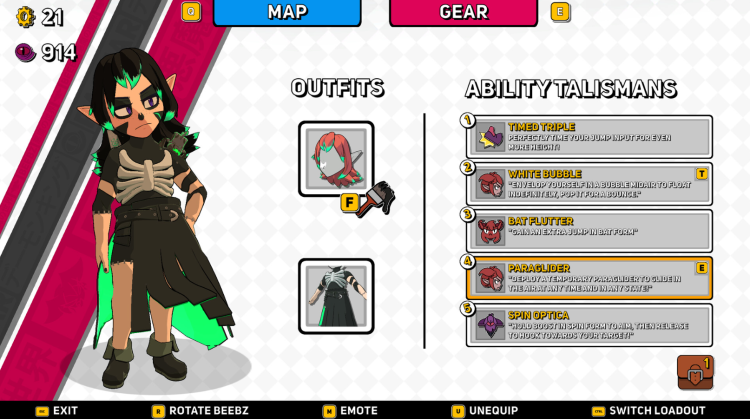
The art direction replaces Demon Turf's visual style entirely with a cel-shaded aesthetic that reviewers describe as more vibrant than its predecessor. The soundtrack runs funky and scratchy, fitting the movement system — equipping the roller skate talisman and tearing through a level produces a specific sensation that reviewers have compared to Jet Set Radio Future. The world design across the three ocean regions gives each area a distinct personality through biome and color palette, though the third region's cave concentration breaks that variety in the final stretch.
I think Demon Tides earns a place alongside the strongest 3D platformers in recent memory, not despite the looseness of its open world but because Fabraz built movement expressive enough to make that looseness feel intentional rather than underdeveloped.
Verdict
Demon Tides is a 8/10 game. The talisman system builds genuine creative depth into platforming that already functions at the highest level of the genre, and the story commits to character work that most 3D platformers treat as optional — the only meaningful friction comes from Golden Gear scarcity in later regions and a third-area design that drains momentum precisely where the campaign has earned the right to finish strong.
Pros:
- Talisman customization produces a movement system with more expressive range than any current competitor in the genre
- Story delivers character depth and emotional stakes that exceed the expectations the art style sets
- Open ocean structure gives players genuine freedom without sacrificing the density needed to make exploration worth doing
Cons:
- Golden Gear distribution skews toward talismans and costumes in late islands, creating friction in progression that the game could resolve with minor rebalancing
- Third ocean region's cave-heavy design delivers less variety than the first two, ending the gear clean-up run on a low note
Fabraz set out to make an open-world 3D platformer that justifies the scale through movement quality, and Demon Tides delivers on that entirely within its best sections. The structural problems in the final region and the reduced checkpoint stakes are real, but neither destabilizes what the game builds across its fifteen hours. If the second game in the series reaches this level, the third has genuine potential to be something exceptional.
Exploring the Best Singleplayer Games 2026 is a reminder that solo gaming still offers some of the most immersive stories, memorable characters, and emotionally rich experiences you can enjoy at your own pace.


 Successfully copied... Thank you for sharing our content!:



5% deposit bonus up to 100 gems

a free Gift Case





EGAMERSW - get 11% Deposit Bonus + Bonus Wheel free spin


EXTRA 10% DEPOSIT BONUS + free 2 spins

3 Free Cases + 100% up to 100 Coins on First Deposit


5 Free Cases, Daily FREE & Welcome Bonuses up to 35%

3 free cases and a 5% bonus added to all cash deposits.

+5% to deposit




Comments