




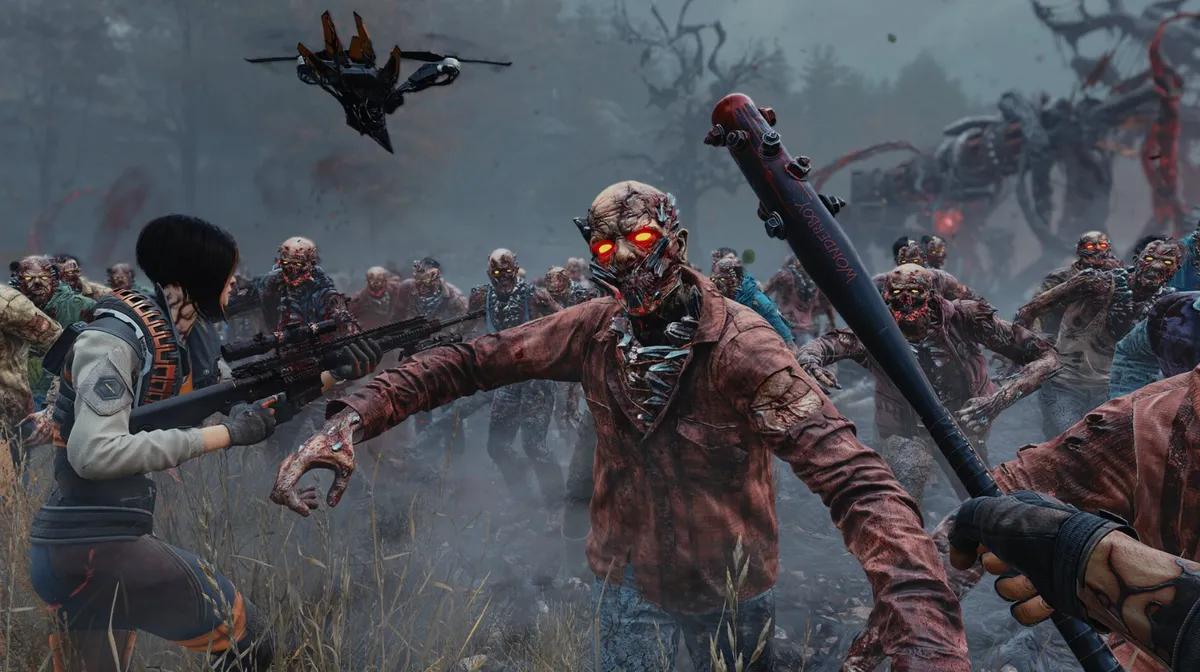
John Carpenter's Toxic Commando Review
 PlayStation
 Steam
Steam Review
Saber Interactive first showed John Carpenter's Toxic Commando at the 2023 Summer Games Fest alongside a Bon Jovi-soundtracked trailer and a clear promise of over-the-top zombie carnage. The finished game delivers on that promise within a measured scope: nine missions, four playable classes, and a co-op structure built directly from the Left 4 Dead template. It carries the name of the director responsible for The Thing, Big Trouble in Little China, and They Live — a legacy that loads the game with specific expectations around atmosphere and tone. What arrives is a competent co-op shooter that leans on borrowed mechanics, adds one genuinely novel element, and stumbles where too many games in this genre have stumbled before.
Premise and the Sludge God
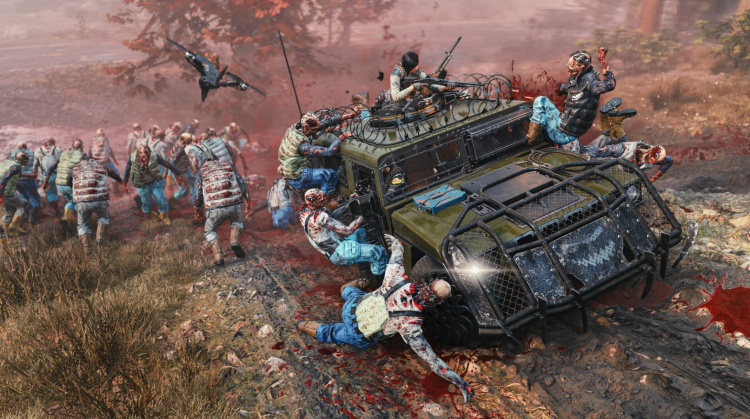
The game is set in the near future and drops four mercenaries into a military zone overrun by mutants produced by a necrotic substance called Sludge. A scientist of dubious ethics employs the team for a high-risk delivery mission; exposure to the Sludge traps them inside, and destroying the Sludge God — the source of the infestation — becomes the only exit. That setup exists almost entirely to justify the mission structure. Objectives cycle through variations of retrieve-this and bring-it-there, occasionally asking the team to blow something up, activate a machine, or defend a fixed position against incoming waves. The narrative does not pretend to be more than this. Saber Interactive built Toxic Commando on the same structural foundation as their earlier World War Z, and the DNA is immediately visible from the first mission.
Weapons and Combat
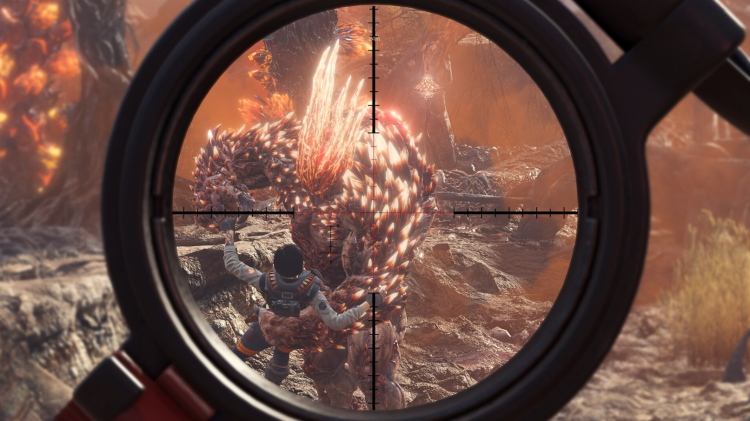
The combat loop tracks Left 4 Dead closely. Teams of four push through maps, complete objectives, and survive dynamically deployed zombie hordes managed by an AI director. Special enemy types carry names like Stalker, Snare, Slob, Nuker, and Blaster — Left 4 Dead equivalents with a coating of Sludge mythology over them. The Nuker carries a massively swollen head and screams continuously until it detonates in range or gets shot from a distance. The Blaster is a large plant-like formation that fires a sustained laser. Both deviate from genre archetypes in concept, though neither stands out as clearly in the chaos of combat as the design might intend.
Weapon selection is broad: sixteen primary weapons and three secondaries, all available from the start with no unlock grind required. Players can pick up additional special weapons during a match. Four playable classes each carry RPG-style skill trees that develop through earned experience. The combination of immediate weapon access and gradual class upgrades gives new players enough variety to engage with early, while theoretically providing longer-term progression for dedicated players. Saber has confirmed further weapons will arrive post-launch.
The gunplay presents a split in reviewer opinion. Some describe the weapon variety as a strength that places focus on action rather than on grinding toward gear. Others find the firearms lacking weight and impact, describing them as feeling like a PC shooter from twenty years ago. Both assessments have some accuracy depending on the weapon. Heavier ordnance — flamethrowers, special pickups — delivers more feedback than standard rifles and SMGs.
Vehicles
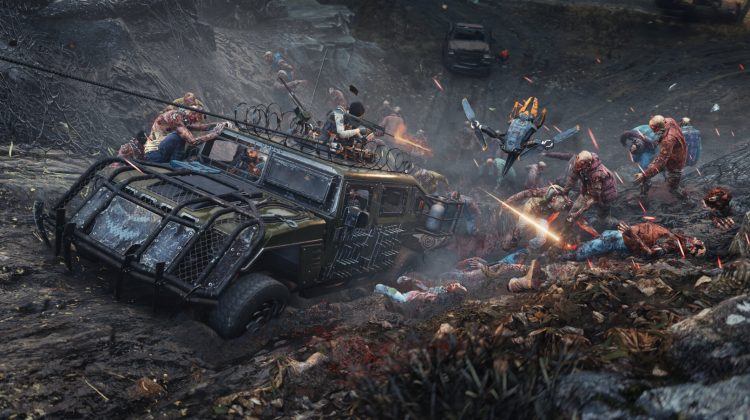
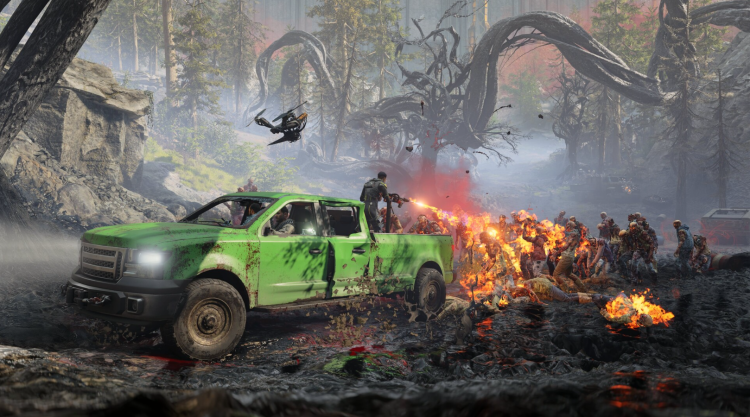
The most distinct element in the game's design comes from Saber's history with Mudrunner and Snowrunner. Missions unfold across mini open worlds rather than linear corridors, and trucks, cop cars, ambulances, and other vehicles serve as mobile bases as much as means of transport. Not every vehicle is identical in function: some carry mounted weapons, one can heal the party, another converts into a large bomb. Roads are largely sludge-covered paths by design, and vehicles regularly become stuck in mud and require a winch to extract.
When the vehicle system works, it creates pressure the genre's standard wave mechanics rarely replicate. Not every vehicle carries a winch, which means a team extracting a stuck truck while managing incoming waves from multiple directions ends up in the kind of ad-hoc set-piece that feels earned rather than scripted. A late-game mission tasks the group with navigating an ambulance between safe points across the full map, balancing the vehicle's healing output against a ticking sludge-poisoning timer. That mission deploys the vehicle concept precisely. The rest of the campaign applies it less consistently, but the system justifies its presence.
Saber's Swarm engine, visible in World War Z and Warhammer 40,000: Space Marine 2, handles zombie hordes moving through these environments with technical effectiveness. Enemies flow like fluid through the terrain, piling against walls and scaling ledges in ways that match the name. The engine is impressive in motion even if the environments it populates are not always distinctive enough to make full use of it.
Meta-Progression
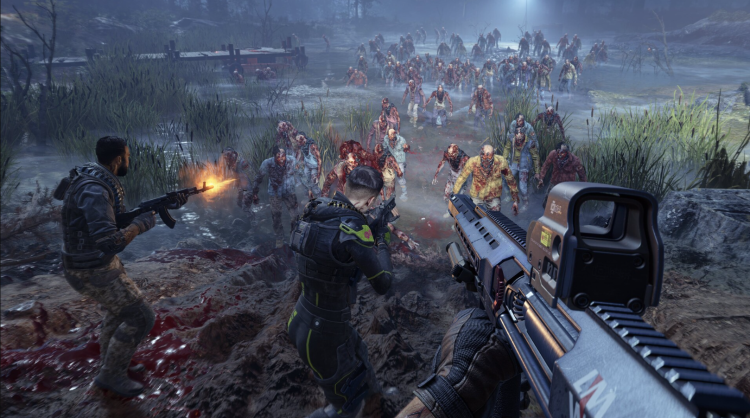
Each of the four classes carries an upgrade tree. Experience currency appears throughout levels as collectible crystals scattered across the map. Weapons gain attachments through their own separate progression track. The PS5 trophy list requires players to fully level every class and every piece of equipment — a grind the game's co-op structure makes difficult to sustain across a consistent group.
The progression layer interrupts the rhythm of play more than it adds to it. Collecting upgrade crystals from trees across the open map means repeatedly stopping the vehicle, stepping out into contested territory, and retrieving currency before continuing toward the actual objective. The skill tree improvements are situational at best. A drone that can now assist with vehicle repairs is marginally useful compared to direct improvements to damage output, movement speed, or maximum health — the three variables that affect every fight.
I think this is the most damaging structural decision the game makes. Left 4 Dead did not build its reputation by adding meta-progression to its combat. Valve built it by removing features during development until only the action remained. Nearly every game that has followed the same genre — from Vermintide to Back 4 Blood — has reversed that decision, layering supplementary systems on top of a design that works better without them. Toxic Commando repeats the pattern. The weapon progression exacerbates this by creating implicit pressure to commit to one firearm and level it fully rather than rotate through all sixteen. The accessible loadout the game provides at the start is gradually undermined by a system that rewards specialization over breadth.
Maps and Replay Value
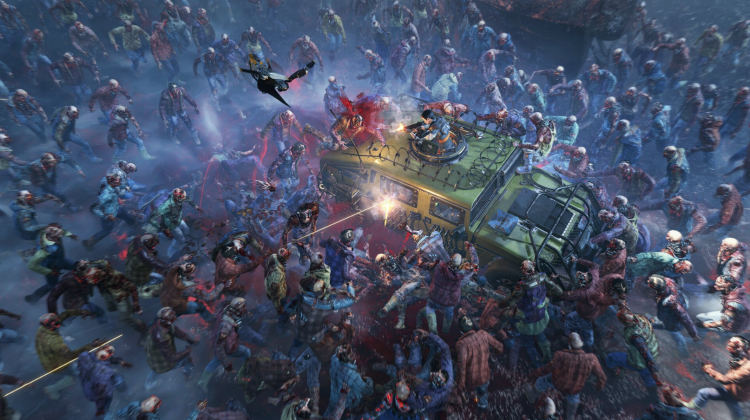
The nine missions use open maps with shuffled objective locations between runs, which Saber has positioned as a source of replay value. In practice, the approach produces an uneven result. The maps are large enough that vehicle traversal across them begins to feel repetitive before a session ends. Multiple reviewers describe them as unremarkable craggy woodlands, differentiated by motel buildings and explosives factories rather than by distinctive geography or authored set-pieces. The absence of save points means a team that loses progress midway through a mission restarts the full map — which, given that the terrain is nondescript, arrives as more of a slog than an invitation.
The final mission diverges from this pattern. It concentrates the game's carnage and scale in a way the earlier missions only suggest, and reviewers across multiple outlets identified it as the campaign's most purely enjoyable section. That it stands out so clearly underlines the relative uniformity of what precedes it.
Static, tightly authored level design holds up across hundreds of playthroughs because the space itself becomes part of the player's knowledge. Counter-Strike's de_dust has sustained an active community for twenty-five years. Left 4 Dead's airport section is still referenced by players who have completed it dozens of times. That durability comes from knowing a space well enough that every new run produces different action within a fixed frame. Shuffled objectives in a nondescript map do not produce the same effect. They produce variation, but not memory.
Presentation and the Carpenter Name
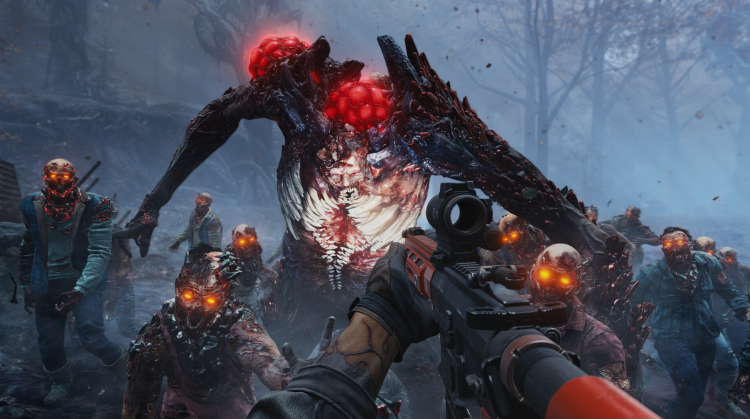
Saber markets Toxic Commando as a tribute to 80s action-horror, and the soundtrack earns that description. A synth-heavy blend of disco and metal runs through the game, co-composed by Carpenter, and when it plays from a vehicle's radio it briefly captures the atmosphere the branding promises. Elsewhere, the presentation works less hard. The colour palette settles into black and red across sludge-drenched post-apocalyptic environments, and the overall visual tone reads closer to latter-day Stranger Things than to the specific language of The Thing or They Live.
I see a game that understands the commercial value of the name it carries but applies it unevenly. The soundtrack is the sharpest point of contact with Carpenter's actual work. The environment design does not follow through. Character dialogue functions as corny banter that works in early sessions but loses novelty without ever reaching Borderlands 3-level irritation — a faint distinction at best.
The engine handles what it was built for. Swarm technology pushes large numbers of enemies through terrain convincingly. The visual quality overall has been characterized as mid-budget, with multiple reviewers noting the game looks like a PS4-era release rather than a current-generation title. AI companions engage enemies effectively in solo play but do not interact with mission objectives — they will not carry a fuel canister or handle an explosive — which makes solo progression through objective-heavy missions substantially harder than the co-op experience the game was built around.
Verdict
John Carpenter's Toxic Commando is a 6/10 game. The vehicle system adds genuine tactical texture, the weapon roster is immediately accessible, and the soundtrack connects to its namesake in ways the visuals do not — but meta-progression clogs the pacing, maps lack the authored specificity the genre needs to sustain replay value, and the Carpenter name sets expectations the overall presentation only partially meets.
Pros:
- Vehicle mechanics generate tactical variety absent from most horde shooters
- All sixteen primary weapons available from the start without unlock grind
- Swarm engine handles large zombie hordes with technical effectiveness
Cons:
- Meta-progression interrupts pacing without meaningfully improving combat performance
- Open maps lack the tightly designed geography needed to support long-term replay value
The final mission delivers on the game's premise more fully than any of the eight that precede it. A few additional maps designed with that same level of intent would improve the overall package considerably. Until those updates arrive, Toxic Commando offers a functional co-op weekend for players who already enjoy the genre — and little sustained argument for anyone who does not.
After burning out on competitive online titles and taking a long break, it was discovering the Best Multiplayer Games 2026 that pulled me back in. I’m back in business, mates.


 Successfully copied... Thank you for sharing our content!:



5% deposit bonus up to 100 gems

a free Gift Case





EGAMERSW - get 11% Deposit Bonus + Bonus Wheel free spin


EXTRA 10% DEPOSIT BONUS + free 2 spins

3 Free Cases + 100% up to 100 Coins on First Deposit


5 Free Cases, Daily FREE & Welcome Bonuses up to 35%

3 free cases and a 5% bonus added to all cash deposits.

+5% to deposit




Comments