




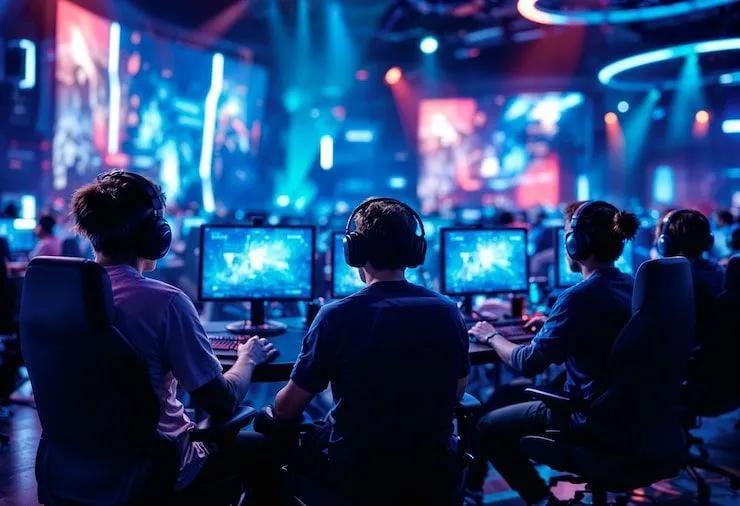
Why Esports Players Are Exploring All Social Casinos Available in the US in 2026
US esports players entering 2026 spend more hours per week inside the competitive-gaming calendar than any other cohort in online entertainment. The Counter-Strike 2 season is a year-round grind that runs through BLAST Premier stops, IEM Katowice, the PGL Major, and into the Esports World Cup schedule in Riyadh. The League of Legends LCS has continued under its reshaped two-split format, with the Mid-Season Invitational and the Worlds cycle giving the year a familiar arc. Valorant Champions Tour Americas has become the benchmark competition for North American tactical shooter talent, and the Dota 2 ESL Pro Tour and Underlords circuits continue to shape the cadence for strategy players. That dense calendar produces a specific kind of player: someone whose leisure time, attention budget, and entertainment reflexes are tuned to session loops, tournament formats, cosmetic progression, and free-to-play-with-rewards design.
A quieter shift has been happening in parallel. The social casino segment in the United States, the entertainment-only and dual-currency platforms that run under national sweepstakes promotion laws rather than under state gaming licences, has pulled in a growing share of US esports players. The overlap is not random. The mechanics inside a modern social casino feel familiar to anyone who has spent three hundred hours in Valorant ranked or ground out a Dota 2 seasonal pass. The session loop, the cosmetic meta, the tournament structure, and the free-to-play-with-rewards promise are the same four design patterns that define modern competitive gaming. Reading social casinos through an esports lens, rather than through a traditional casino lens, explains the crossover more clearly than any demographic chart.
Coverage of the US social casino segment sits alongside the regular esports news cycle for players who track both. The long-running Las Vegas trade title Gaming Today has kept a dedicated desk that catalogues the full US market and lets readers compare all social casinos on the same side-by-side format the site already applies to sports books and online casino operators. The sections below walk through the specific design patterns that connect the two worlds, why the overlap has grown most sharply among US competitive-gaming audiences, and where the category sits inside the broader 2026 esports calendar.
The Session Loop Is the Same Loop
The first design pattern that transfers from esports to the social casino segment is the session loop. A Valorant player who fires up a competitive queue for a two-hour block is running a loop that starts with a champion-select phase, moves into twenty-four rounds of tactical play, and closes with a ranked-rating update and a battle-pass bump. A Counter-Strike 2 player running MR12 competitive inside Premier mode follows an almost identical rhythm. The session has a fixed-length opening, a variable-intensity middle, and a clear numerical payoff at the end. Social casino session design in 2026 has borrowed that structure closely. A player opens a session with a daily-login reward, moves through a run of slot spins, instant scratch reveals, and mini-game rounds, and closes the session with a progress bar that fills toward a milestone unlock. The play-to-next-reward cadence is tuned to roughly twenty-five to forty minutes, the same window that most Valorant and Dota 2 matches occupy. Players who have internalised the rhythm of competitive gaming sessions slide into the social casino format without a recalibration period, because the loop is recognisable within the first ten minutes.
Cosmetic Meta and the Logic of Unlocking Items That Do Not Change Outcomes
The second pattern is cosmetic meta. Modern competitive games have built some of the largest cosmetic economies in entertainment. Counter-Strike 2 skin values peaked past ten thousand dollars per item inside the 2025 float-tier market, and the wider CS2 skin economy is tracked as a real market with measurable volume and liquidity. League of Legends' Arcane and World Championship skin lines continue to drive the game's cosmetic revenue. Valorant's Night Market and Episode pass cosmetics are an established expectation for any returning season. The shared principle is that cosmetic unlocks do not change outcomes. A competitive player knows that skins do not affect hit-registration, map geometry, or damage output. The unlock matters because the player wants the item for itself, for expression, and for the signal of time invested. Social casino cosmetic design in 2026 runs on the same principle. The avatar frames, the VIP tier badges, the profile banners, and the table-theme unlocks in modern social casino products are explicitly non-functional. They exist to signal progression and to give the player a collectible against which to orient. The logic of pursuing a cosmetic item that does not change outcomes is immediately familiar to anyone who has spent a thousand hours on Counter-Strike 2 or Valorant.
Tournament Structure Mirrors the Esports Bracket
The third pattern is tournament structure. Competitive-gaming audiences are conditioned to swiss-stage openings, double-elimination brackets, and best-of-five grand finals. The BLAST Premier circuit in 2025 and 2026, the LCS finals across two splits, the Valorant Champions Tour playoffs, and the ESL Pro Tour Dota 2 majors all converge on the same structural language. Social casino operators in 2026 have leaned into that language. Weekly slot tournaments run on a leaderboard model that mirrors the top-eight progression of an esports playoff. Multi-round bracket events with qualifier and main-event phases have appeared across the larger US social casino operators, and the communication style around those events borrows directly from esports broadcast design. For a viewer who follows the IEM Katowice play-in stage closely, a social casino weekly-tournament format is visually and structurally familiar. The reward pool, the qualification threshold, the elimination step, and the final standings all read like a compressed esports event. That parallel is why competitive-gaming players describe social casino tournaments as feeling more like a quick-format tournament than a gambling session.
The Esports World Cup Calendar as a Reference Point for the Crossover
A useful reference point for the crossover is the structure of the modern esports super-event. The EGW's complete guide to the Esports World Cup 2026 lays out how the Riyadh-based tournament combines ten separate competitive titles inside a single summer-window format, how the Club Championship overlay stacks team-level rankings across those titles, and how the prize-pool structure rewards both title-specific performance and multi-title commitment. That design is a super-structure that US esports fans now measure other long-form competitions against. The super-event format has specifically influenced the way US social casino operators communicate their largest seasonal promotions in 2026. The seasonal festival, the multi-week qualifier, the cross-game prize pool, and the featured broadcast day are all patterns the social casino segment has imported from the esports super-event playbook. A player who plans their summer around the Esports World Cup schedule recognises the underlying structure immediately when they see the same ribboning used to describe a social casino seasonal festival.
Free-to-Play-With-Rewards Is the Default Expectation, Not the Exception
The fourth pattern is the free-to-play-with-rewards expectation. Competitive gaming has normalised the idea that the core product is free to install, free to play, and supported by optional cosmetic spending that contributes to both the player's collection and the broader economy. Valorant, Counter-Strike 2, Dota 2, League of Legends, and Fortnite are the central examples. Social casinos in the US sweepstakes segment run on the same principle. The standard product is free to register, free to play with gold-coin currency, and supported by an optional dual-currency model whose redemption side is governed by sweepstakes promotion law. The player can spend hours inside the platform without paying anything, can participate in the daily and weekly promotional cycle at no cost, and can redeem the sweeps-currency side for cash once the play-through requirement is met. Competitive-gaming players entering the social casino segment tend to recognise that economic model within the first day of use. The concept of a paid convenience layer sitting on top of a fully functional free product is not new to them. It is the default condition of every large competitive game they already play.
The Shared Stress Profile and the Reason the Crossover Sticks
The reason a competitive-gaming player often continues to run social casino sessions once the novelty has passed has more to do with stress profile than with either mechanics or rewards. Wired's feature on the stress load competitive gamers carry documents how the cognitive load of high-rank ladder play in games like Counter-Strike 2, League of Legends, and Valorant maps onto measurable stress indicators comparable to those in traditional elite sport. A competitive player running ten hours of ranked ladder per week carries a real decision-fatigue profile. The social casino format offers a low-stakes counter-session that uses the same reflex vocabulary, the same visual grammar, and the same reward cadence, without the rating pressure. A ranked Counter-Strike 2 match demands performance. A social casino slot tournament demands presence. The crossover sticks because the player gets the familiar surface of a competitive session without the stake of an Elo or rating loss. That complementary positioning is what keeps the segment growing inside the US esports audience rather than bouncing off as a one-week curiosity.
Where the US Market Sits and How It Is Structured
The US social casino market in 2026 has grown to more than thirty distinct national operators running under the sweepstakes promotion model, with a handful of category-leading brands owning the largest share of active accounts. The category is distinct from the real-money online casino footprint that operates in Connecticut, Delaware, Michigan, New Jersey, Pennsylvania, Rhode Island, and West Virginia, and it is distinct again from the pure social casino apps that do not offer any redemption path. The US sweepstakes-model operators run a dual-currency system, usually a gold-coin currency for entertainment play and a sweeps-coin currency that can be redeemed for cash once the promotional play-through is met. The segment's growth through 2024 and 2025 was roughly thirty percent year on year by active-account count, and the 2026 growth curve has continued on the same slope through the first quarter. Competitive-gaming players form one of the fastest-growing cohorts inside that curve, driven in large part by the pattern overlap described above. The segment's marketing now leans into that crossover more openly, with several operators sponsoring collegiate esports broadcasts and regional competitive events.
Specific Design Parallels Competitive Gamers Recognise Inside Social Casinos
The list below summarises the specific parallels that competitive-gaming players tend to spot first. Each item is a design pattern familiar from modern esports titles that appears, in a recognisable form, inside a 2026 US social casino product.
- Daily login reward escalators that mirror the weekly-quest structure of a Valorant or Counter-Strike 2 battle pass.
- Leaderboard-driven weekly tournaments with a top-eight payout that mirrors the play-in-to-playoff ladder of an ESL Pro Tour Dota 2 stop.
- Cosmetic unlocks that do not change outcomes, signalling time invested rather than competitive advantage.
- Seasonal festivals structured as multi-week qualifiers culminating in a featured-broadcast finale day, borrowed from the esports super-event format.
- Mid-session mini-games styled as short-format bonus rounds, comparable in length and pacing to a Valorant round or a Dota 2 lane phase.
- Free-to-play economies with an optional convenience layer that matches the model competitive gamers already accept in every major esports title.
- Progression bars, milestone unlocks, and prestige tiers tuned to the same dopamine cadence as ranked ladder climbs.
- Community overlays, referral trees, and friend-list tournaments that replicate the guild and club structures common across competitive-gaming platforms.
Any one of those parallels alone is a weak signal. All eight combined, which is increasingly the default in the largest US social casino operators, produce an environment that reads as a natural adjacent category rather than as a separate genre.
What the Crossover Means for the Rest of the 2026 Esports Calendar
The rest of the 2026 esports calendar is dense enough that the crossover has real scheduling consequences. BLAST Premier Spring Finals, the LCS Summer Split, the Valorant Champions Tour Masters stop, the ESL Pro Tour Dota 2 Birmingham major, the Esports World Cup window in Riyadh, and the Worlds cycle for League of Legends together claim a large share of the competitive-gaming audience's attention budget across June, July, and August. Social casino operators have begun tuning their seasonal promotional cadence to sit adjacent to those windows rather than to compete with them. Off-season weeks for a given esports title often correspond to a featured-broadcast promotional block inside a social casino platform that specifically targets that title's audience. The net effect is that the competitive-gaming player's entertainment schedule now contains a low-stakes adjacent segment that runs concurrently with their primary game's competitive calendar, rather than pulling attention away from it. That complementary positioning is what has let the crossover scale without the social casino segment reading as a replacement for competitive play.
Reading the Segment the Way a Regular Esports Viewer Reads the Rest of the Calendar
For an esports viewer who already reads the rest of the competitive calendar carefully, the right way to read the US social casino segment in 2026 is as another parallel calendar rather than as a separate category. The operators run weekly tournaments, seasonal festivals, and cross-game events. The top ten national operators publish something close to a regular competition schedule. The reward structures are explicit. The winners are listed. The format is stable enough that a viewer can follow it without having to re-learn it every month. Treating the segment with the same viewer habits that apply to Counter-Strike 2 tournaments, Valorant VCT stops, or the Dota 2 Pro Tour is the reading that fits. It is not the traditional casino reading, because the mechanics are not traditional casino mechanics. It is an esports-adjacent reading of a format that was designed for an audience that already knows how to watch and play competitive games. Once a viewer makes that shift, the rest of the category starts to look less like a gambling segment and more like a parallel gaming calendar with its own bracket, its own prize pools, and its own featured broadcast days.


 Successfully copied... Thank you for sharing our content!:

Comments