




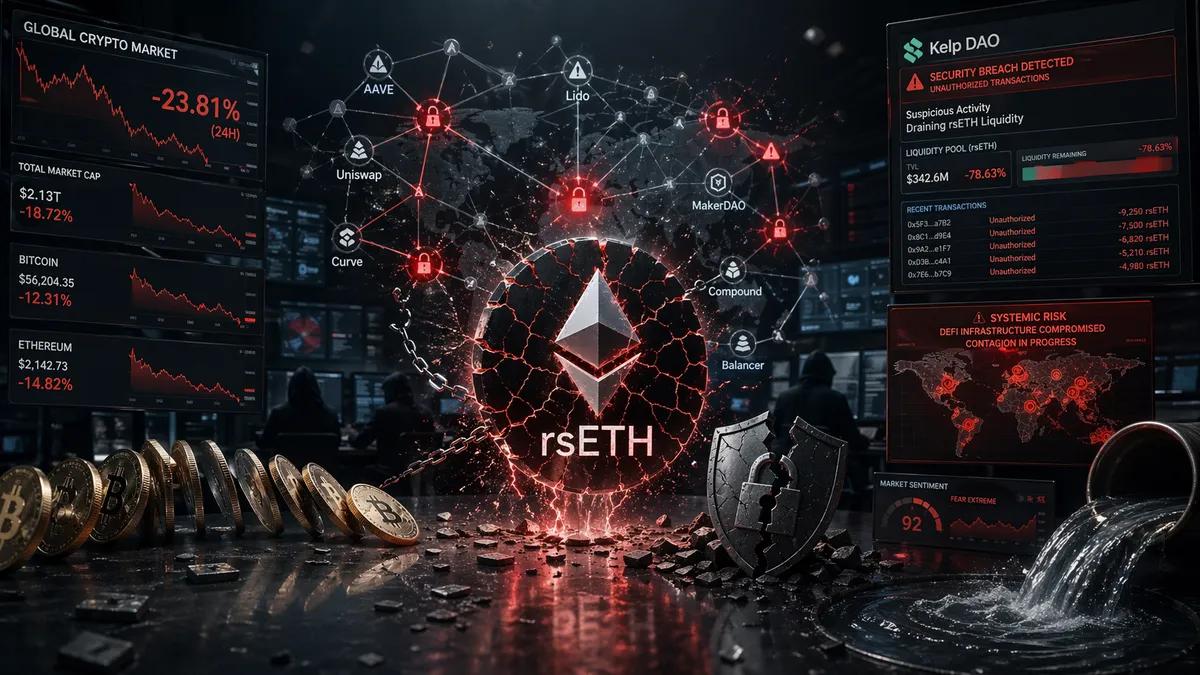
The Entire Crypto Market Is Under Threat! rsETH Kelp DAO Hack Escalates into a Systemic DeFi Crisis
 DeFi
DeFi SCAM
SCAMLess than a week after the massive rsETH hack (116,500 tokens worth ~$292 million), the fallout has spread far beyond a single protocol. What started as an attack on the Kelp DAO bridge via LayerZero is now paralyzing Aave, triggering massive liquidity outflows, and freezing withdrawals from major exchanges.
According to Arkham Intelligence, the exchange MEXC still holds 347 million USDT in Aave and has begun withdrawing it in small tranches (from $100k to $1M) since April 19. CoinEx has $151 million locked, and Kiln has $165 million, both currently difficult to withdraw. It’s still unknown how many more billions belonging to exchanges and large players remain “frozen” across Aave markets. Aave has already frozen rsETH markets on V3 and V4, and the platform’s TVL has plummeted by billions due to panic.
The hacker exploited a configuration vulnerability in the Kelp DAO bridge (single-DVN setup), spoofed messages, and drained rsETH, which were then used as collateral on Aave to borrow hundreds of millions in WETH. The protocol is now sitting on over $200 million in bad debt, and users have started a full-scale bank run, withdrawing assets even from untouched pools.
Why are crypto protocols hacked so frequently?
- Complexity and interconnectedness. Modern DeFi protocols are chains of smart contracts, oracles, bridges, and L2s. One wrong parameter (like single-DVN in LayerZero), and the entire system collapses. The hacker didn’t break Aave or Kelp code directly, he simply “spoofed trust” between networks.
- Open-source = open target. Most protocols are fully open-source. Hackers can spend months auditing the code, finding edge cases, and preparing attacks. In 2026, 5 out of 6 hacks this month were pure code exploits, not social engineering.
- Bridges remain the weakest link. Cross-chain bridges (LayerZero, Wormhole, Axelar, etc.) move billions and often rely on “trust” in a handful of verifiers. One compromised or misconfigured node, and millions vanish. History repeats: Ronin, Nomad, Wormhole, now Kelp.
- Insufficient audits and “fast launch” culture. Many teams cut corners on multi-stage audits or ignore recommendations. “Modular security” without strict minimum standards (as in the DVN case) creates an illusion of safety.
- Huge economic incentives for attackers. Transactions are irreversible. Flash loans let hackers manipulate prices in seconds. Reward: hundreds of millions. Risk: minimal (if they don’t get caught). According to Chainalysis and DefiLlama data, 97% of stolen crypto assets from 2022–2026 came from DeFi.
Crypto today is when the hack of a third-tier bridge in a third-tier LRT protocol puts the entire DeFi ecosystem at risk, freezes exchange funds, and triggers panic among millions of users. rsETH was just the trigger. The real problem lies in the systemic architecture where security is constantly sacrificed for speed and yield.
While teams figure out how to “socialize losses” and users rush to withdraw whatever they can, the market is getting another harsh reminder: “Not your keys, not your coins” is already outdated. Today even “your keys” don’t always save you if they sit in a protocol connected to a vulnerable bridge.


 Successfully copied... Thank you for sharing our content!:



5% deposit bonus up to 100 gems

a free Gift Case





EGAMERSW - get 11% Deposit Bonus + Bonus Wheel free spin


EXTRA 10% DEPOSIT BONUS + free 2 spins

3 Free Cases + 100% up to 100 Coins on First Deposit


5 Free Cases, Daily FREE & Welcome Bonuses up to 35%

3 free cases and a 5% bonus added to all cash deposits.

+5% to deposit




Comments